
In May 2026, the Supreme Court of India settled what looked, on its face, like a minor service-law dispute. K. Poovarasan, a temporary attendant dismissed in 2018 for concealing that he had acquired a degree after being hired for a post reserved for candidates who had not studied past the twelfth standard, lost his final appeal for reinstatement. A two-judge bench held that permitting an overqualified candidate to occupy a post "specifically intended for candidates possessing lower educational qualifications" would necessarily deprive a genuinely eligible applicant of a fair chance (General Manager (HR) v. K. Poovarasan, 2026).
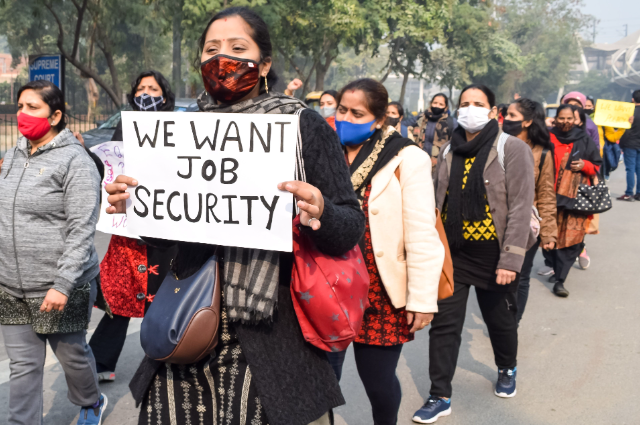
The case would be unremarkable were it not for the scale of the phenomenon it quietly ratifies. Across India, government recruitment drives for peons, sweepers, messengers and clerks now routinely draw applications from engineers, MBAs and PhD holders in numbers that dwarf the vacancies on offer. The Poovarasan ruling did not create this pattern; it merely gave it the sanction of law. This article argues that the judgment is best read not as an isolated verdict on educational suppression, but as a legal artefact of a much larger economic condition — a growing chasm between India's headline growth numbers and the availability of stable, formal work for its most educated young citizens.
Background: The Degree Explosion
India's higher-education system has expanded at a pace with few global parallels. The share of young people holding a graduate degree rose from roughly 10 per cent in 2004 to 28 per cent by 2023, a shift driven overwhelmingly by the growth of private institutions, which multiplied from 1,644 to over 69,500 in the same period (Azim Premji University, 2026). College density nearly doubled in a decade, rising from about 29 colleges per lakh youth in 2010 to 45 in 2021.
This expansion was, by most measures, a genuine achievement: it drew young Indians out of agriculture, narrowed gender gaps in enrolment, and raised aspirations across class and caste lines (Azim Premji University, 2026). But it was not accompanied by a matching expansion in the kind of work a degree was traditionally expected to unlock. Between 2004-05 and 2023, roughly five million new graduates entered the labour force every year; only about 2.8 million of them found any employment at all, let alone salaried work (Business Standard, 2026). The credential multiplied faster than the opportunity it was supposed to represent.
The Pattern: From Poovarasan to the Recruitment Halls
Poovarasan first registered with the Employment Exchange in 1998, when his highest qualification was a pass in the eighth standard. By the time he was sponsored for the attendant's post years later, he had gone on to complete a degree — a fact he did not disclose. When the omission surfaced, his employer dismissed him; a labour court and later the Madras High Court's Division Bench ordered his reinstatement; and in May 2026 the Supreme Court reversed that relief, restoring the original dismissal order of 30 October 2018 (Lawstreet, 2026).
The Bench's underlying rationale, that qualification ceilings exist to protect candidates who "could not pursue higher education" from unequal competition with more credentialed rivals (General Manager (HR) v. K. Poovarasan, 2026), only makes sense against a backdrop the judgment itself does not narrate: the sheer volume of overqualified applicants now chasing India's lowest-rung government posts. In 2025, Rajasthan received 24.76 lakh applications, including from PhD and MBA holders, for 53,749 peon positions. In neighbouring Haryana the same year, roughly 18 lakh candidates competed for 18,000 Group-D vacancies, and a single sweeper's post drew nearly 40,000 applicants, of whom 6,112 held postgraduate degrees (Inventiva, 2025; Tribune India, 2026). Uttar Pradesh has repeated this pattern for over a decade: 93,000 applicants, including roughly 3,700 PhD holders, for 62 messenger posts requiring only a fifth-standard pass.
These are not isolated anomalies but a recurring national ritual, repeating in Rajasthan, Haryana, Uttar Pradesh, Maharashtra and Tamil Nadu across successive recruitment cycles, each time drawing fresh disbelief and the same underlying explanation: there is simply nowhere else for these applicants to go.
Deeper Analysis: Growth Without Jobs
The economic logic behind this queuing is captured in a single statistic: employment elasticity, the rate at which jobs are created per unit of GDP growth, fell from about 0.26 between 2000 and 2012 to roughly 0.001 by 2019 (Vajiram & Ravi, 2026). In plain terms, India's economy has been growing largely without generating a matching number of jobs. Even as GDP is projected to expand by around 7.4 per cent in FY 2025-26, keeping India the fastest-growing major economy in the world (Anantam IAS, 2026), the manufacturing sector, historically the most reliable absorber of large numbers of workers, has remained stuck at roughly 14 to 17 per cent of GDP for three decades, while services and finance grow in ways that are increasingly capital-intensive rather than labour-intensive.
The State of Working India 2026 report quantifies what this means for graduates specifically: unemployment among 15-to-25-year-old graduates stands at nearly 40 per cent, falling to about 20 per cent for those aged 25 to 29; fewer than seven per cent of young male graduates land a permanent salaried job within a year of entering the workforce, and only 3.7 per cent obtain white-collar employment at all (Azim Premji University, 2026). The share of graduates among India's unemployed youth rose from 46 per cent in 2017 to 67 per cent in 2023 (Business Standard, 2026). The degree, in other words, has stopped functioning as a reliable predictor of formal employment; it has instead become the median condition of the unemployed.
The Human Dimension: Waiting, Settling, and the Gig Economy
Behind the aggregate numbers sits a quieter, more corrosive phenomenon that labour economists term "waiting unemployment" — young people, often supported by improving household incomes, delaying entry into low-quality work in the hope that something better will materialise (Azim Premji University, 2026; The Wire, 2026). For many, that wait ends not in a white-collar post but in an application for a peon's job, a food-delivery gig, or a driving assignment with an app-based platform. One young Rajasthan applicant summarised the calculus starkly, saying an attendant's post is preferable to remaining jobless (Inventiva, 2025).
This is the layer of the story that recruitment statistics alone cannot capture: a graduate's decision to conceal, as Poovarasan did, or to openly compete for a post several rungs below their credentials is rarely irrational. It is a rational response to an economy in which nearly 90 per cent of the workforce remains informal and lacks any access to provident-fund coverage, paid leave, or retirement security (GDP Index, 2026). A government post that pays a modest but assured salary, however menial its designation, offers something the formal private sector increasingly does not: certainty.
Institutional Response: The Law's Adequacy
The Supreme Court's reasoning in Poovarasan is not, on its own terms, indefensible. Reserving certain posts for less-educated applicants is a coherent form of protective discrimination, intended to stop India's most disadvantaged job seekers from being permanently crowded out by better-credentialed competitors; the Delhi High Court has since relied on the same logic in a separate teaching-post dispute (Daily Judgments, 2026). The difficulty is that the judgment addresses the symptom of the crisis rather than its cause. It polices who may compete for the scarce rung at the bottom of the formal job market without asking why so many overqualified citizens are competing for that rung in the first place.
On the policy side, the record is mixed. Formalisation efforts have shown some traction: net additions to the Employees' Provident Fund Organisation have at times exceeded twenty lakh subscribers a month, suggesting a gradual shift from cash-based to organised employment (Drishti IAS, 2026a). Yet India still needs an estimated 7.85 million new non-farm jobs every year through 2030 simply to absorb new entrants to the workforce, a target current formal job creation falls well short of (Drishti IAS, 2026a). Flagship manufacturing incentives have not moved the sector's employment share meaningfully in over a decade. The state, in short, has been more effective at adjudicating who gets access to the existing pool of low-rung government jobs than at enlarging the pool of well-paying formal jobs itself.
K. Poovarasan hid a degree to keep a job that paid him to sweep floors and carry files, and the country's highest court has now ruled that his dishonesty, not the economy that produced it, was the problem worth correcting. That verdict will settle service-law disputes for years. It will not explain why, in the same year it was delivered, lakhs of India's most qualified young citizens lined up for the same category of job that Poovarasan quietly clung to. Until GDP growth translates into formal jobs atṅ something closer to the rate it once did, the queue outside India's recruitment halls will keep growing longer than the line of vacancies it is chasing — and the country's growth story will keep being told twice: once in the numbers, and once in the queue.
References
- Anantam IAS. (2026, April 30). GDP of India 2026: Growth rate, sector-wise data & UPSC guide. https://anantamias.com
- Azim Premji University. (2026, March 17). State of Working India 2026: India's young workforce is growing and getting more educated. https://azimpremjiuniversity.edu.in
- Business Standard. (2026, March 17). Two-thirds of unemployed youth are graduates: State of Working India report. https://www.business-standard.com
- Daily Judgments of 15 July. (2026). Govt. of NCT of Delhi and Anr. v. Manu and Ors. https://askjunior.substack.com
- Drishti IAS. (2026a). Building inclusive and sustainable employment in India. https://www.drishtiias.com
- GDP Index. (2026). India economy 2026: GDP, growth, inflation & forecast. https://gdpindex.org
- General Manager (HR) and Another v. K. Poovarasan, 2026 INSC 581 (Supreme Court of India, May 19, 2026).
- Inventiva. (2025, November 21). India's talent wasteland: When PhDs queue for peon jobs. https://www.inventiva.co.in
- Lawstreet. (2026, June 22). Overqualified candidate who hid degree to get government job cannot claim reinstatement: SC. https://lawstreet.co
- Tribune India. (2026). No jobs: Graduates applying for posts of sweeper in state, says Hooda. https://www.tribuneindia.com
- Vajiram & Ravi. (2026, March 23). Jobless growth: Causes, implications, data, impacts, solutions. https://vajiramandravi.com
- The Wire. (2026, March 18). Nearly 40% of Indian graduates under the age of 25 are unemployed: Azim Premji report. https://m.thewire.in