
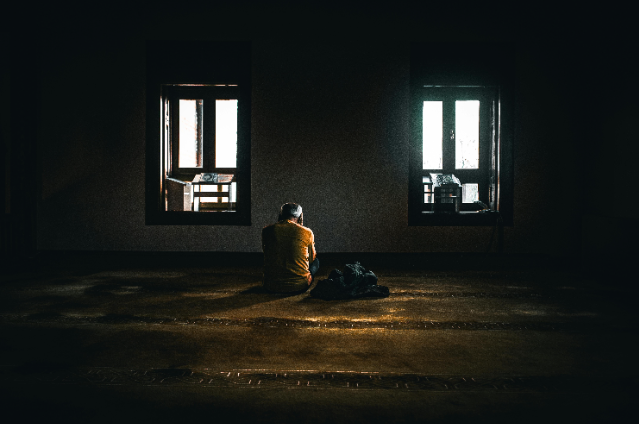
There exists, in the practice of prayer and spiritual devotion, a moment that conventional religious instruction rarely addresses with adequate depth: the interval immediately following the conclusion of active petition or supplication. In that threshold space — after the spoken word or silent intention has been released, yet before the practitioner returns to the rhythms of ordinary consciousness — a qualitatively distinct mode of awareness frequently emerges. It is neither the focused intentionality of prayer itself nor the distracted busyness of secular life, but something irreducible to either category.
Western religious culture, particularly in its popular and evangelical expressions, has historically privileged active, articulate, emotionally demonstrable modes of faith. The burning testimonial, the dramatic conversion, the ecstatic encounter with the numinous — these narratives dominate the spiritual imagination and implicitly establish a normative standard against which quieter, more ambiguous forms of religious experience are measured and, frequently, found wanting. The practitioner who prays in silence and receives what feels like silence in return may conclude that something has gone wrong with their spiritual practice, their faith, or themselves.
This article challenges that conclusion. Drawing on the rich contemplative resources of multiple traditions — Christian mysticism, Islamic Sufi philosophy, Jewish mystical thought — as well as contemporary contemplative psychology, it argues that sacred silence is not a failure of religious communication but a sophisticated and often advanced mode of spiritual engagement. The apparent absence of the divine may, paradoxically, constitute a form of divine presence that exceeds the conceptual categories through which we habitually seek to apprehend it.
The Apophatic Tradition: Theology of the Unknown
Among the most intellectually rigorous responses to the problem of divine silence is the apophatic or negative theological tradition within Christianity. Associated with figures such as Pseudo-Dionysius the Areopagite, Meister Eckhart, and the anonymous author of The Cloud of Unknowing, apophatic theology proceeds from the foundational conviction that the ultimate nature of the divine radically exceeds the capacity of human cognition and language. God cannot be adequately described by positive predication — that is, by asserting what God is — but only by the successive negation of inadequate concepts.
The via negativa, or negative way, thus represents not a counsel of despair but a rigorous epistemological discipline: the systematic dismantling of all conceptual idols that the human mind erects in place of genuine encounter with the transcendent. Pseudo-Dionysius argues in The Mystical Theology that the highest union with God is achieved precisely through the abandonment of speech, thought, and sensory perception — through what he terms a "darkness of unknowing" that paradoxically constitutes the most luminous spiritual state available to human beings.
This tradition has profound implications for the practitioner who experiences their prayers as met with silence. If the divine is, by nature, that which exceeds all conceptual and linguistic mediation, then the experience of silence following prayer may indicate not the absence of a divine response but the inadequacy of the categories through which such a response is expected. The silence, in this reading, is not empty; it is saturated with a presence that overflows the vessels of conventional religious expectation.
The Sacred Longing: Sufi and Islamic Contemplative Perspectives
Islamic mystical philosophy, particularly in its Sufi expressions, offers a complementary and independently developed account of sacred silence and spiritual longing. The concept of shawq — often translated as "yearning" or "longing" — occupies a central position in the Sufi understanding of the soul's relationship to God. For thinkers such as Al-Ghazali, Ibn Arabi, and Rumi, the experience of longing for divine proximity is not a symptom of separation but a form of intimacy. The very capacity to yearn for God is itself a modality of divine presence within the human person.
Rumi's Masnavi opens with the famous image of the reed flute, whose music is an expression of its grief at having been cut from the reed bed — a grief that is simultaneously a song, an act of beauty, and a form of connection to its origin. The wound of separation is, paradoxically, the instrument of communion. Applied to the experience of prayer met with apparent silence, this framework suggests that the ache of unanswered longing is not a sign that one's spiritual practice has failed, but that the soul is alive to its deepest truth: its constitutive orientation toward a transcendence that exceeds complete satisfaction within the conditions of ordinary experience.
Furthermore, the Islamic theological concept of tawakkul — radical trust or reliance upon God — implies a willingness to receive divine communication in forms that may not correspond to one's prior expectations. The practitioner who has cultivated tawakkul does not demand that the divine response assume a particular shape or arrive within a particular timeframe. This posture of open receptivity is itself a contemplative achievement, and it creates the conditions under which subtler registers of spiritual experience — including the experience of pregnant silence — can be recognised and honoured.
Tzimtzum and the Generative Void: Jewish Mystical Philosophy
The Lurianic Kabbalistic doctrine of tzimtzum provides yet another sophisticated framework for understanding the theological significance of apparent divine absence. According to Isaac Luria, the sixteenth-century Kabbalist whose teachings profoundly shaped subsequent Jewish mysticism, God's initial act was not one of emanation or creation ex nihilo in the conventional sense, but of contraction: God withdrew or contracted the divine Infinite (Ein Sof) from a primordial space to make room for the existence of finite creation.
This cosmological narrative carries profound implications for the theology of spiritual experience. If divine withdrawal is understood as a constitutive feature of creation's existence — the very condition that makes human freedom, moral agency, and genuine relationship possible — then the experience of divine absence in prayer can be reframed not as abandonment but as a form of love: the love that creates space for the beloved to exist as genuinely other. The silence of God may be the silence of a presence that has deliberately made room for the human person to be fully themselves.
Small Altars: The Phenomenology of Everyday Spiritual Practice
The preceding theological frameworks, while conceptually sophisticated, must not be permitted to remain purely abstract. The practitioner who lights a candle each morning as an act of gratitude, who pauses before a meal in wordless acknowledgement, who stands at the threshold of evening and feels — inexplicably, sometimes inarticulately — that they are not alone in the universe: these are not instances of a lesser or inchoate spirituality awaiting doctrinal refinement. They are, phenomenologically speaking, primary spiritual experiences of significant depth and authenticity.
William James, in his foundational phenomenological study The Varieties of Religious Experience (1902), identified a cluster of characteristics common to what he termed "mystical states of consciousness": ineffability (resistance to adequate linguistic expression), noetic quality (a sense that genuine knowledge or insight has been conveyed), transiency, and passivity (the sense that one's ordinary will has been superseded or transcended). Strikingly, many of the experiences James catalogued were precisely of this quiet, borderline variety — not the dramatic visions of canonical mystics, but the subtler apprehensions of presence, meaning, and connection available to ordinary practitioners in the interstices of daily life.
Contemporary contemplative psychology has extended James's analysis through empirical investigation of mindfulness, meditative practice, and the neuroscience of spiritual experience. Research consistently indicates that states of mental stillness, non-discursive awareness, and receptive attentiveness are associated with measurable changes in neurological activity and with subjective reports of well-being, meaning, and what subjects frequently describe as a sense of connection to something larger than themselves. The phenomenological data, in other words, support the theological intuition that silence is not absence but a distinct mode of presence.
The Watching Father: Hermeneutical Reflections on Return and Recognition
The Lukan parable of the Prodigal Son (Luke 15:11-32) has generated an extraordinarily rich tradition of theological and literary interpretation, from Origen and Ambrose through Rembrandt and Karl Barth to Henri Nouwen's celebrated contemplative reading in The Return of the Prodigal Son (1992). For present purposes, one detail of the narrative merits particular attention: the description of the father as having seen his returning son "while he was still a great way off." This detail implies persistent watching — a sustained orientation of attention toward the possibility of return, maintained through an unspecified but presumably extended interval of absence.
This image of the watching father provides a powerful counter-narrative to the experience of divine silence as abandonment. If the parabolical father maintained his gaze toward the horizon throughout the period of his son's absence — an absence that the son experienced as separation, even while the father experienced it as sustained attention — then the silence that the praying person experiences as God's inattention may be, from the divine perspective (if such a perspective is theologically admissible), not silence at all, but a form of watching that the human subject has not yet developed the spiritual perception to recognize.
The foregoing analysis suggests that the normative model of spiritual experience operative in much popular religious culture — a model premised on clarity, certainty, demonstrable divine responsiveness, and the continuous experience of felt connection — is both theologically inadequate and pastorally harmful. It is theologically inadequate because it fails to account for the sophisticated apophatic, mystical, and contemplative traditions within the major world religions, each of which offers resources for a positive theological revaluation of silence, absence, and unknowing. It is pastorally harmful because it implicitly pathologises the experience of the majority of sincere practitioners, who navigate their spiritual lives in conditions of considerable ambiguity.
What is required, this article has argued, is a spirituality of receptive unknowing: a disciplined willingness to remain in the silence following prayer without immediately filling it with interpretation, anxiety, or the demand for legible divine communication. Such a spirituality does not abandon the hope of encounter but refines and deepens it, creating space for modes of divine presence that exceed the narrow bandwidth of our conceptual expectations. The silence between prayers, in this reading, is not a void to be anxiously filled but a threshold to be attentively inhabited — a space in which something irreducible to human categories quietly and persistently waits.
The candle lit in the early morning, the folded hands, the wordless gesture before sleep: these are not marginal spiritual acts. Understood within the frameworks traced here, they constitute an authentic and venerable participation in the contemplative life — a life oriented not toward the elimination of mystery but toward an ever-deepening capacity to dwell within it.
References
- Dionysius the Areopagite. (1987). The mystical theology. In C. Luibheid (Trans.), Pseudo-Dionysius: The complete works. Paulist Press.
- Eckhart, M. (1981). Meister Eckhart: The essential sermons, commentaries, treatises, and defence (E. Colledge & B. McGinn, Trans.). Paulist Press.
- Ghazali, A. H. (2001). The remembrance of death and the afterlife (T. J. Winter, Trans.). Islamic Texts Society.
- Ibn Arabi. (2004). The bezels of wisdom (R. W. J. Austin, Trans.). Paulist Press.
- James, W. (1902). The varieties of religious experience: A study in human nature. Longman, Green, and Co.
- Luria, I. (as discussed in) Scholem, G. (1974). Kabbalah. Quadrangle/New York Times Book Co.
- Nouwen, H. J. M. (1992). The return of the prodigal son: A story of homecoming. Doubleday.
- Rumi, J. (2004). The Masnavi (R. A. Nicholson, Trans.). E. J. Brill.
- The Cloud of Unknowing. (1981). (J. Walsh, Trans.). Paulist Press.