
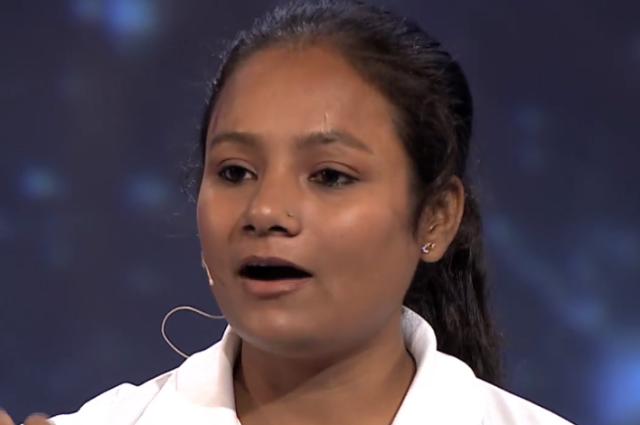
Arunima Sinha’s journey is one of the most remarkable tales of human will overcoming adversity. Born in 1989 in Ambedkar Nagar, Uttar Pradesh, she grew up in a modest family (her father was an army engineer who died when she was three, and her mother was a health worker). A natural athlete, Arunima represented her school and college in football and volleyball, eventually playing volleyball at the national level. By 2011, as a young law graduate, she was preparing for a secure future: applying for a CISF job that would allow her to combine a service career with her passion for sports.
The Train Accident and Its Aftermath
On the night of 11–12 April 2011, Arunima’s life was violently upended. En route from Lucknow to Delhi on the Padmavati (Padmawat) Express for her CISF interview, she was attacked by a gang of thieves who attempted to snatch her gold chain. Arunima resisted fiercely; witnesses later said she “kicked, punched and fought” her assailants. In retaliation, the thieves threw her from the moving train. She flew against a parallel track, and within seconds, a second train running on that track crushed her left leg below the knee. Miraculously, Arunima survived the trauma: she lay badly injured and bleeding on the tracks for the rest of the night. “I discovered later that 49 trains had passed me by as I lay wrecked and bleeding on the tracks”, before villagers found and took her to the hospital at dawn.
In the hospital, doctors worked to save her life. The wounds were septic, and the blood loss severe. Arunima’s left limb was amputated below the knee to prevent fatal gangrene. She also suffered a shattered right leg and spinal injuries. The crude conditions of the rural hospital were horrifying (she recounted a street dog eating part of the amputated limb), and she needed urgent care. Arunima was transferred to AIIMS Delhi on 18 April 2011 and spent four months undergoing multiple surgeries and rehabilitation there. During this harrowing recovery, a childhood athletic spirit began to awaken: even as she lay in the hospital bed, Arunima resolved not to be defined by her disability. As she later recalled in interviews, once her immediate survival was assured, she felt “everyone was worried for me. I then realised I had to do something so people stop looking at me with pity”. This decision – to fight stigma and reclaim her life – marked the start of an extraordinary new goal.
Recovery and the Decision to Climb Everest
In the months following her accident, Arunima faced physical pain, prosthetic training, and immense psychological strain. Receiving a prosthetic leg free of charge, she relearned to walk and eventually to run and cycle again. Despite the difficulties, her determination only grew. Inspired by stories of athletes overcoming illness (she cites cricketer Yuvraj Singh’s cancer recovery) and guided by her family’s encouragement, Arunima set her sights on the impossible: to climb Mount Everest, the world’s highest peak. Her mother especially motivated her, and by mid-2011, Arunima was fully committed to this goal. In her own words at the time, she wanted to “reclaim her life” right there in the hospital.
A key moment came when Arunima reached out to Bachendri Pal, the first Indian woman to summit Everest (in 1984). Bachendri Pal embraced Arunima’s dream without hesitation. As Arunima recalled, Bachendri said, “My child, you decided to climb Mount Everest in these situations with a prosthetic leg. You will achieve it – the only thing remaining is for the world to know.” With Pal’s encouragement and help from the Tata Steel Adventure Foundation (TSAF), Arunima began formal mountaineering training. She joined the Nehru Institute of Mountaineering in Uttarkashi for a basic course, and in 2012, climbed Nepal’s Island Peak (6150m) as a trial ascent. These experiences proved that she could indeed endure high-altitude climbing on one leg. By the end of 2012, she was ready for a full Everest expedition.
Training with Bachendri Pal and Expedition Preparation
From late 2011 through early 2013, Arunima trained intensively. She joined mountaineering camps and used every spare moment to prepare physically and mentally. The Tata Steel Adventure Foundation sponsored her Everest bid. Under Bachendri Pal’s mentorship, Arunima learned to navigate icefalls, crevasses, and technical climbing. One of her challenges was the prosthetic itself: initially, it caused chafing and bleeding, but an improved custom limb (provided by a private company) eventually fitted her for the gruelling ascent. Meanwhile, media attention to Arunima’s goal began to grow, as reporters and sponsors took notice of the former volleyball player-turned-Everest hopeful.
At the end of 2012, Arunima flew to Nepal and trekked to Everest Base Camp with a team organised by Sherpa leaders and TSAF. The plan was to tackle Everest in the spring 2013 climbing season. She was accompanied by professional guides and a fellow climber, Susan Mahout of the U.S., who had also trained at TSAF and Island Peak. Arunima expected hardships. “I knew nothing would be easy,” she said later, yet her resolve was firm: “I made my disability my strength, not my weakness”. In spring 2013, after weeks of acclimatisation rotations up the lower slopes of Everest, she was ready to make the summit push.
The Everest Summit: Challenges and Triumph
Arunima Sinha began her final ascent in May 2013. An unusually high number of climbers attempted Everest that season, and weather windows came and went quickly. She and her team left the high Camp 4 around 6 pm on 20 May, aiming for the summit the next morning. The night climb in sub-zero darkness was arduous. At one point above 8,750 meters, her Sherpa guides grew worried at her slow pace. But Arunima dug deep: recalling the countless hours of rehabilitation, she kept moving. To everyone’s astonishment, once she reached the final steep section, she “suddenly gained energy and confidence” and raced to the top.
On 21 May 2013 at 10:55 am (local time), Arunima Sinha reached the summit of Everest. With her prosthetic limb and two guides, she planted the Indian flag on the “roof of the world.” At age 23, she became the first female amputee in the world to stand atop Everest. Spectators in Kathmandu and colleagues back home erupted in celebration. In her first comments from the summit, Arunima said she felt humbled and grateful: she held a small handwritten note in the snow thanking God and Swami Vivekananda for inspiration. The image of this young woman praying on the summit captured headlines globally.
The climb itself tested every ounce of Arunima’s resilience. Climbing Everest on one leg meant she had to modify techniques: using ice axes to compensate for extra effort, stepping carefully to avoid twisting her artificial knee, and enduring far more pain in each step than able climbers. Yet she repeatedly said the high-altitude ordeal – the endless cold nights, oxygen deprivation, and brutal Khumbu Icefall – was survivable compared to the vision of life lived in pity. This was, she felt, her ultimate triumph: not merely reaching 8,848 meters, but demonstrating in the starkest way that willpower and determination can overcome physical limitations.
Case Study in Resilience and Inner Strength
Arunima Sinha’s story is often cited as a textbook example of psychological resilience and grit. Her trajectory fits with resilience theory: despite a catastrophic trauma, she showed an extraordinary ability to adapt positively. Psychologists define resilience as the process of coping successfully in the face of adversity, not just enduring but growing from it. Arunima embodied this: from the moment of crisis (the train accident), she made a conscious choice to “refuse to give in to despair”. Where many would fall into depression or accept victimhood, she found motivation. In media interviews, she repeatedly emphasized her mental strength: “Physical disability can never be a hindrance in achieving your life’s goal if you have mental strength, strong willpower and firm determination.” (Arunima’s own words, often quoted in coverage). After Everest, she added, “I wanted to show the world I could do anything.”
Experts note that setting such a bold goal – climbing Everest – can itself fuel resilience by giving a sense of purpose. Arunima’s single-minded focus on Everest helped her endure the grueling rehab and training. When she was exhausted on Everest’s upper slopes, she drew on mental training and images of her family, often thinking of her late father and supportive mother. After the summit, even strangers praised her inner strength. The Vice-Chancellor of Strathclyde University (Scotland) remarked that Arunima’s “real spirit, courage and determination” inspired not only amputees but all people facing adversity. Her leap from a hospital bed to the top of Everest in two years is thus frequently used as a case study in determination and goal-setting.
In sum, Arunima’s resilience was not just survival but transformation. After her accident she could have lived quietly, but instead she transcended expectations. This transformative resilience – turning a disability into a platform for achievement – resonated with the public. Psychologists observe that such “post-traumatic growth” can occur when individuals find new meaning after trauma. Arunima’s narrative fits this pattern: by the time she stood on Everest, the accident was reinterpreted as the turning point that made her stronger. She became a symbol of the idea that one’s mindset can convert tragedy into triumph.
Broader Impact: Disability, Motivation, and Social Perception
Arunima Sinha’s story had implications far beyond mountaineering. In India and around the world, her achievement became a symbol in the disability rights and empowerment movement. First and foremost, she shattered stereotypes. As the first female amputee Everest climber, she defied the common notion that physical disability inevitably limits one’s life options. Media coverage emphasized that she “made her disability her strength” and insisted on being treated like any other athlete. A national survey of public opinion after her climb found that many disabled people felt inspired and more hopeful about opportunities after seeing her success.
Her climb also sparked public conversations about accessibility and prejudice. In one notable incident after Everest, Arunima tweeted that she felt “greater pain” being mocked for her disability at a temple than on the mountain. Security personnel in Mahakal Temple had repeatedly stopped her from proceeding, despite a ramp being available. Her public complaint (tweeting the Prime Minister’s Office) generated national debate about how society still stigmatises the disabled, even when they are heroes. In this way, her Everest fame was a platform to highlight everyday discrimination: she used her voice to demand respect and equal treatment for the disabled.
On the motivational speaking circuit, Arunima quickly became a sought-after figure. She was invited to talk in schools, corporate events, and veteran forums, sharing lessons of courage and perseverance. Each talk reinforced a message: that “mental strength and determination” (her frequent phrase) matter more than any physical limitation. Her own words – e.g. “I realised I had to do something so people would stop looking at me with pity” – became rallying cries for people with disabilities to assert their agency. Arundances of people with disabilities often cited her story as proof that social attitudes should shift from pity to respect.
Institutionally, Arunima’s success also translated into tangible support for the disabled. Government and corporate sponsors became more willing to back para-athletes and adventure programs. She was honoured by the Indian government with the Padma Shri award in 2015 – a rare civilian honour for a disabled athlete. By contrast, just after the accident, she had received public outrage when officials offered her a meagre compensation; by 2015, the same society was celebrating her as a national hero. This shift illustrated changing perceptions: from seeing an accident victim as helpless to viewing her as an extraordinary achiever. Arunima herself worked to widen that impact: she announced plans to found a free sports academy (“Shaheed Chandra Shekhar Azad Viklang Khel Academy”) for children with disabilities and poor backgrounds. She channelled prize money and aid into this cause. Her charitable Arunima Foundation was launched to empower women and disabled people through sports and education.
In the context of disability rights, Arunima’s story underscores a key narrative: that barriers are often as much societal as physical. Every segment of her journey – fighting robbers, surviving the hospital, reaching Everest, and even facing temple guards – highlighted both the possibilities and the prejudices disabled people face. Advocates noted that while her case was exceptional, it inspired others to challenge infrastructural and attitudinal barriers (for example, better accessibility at public sites, more support for disabled athletes, and stronger enforcement of disability law). Arunima’s public profile gave a face to these abstract issues and motivated change simply by insisting on competing at the highest levels.
Legacy and Continuing Influence
Today, Arunima Sinha stands as a cultural icon of resilience in India. Her Everest summit is just the most famous chapter: she went on to climb the highest peaks of other continents (Kilimanjaro, Elbrus, Kosciuszko, Aconcagua, Denali) and by 2019 became the first female amputee to complete the “Seven Summits” challenge. Each of these feats reinforced her message that physical disability is not destiny. Her autobiography Born Again on the Mountain (2014) became a bestseller in India, used in motivational workshops and schools. In recognition of her impact, universities abroad (e.g. University of Strathclyde) have awarded her honorary doctorates, citing her “inspirational achievements”.
Arunima’s impact on public perception has been lasting. She has helped move the narrative from “can’t” to “can”, especially regarding disability. As one commentator put it, her life reminds us “the human will is more powerful than suffering and misfortune.” In urban and rural India alike, statues, murals, and even street art have celebrated her image – an amputee with arms raised on Everest – as a symbol of determination. Young people with injuries or congenital limb loss now often cite Arunima as a role model. Disability rights groups have invited her to campaigns, using her voice to advocate for inclusion and anti-discrimination. Government programs for adaptive sports and adventure tourism often showcase her story.
In sum, Arunima Sinha’s journey from a hospital bed to a mountain summit exemplifies resilience in its truest sense: not just enduring hardship, but transforming it into purpose. It illustrates how one person’s refusal to surrender can shift social attitudes. By becoming the first amputee woman to conquer Everest and other peaks, Arunima forced society to confront its underestimation of disabled people. Her continued work – through speeches, her academy project, and the Arunima Foundation – ensures that her legacy is not just the symbolic act of summiting Everest, but the real change she inspires.
Even as a public figure, she remains humble about the awards and honours. Each time a young amputee gains confidence, or a policymaker notes the need for better accessibility because of her example, Arunima’s influence as a motivational icon is felt. Her story continues to be told in news articles, books, and interviews – a narrative woven into India’s cultural fabric of courage. In the end, she is not remembered for pity over her disability, but for proving “the sky is the limit” if one has the will to climb.
. . .
References:
- Arunima Sinha’s story and achievements are documented in news reports and interviews, official government award announcements, and her own accounts in magazine interviews.