
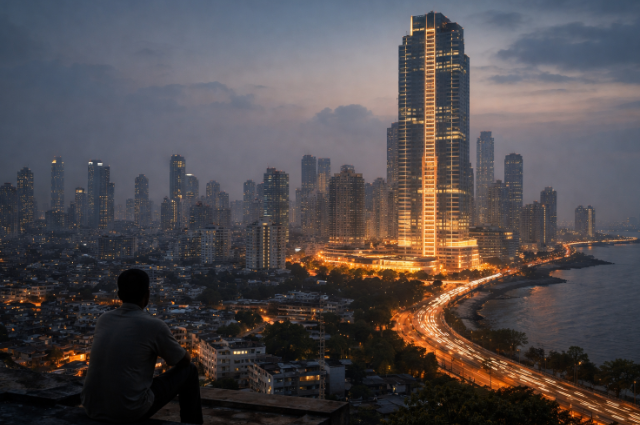
In political philosophy, the state is not judged merely by what it builds, but by where and why it builds. Infrastructure is never neutral. Roads reveal priorities, hospitals reveal ethics, and buildings constructed outside one’s own territory reveal something deeper: the spatial limits of governance. The recent expansion of the Bihar Bhawan concept from an administrative guest house in Delhi to a 30-storey skyscraper in Mumbai forces a confrontation with this uncomfortable truth. What does it mean when a state’s most ambitious welfare architecture rises not within its borders, but two thousand kilometres away?
At first glance, the new Bihar Bhawan in Mumbai appears humane. Approved in January 2026, it promises relief to cancer patients from Bihar who seek treatment at Tata Memorial Hospital. Dormitories, medical rooms, cafeterias, and administrative coordination are not trivial offerings. In a country where illness often leads to homelessness, the provision of shelter is an act of mercy. Yet political philosophy demands that we look beyond intention to structure. It asks not only what is being done, but what kind of state logic makes this necessary.
The core paradox is spatial. Care has migrated. Instead of healthcare capacity moving toward the people, people move toward distant healthcare, and the state follows them there, constructing towers of accommodation rather than foundations of cure. This inversion is not accidental. It reflects a model of governance increasingly comfortable with managing consequences rather than eliminating causes. Bihar Bhawan, in this sense, is not merely a welfare facility; it is an architectural acceptance of systemic absence.
In classical state theory, legitimacy arises from proximity. Aristotle viewed the polis as a space where rulers and ruled share common ground. Even modern welfare states rely on the idea that essential services must exist within reach of the citizen. When a state invests hundreds of crores in managing medical displacement rather than preventing it, legitimacy becomes outsourced. The state remains present but only after the citizen has left home, language, livelihood, and community behind.
The ethical discomfort intensifies when we examine internal hierarchies. Of the total capacity in the Mumbai project, 240 beds are allocated for patients and attendants, while 178 rooms are reserved for officials. This is not merely a numerical imbalance; it is a philosophical statement. The architecture suggests parity between suffering and administration, between vulnerability and authority. The poor are accommodated; power is hosted. The building thus performs a familiar bureaucratic choreography; welfare exists, but it must coexist symmetrically with privilege.
Michel Foucault argued that modern power often expresses itself through institutions that appear benevolent. Hospitals, hostels, and welfare centres can function simultaneously as sites of care and control. Bihar Bhawan fits uneasily into this tradition. It shelters the sick, yet it also consolidates administrative presence, protocol, and hierarchy. The patient is never alone with care; the state is always watching, managing, regulating.
This duality is echoed in Delhi, where Bihar’s “mini-embassies” have long existed as extensions of state power beyond territorial boundaries. Bihar Bhawan at Kautilya Marg handles files and influence; Bihar Sadan in Dwarka absorbs overflow; Bihar Niwas, now slated for demolition and rebuilding, has become a site of political memory and contestation. The debate over Bihar Niwas is not truly about structural safety. It is about narrative control who gets to be remembered, and whose name is allowed to endure in stone.
Philosophically, demolition is never neutral. To rebuild is to reinterpret history. When legacy becomes inconvenient, modernisation becomes the language of justification. The state claims efficiency; opponents hear erasure. Thus, even guest houses become ideological terrain, revealing how power negotiates with memory.
Mumbai adds another ethical layer. Land is not infinite, especially in a city defined by scarcity. The decision to allocate prime Port Trust land to an out-of-state project raises questions of distributive justice. Who has the right to the city? When multiple states erect their own vertical enclaves in metropolitan centres, federal cooperation begins to resemble quiet competition. The city becomes a shared resource unevenly burdened, and local needs are asked to make room for national dysfunctions.
From the perspective of urban philosophy, this is a failure of coordination masquerading as unity. True federalism would reduce forced migration by strengthening regional capacities. Instead, the current model treats metropolitan India as a pressure valve, absorbing the failures of smaller states through land, labour, and infrastructure.
Yet perhaps the most revealing aspect of the Bihar Bhawan phenomenon is its verticality. The skyscraper is a modern symbol of ambition, visibility, and success. It announces presence. It reassures authority. It is easier to point to thirty floors of concrete than to invisible improvements in primary healthcare systems. Vertical construction creates spectacle; horizontal reform requires patience.
This is why Bihar Bhawan feels simultaneously impressive and tragic. It solves a real problem, but in doing so, it risks freezing that problem into permanence. Once accommodation is institutionalised, displacement becomes normal. Once exile is made comfortable, return becomes less urgent.
The question, then, is not whether Bihar Bhawan will help patients; it will. The deeper question is whether it allows the state to postpone a more difficult moral obligation: to build a Bihar where such journeys are rare rather than routine.
In the end, Bihar Bhawan stands as a philosophical monument to modern governance, a structure where compassion and compromise coexist uneasily. It reflects a state that cares, but from afar; that spends generously, but elsewhere; that rises vertically in Mumbai while remaining unresolved horizontally at home.
Until the day healthcare no longer requires migration, every floor added to Bihar Bhawan will quietly ask the same question: Is this progress, or is it the architecture of acceptance?
. . .
References:
- Jagran