
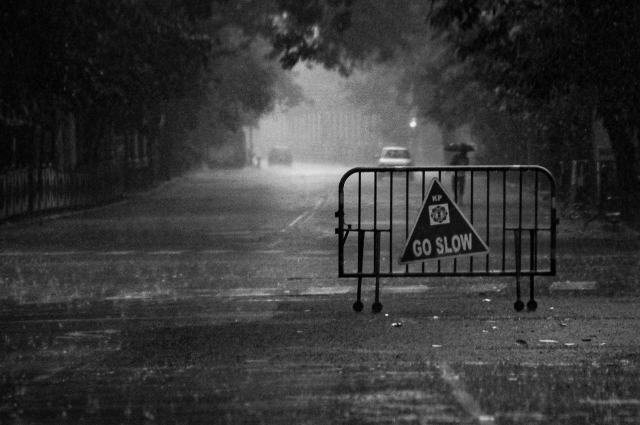
At certain turns in life, you expect a warning, a railing, a wall, a sign that says slow down, danger ahead. Civilisation is supposed to be that railing. On the night of January 16–17, 2026, at a sharp ninety-degree turn in Sector 150, Noida, the railing simply wasn’t there. And in that absence, a young man named Yuvraj Mehta disappeared into cold water while the city watched. Not metaphorically. Literally.
Maps are honest. They show angles without emotion. If you look at that turn from above, it’s just mathematics: ninety degrees, a sudden break, and beyond it a twenty-foot construction pit filled with black winter water. But maps do not show what was missing. A boundary wall had been broken for four months of files, four months of “not our department,” four months of the oldest sport in governance: passing the ball until gravity handles the rest. The residents complained. The builders blamed the authority. The authority blamed the builders. Both blamed the procedure. Instead of a wall, they installed plastic orange barricades, the kind that flutter like festival decorations. Plastic pretending to be concrete. Safety pretending to be responsibility. In dense winter fog, plastic is not a barrier. It is a suggestion. And suggestions don’t stop cars.
Yuvraj Mehta, twenty-seven, a software engineer's son, an ordinary dreamer of ordinary tomorrows, drove home that night. Perhaps he was thinking about code, or deadlines, or what to eat when he reached his apartment. No one ever thinks, Tonight I will drown inside a construction pit because two institutions are arguing. He drove straight. The road seemed continuous. Fog erased edges. And then nothing. Not a crash, exactly, more like subtraction. The ground simply ended. His car sailed through the gap where a wall should have stood and fell into dark water. If negligence had a sound, it would be that splash.
He did not die immediately. The car did not sink at once. He climbed onto the roof. Imagine the cold January water, metal roof, night air cutting like glass. He called his father. “Papa.” There is something ancient about that word. It shrinks a grown man back into childhood. His father reached the spot and saw him not a body, but a living boy. For ninety minutes, life hovered. Yuvraj kept his phone’s flashlight on so people could see him through the fog, a tiny star trembling over black water, a human lighthouse. He shouted that the water was freezing. He shouted for help. Light blinking. Voice cracking. Breath fogging. Time stretching. Ninety minutes is enough to watch a movie, enough to cook dinner, and enough to save a life. But that night, ninety minutes became a museum of inaction.
The police arrived. The fire brigade arrived. Uniforms. Vehicles. Authority. But not equipment. No boats. No life jackets. No long ropes. The tools of rescue were absent, just as the wall had been absent. Excuses arrived faster. “We can’t swim.” “There might be electric wires.” “There could be iron rods underwater.” “It’s risky.” Risky is a word designed to protect the living from responsibility toward the dying. So they waited. Waiting became policy. Policy became paralysed. Someone called the NDRF from another city, because bureaucracy believes distance is safer than courage. While paperwork travelled, the cold climbed into Yuvraj’s bones. His father watched his son’s light flicker like a candle in a storm. At 2:15 AM, the light went out. Not dramatically. Just gone as if the night swallowed it politely. The screaming stopped. Silence signed the death certificate.
We like to imagine uniforms as symbols of bravery, but bravery is not stitched into fabric; it lives in the spine. That night, fear weighed more than duty. A twenty-seven-year-old clung to life while trained responders clung to caution. Civilisation reversed. The citizen became the brave one. The system became the spectator. It was not drowning alone that killed Yuvraj. It was hesitation. It was the mathematics of “not my job.” It was death by protocol.
Then came Moninder, not a commander, not an officer, but a delivery agent, a gig worker, a man paid by the hour, not by honour. When the police would not jump, he did, because humanity does not require authorisation. He entered the same freezing water the trained men feared. The lowest rung of the economic ladder carried the highest measure of courage. History is full of unnamed people doing what institutions only promise. But when Moninder told the media the truth that the police did nothing, something curious happened. Truth made power uncomfortable. He was pressured, threatened, and asked to record a “correct” version, a scripted praise. Heroism was rewritten. Reality edited, as if saving face mattered more than saving lives. Gaslighting the witness because authority often prefers fiction over accountability.
Later, punishments came. The CEO was sacked. The builder was arrested. Reports filed. Tweets posted. Public anger demands sacrifices. But none of these brings back a flashlight in the fog. The real killer wasn’t one person. It was designed a system where walls take months, responsibility takes years, and death takes seconds. This is how modern tragedy works, not with villains, but with vacancies. The missing wall. The missing rope. The missing courage. Absence is deadlier than violence.
We speak proudly of “smart cities”, glass towers, apps, sensors, and Wi-Fi. But what is intelligence without empathy? A city isn’t smart because it has technology. It is smart because it protects its weakest moment. After all, at 2 AM, when a single citizen screams for help, the system runs, not calculates. That night, there was a thirty-foot gap in the social contract, and Yuvraj fell through it.
Somewhere, that image persists: a boy on a car roof, phone raised, light trembling against fog, fighting darkness with a battery percentage. That small light outlasted the entire system, outshone police sirens, outshone protocols, outshone bureaucracy. A single human trying to be seen. Perhaps that is what tragedy really is, not death, but the unbearable knowledge that rescue was possible; that a wall, a rope, a jump, a decision, any one of them could have rewritten the ending. Instead, the night kept its silence, and the city kept its excuses. But the flashlight remains in memory, still glowing, still asking: in a world of concrete and commands and uniforms, why was the bravest thing that night just a small light refusing to go out?