
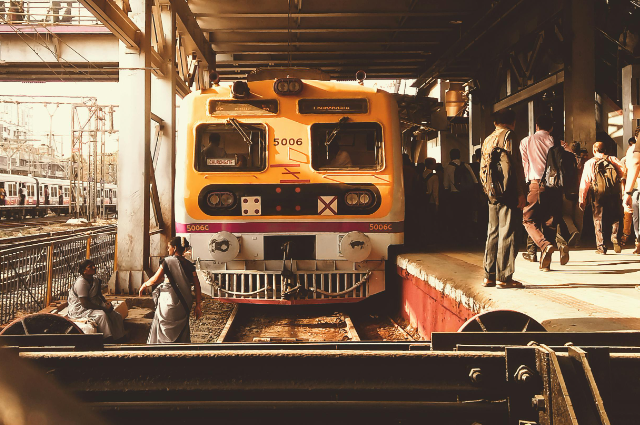
At 5:42 p.m., the Borivali-bound slow train pulled into Malad like it always does, breathing out heat, impatience, and a thousand unfinished conversations. Inside the second-class coach, bodies leaned into bodies, elbows negotiated inches, and the mathematics of survival was being solved in real time. There is a peculiar arithmetic to Mumbai’s local trains: if one man moves two steps, three others must adjust; if one hand loses grip, five hands instinctively brace. It is a system held together by routine and restraint.
On Saturday, January 24, 2026, that restraint fractured.
Alok Kumar Singh, 33, a junior college professor of Mathematics and Statistics at Narsee Monjee (NM) College of Commerce & Economics, had boarded the train as he had countless times before. He lived in Kandivali, taught in Vile Parle, and commuted through the city’s steel arteries like millions of others. It was supposed to be an ordinary ride home. It was also his wife’s birthday.
As the train neared Malad, the ritual began: those near the door prepared to alight, those outside angled to board. In the compressed geometry of the compartment, “right of way” is not merely etiquette it is survival. A minor argument sparked. Someone wanted to get down. Someone else couldn’t move. Singh reportedly explained he was blocked from behind. Words sharpened. The train slowed.
When the doors opened at Malad railway station, the argument spilt onto Platform 1. What should have dissolved into the anonymity of the crowd instead hardened into something irreversible. The assailant, later identified as 27-year-old daily-wage labourer Omkar Eknath Shinde, pulled out a metal-cutting forceps taken from his workplace. In one swift, brutal motion, he stabbed Singh deeply in the abdomen.
There are moments in a city’s life when time splits. Before. After.
Before, the platform was a blur of vendors, commuters, and announcements crackling overhead. After, a man was collapsing, a stain spreading, a crowd recoiling in disbelief. The attacker fled, swallowed by the same density that had minutes earlier forced strangers into confrontation.
Colleagues and railway police rushed Singh to Shatabdi Hospital (Dr Babasaheb Ambedkar Hospital). Doctors tried. Blood loss had already written its verdict. He was declared dead on arrival.
Within hours, the story ricocheted across the city: a professor stabbed to death over a momentary dispute during rush hour. The Government Railway Police and Borivali police combed through CCTV footage. Cameras captured a young man running across a foot overbridge, panic etched into hurried strides. By the next morning, Shinde was arrested in the Kurar area of Malad East and booked for murder under Section 103 of the Bharatiya Nyaya Sanhita.
The efficiency of the arrest offered procedural reassurance. It did not offer comfort.
Because this was not only a crime story. It was a systems story.
Mumbai’s local trains are often called the city’s lifeline. They are also its pressure cooker. Designed decades ago for a fraction of today’s population, they carry far more than bodies: they carry fatigue from double shifts, anxiety over rent, unfinished assignments, family responsibilities, and the quiet resentment of daily inconvenience. In these coaches, personal space is a luxury and patience a currency constantly devalued.
On most days, the miracle holds. Arguments flare and fade. Someone shouts, someone shrugs, someone apologises. The train moves on. But on January 24, ninety seconds of anger outweighed thirty-three years of life.
Singh’s students remember a teacher who could turn intimidating formulas into friendly puzzles. Mathematics, he would say, is about balance: what you add must equal what you subtract. On that platform, the balance failed. An equation of crowd density, ego, and instant access to a weapon yielded a fatal result.
The CCTV cameras did their job. They recorded. They identified. They helped capture. Yet cameras are historians, not guardians. They tell us what happened; they cannot prevent what begins in the human mind long before a blade is drawn.
For Mumbai’s commuters, the incident has lingered like an unease that does not disperse with the next announcement. Every jostle feels sharper. Every raised voice carries a question: could this escalate? The platform has police. The coaches have chaos. In a compartment designed for thousands but carrying many more, tempers compress just as tightly as bodies.
He boarded a train home. He never reached.
Somewhere in Kandivali, a birthday cake went uncut. Somewhere in a classroom in Vile Parle, a lecture remains unfinished. And on Platform 1 at Malad, trains continue to arrive and depart with mechanical indifference, as if nothing extraordinary occurred.
But the city knows. It felt the rupture.
Because in a metropolis where millions travel shoulder to shoulder, safety is not merely about surveillance or swift arrests. It is about space, infrastructure, and the fragile discipline of coexistence. When that discipline snaps even for a minute, the cost can be a life measured not in statistics, but in silence.