
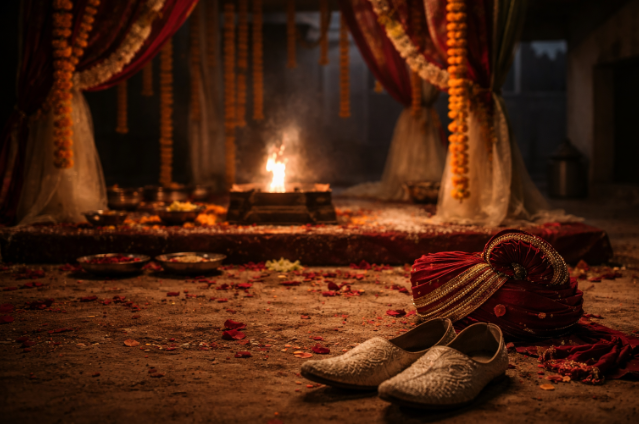
In some marketplaces, prices are slashed during festivals. In others, clearance sales run at the end of the season. And then there are places where marriage itself goes on discount—where instead of negotiating dowry, families negotiate abduction. Pakadwa Vivah is not a glitch in the system; it is the system adapting when morality becomes too expensive.
Here, the groom is not welcomed with garlands. He is seized. He is not asked whether he agrees. He is informed—through fists, firearms, and fear—that agreement has already been recorded on his behalf.
When Tradition Learns Arithmetic
Dowry did not collapse under its own greed; it evolved. Over the decades, it learned arithmetic. It learned to calculate the return on education, the interest on government employment, and the appreciation value of social status. A groom became an asset class. A salary slip became a stock certificate. Marriage negotiations turned into financial prospectuses.
In this inflated economy, daughters became liabilities. Families with limited means faced a brutal equation: pay a fortune or erase the daughter’s future. Pakadwa Vivah emerges here not as rebellion, but as jugaad—an indigenous innovation to beat an unfair market.
Why pay ₹50 lakh when a kidnapping costs ₹5 lakh? In villages where survival routinely defeats ethics, this logic sounds practical. Violence becomes cheaper than virtue.
The Groom as a Product
Pakadwa Vivah exposes an uncomfortable inversion: the groom, traditionally powerful in the marriage hierarchy, becomes the commodity. He is shortlisted not by horoscope alone, but by salary scale and job security. Government officers, engineers, and doctors are prime targets—not because they are loved, but because they are liquid assets.
The kidnapping follows a familiar pattern. Trust is bait. A friendly invitation opens the door. Familiar faces disarm suspicion. Then comes the moment when the world tilts—hands grab, weapons flash, exits disappear. Masculinity, often assumed invincible, collapses quickly when surrounded by armed strangers.
Within hours, the abducted man is stripped of choice and dressed in wedding clothes. The symbolism is brutal: a body restrained in silk, terror wrapped in tradition.
The Wedding Without Will
The wedding ceremony is where the absurdity peaks. Sacred fire burns, but fear burns hotter. Mantras are recited over muffled sobs. Elders bless a union that began as a felony. The groom’s trembling hands apply sindoor as rifles rest casually nearby—because here, the gun is also a witness.
Videos from such weddings do not disturb, not because they show violence, but because they show acceptance of violence. No one screams. No one stops the ritual. The priest does not pause. Society does not blink.
This is not chaos. This is coordination.
The Silent Logic of Staying
Outsiders often ask a simple question: Why doesn’t the groom run away? The answer lies not in walls or weapons, but in shame.
A groom who escapes is not celebrated as a survivor. He is interrogated as a coward. He is reminded that a woman’s life now hangs on his decision. The bride—herself trapped by the same system—becomes the moral hostage. Leaving her means “ruining” her. Staying becomes an act falsely labeled as honor.
Slowly, resistance dulls. Anger negotiates with routine. Fear learns domesticity. The marriage survives, not because love arrives, but because escape costs more than endurance.
This is how coercion disguises itself as compromise.
Two Victims, One Ceremony
Pakadwa Vivah is often narrated as a crime against men, but that framing is incomplete. The bride is no victor. She enters marriage knowing it was forced, knowing affection was extracted, not offered. She must live with the knowledge that her legitimacy rests on violence she did not choose.
Both bride and groom are prisoners sharing a cell called marriage. Society applauds the stability of that cell, mistaking endurance for harmony.
Law Arrives Late to the Wedding
For years, the law remained an absent guest. Police complaints were discouraged. Courts were silent. Tradition spoke louder than statutes.
The Patna High Court’s 2023 ruling disrupted this silence by declaring marriages conducted under coercion legally void. For the first time, the state acknowledged what society refused to admit: rituals performed under threat are not sacred—they are counterfeit.
Yet law operates on paper; society operates on memory. A man may win legal freedom and lose social existence. A woman may gain justice and lose marriageability. The courtroom opens doors that villages quietly shut.
What This Practice Really Reveals
Pakadwa Vivah is not about kidnapping. It is about how deeply consent has been downgraded in the hierarchy of values. It reveals a society where economic survival outranks human choice, where tradition is preserved by sacrificing autonomy, and where marriage—a bond meant to begin with “yes”—starts with “or else.”
This practice survives because it solves a problem without questioning its cause. It attacks dowry by weaponizing it. It challenges exploitation by redistributing trauma.
The Final Irony
Dowry was once justified as security for women. Pakadwa Vivah is justified as a rescue for daughters. Both claim protection. Both deliver captivity.
In the end, the cheapest marriage is the most expensive one. It costs trust. It costs dignity. It costs the very idea that consent matters.
Pakadwa Vivah stands as a warning: when society prices relationships, violence will always undercut the market. And when kidnapping becomes an acceptable alternative, it is not marriage that has failed—it is conscience.
References
- Livemint
- India Today
- wikipedia