
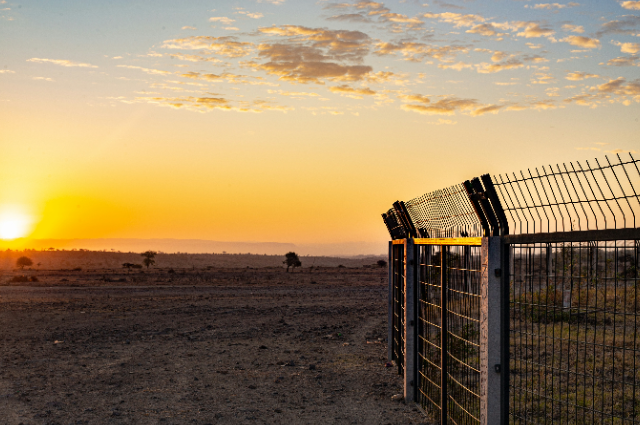
War usually teaches humanity one lesson with brutal consistency: nothing sacred survives prolonged violence. Bullets do not discriminate between belief and brick, and artillery shells are famously indifferent to prayer. Yet, in the western edge of India, where the desert stretches like an unfinished thought and borders are guarded more by vigilance than certainty, stands a contradiction carved in stone and silence—Tanot Mata Temple. It is not merely a survivor of war; it is a philosophical anomaly, a place where destruction paused, hesitated, and inexplicably chose restraint.
Tanot Mata exists in a geography that should never have allowed faith to remain untouched. Just kilometers from the India–Pakistan border, the temple sat directly within the logic of warfare during the Indo-Pak conflicts of 1965 and 1971. Military maps would not have marked it as sacred ground; they would have marked it as a coordinate. And yet, coordinates were rewritten here—not by strategy, but by something far less measurable.
In 1965, the desert around Tanot transformed into an echo chamber of fire. Nearly 3,000 artillery shells were fired toward Indian positions. Around 450 of them landed inside the temple courtyard itself. War manuals predict outcomes; physics predicts explosions. What followed was neither. The shells lay scattered like abandoned arguments, their silence louder than any blast. No cracks in the walls. No shattered idols. No casualties inside the temple premises. What should have been rubble remained refuge.
For the soldiers stationed nearby, this was not just an escape from death—it was a disturbance of certainty. Many later spoke of a shared dream, one that visited them in different bodies but with the same promise. The goddess, they said, assured protection as long as they stood their ground. Whether this was divine intervention or the mind’s rebellion against fear is secondary to its consequence. Courage replaced panic. Resolve replaced doubt. The temple became less of a structure and more of an agreement between belief and bravery.
If the 1965 war posed a question, the 1971 Battle of Longewala attempted to answer it with force. Tanks rolled across the sand, shells carved temporary craters into the earth, and the desert witnessed mechanized violence at its most relentless. Once again, Tanot Mata lay dangerously close to the line of fire. And once again, it emerged untouched. The surrounding land bore scars of conflict, but the temple remained unmarked, as if violence recognized a boundary invisible to humans.
Today, unexploded shells from both wars are preserved in the temple museum. They do not shout victory or defeat. They simply exist—mute witnesses to an unresolved argument between faith and logic. For pilgrims, they are proof of a miracle. For skeptics, they are anomalies awaiting explanation. For philosophers, they are something else entirely: reminders that reality does not always feel obligated to justify itself.
Science, understandably, has tried. Some argue that the soft desert sand absorbed the impact, preventing the shells’ fuses from activating. Others point to defective ammunition or technical failure. These explanations are rational, even elegant. Yet rationality begins to fray when coincidence repeats itself hundreds of times. Probability resists patterns of mercy. Statistics do not favor sanctuaries. And still, Tanot Mata stands.
Interestingly, even disbelief seems to bow its head here. Pakistani Brigadier Shaukat Ali, reportedly moved by the events, visited the temple after the war and gifted a silver chhatra. In a landscape where enemies rarely acknowledge each other’s humanity, this act carried quiet weight. It suggested that even those trained to calculate destruction sensed something beyond calculation at work.
But the most profound transformation did not occur during war—it happened afterward. The Border Security Force took charge of the temple, and in doing so, redefined the idea of service. Soldiers here do not merely guard a border; they guard a belief. Rifles and incense coexist without conflict. The same hands that grip weapons perform aartis. Uniforms blend into ritual, not as a contradiction, but as a continuation.
In Tanot, the concept of priesthood is rewritten. A priest is not someone who renounces violence; it is someone who understands its cost. These soldiers know exactly what artillery can do—perhaps that is why they respect what it did not do here. Every BSF personnel posted at Tanot carries a pinch of the temple’s sand, quietly tucked away. It is not superstiously flaunted, nor officially endorsed. It exists in that intimate space where faith does not seek validation.
Philosophically, Tanot Mata forces an uncomfortable reflection: What is protection? Is it the ability to destroy first, or the rare permission to survive when destruction is due? Modern warfare believes in control—control of airspace, land, and outcomes. Tanot suggests another dimension: surrender. Not surrender to the enemy, but surrender to uncertainty. An acceptance that not everything valuable can be defended by force alone.
The temple also challenges the modern insistence on separating belief from discipline. These soldiers are no less professional because they pray; they are perhaps more aware of the thin margin between life and loss. Faith here does not erase fear—it coexists with it. It does not promise immortality; it offers meaning. In a profession where tomorrow is never guaranteed, meaning is often the strongest armor.
Tanot Mata does not demand belief. It does not issue sermons or explanations. It simply stands—unbroken, uninterested in debate. Perhaps that is its greatest lesson. In a world obsessed with proving, measuring, and conquering, some truths refuse to participate. They remain intact not because they are fragile, but because they are complete.
Where soldiers are priests, war pauses to reflect. Where bombs refuse to explode, questions refuse to die. And in the quiet courtyard of Tanot Mata, history whispers a radical idea: that sometimes, survival itself is the most philosophical rebellion against violence.