
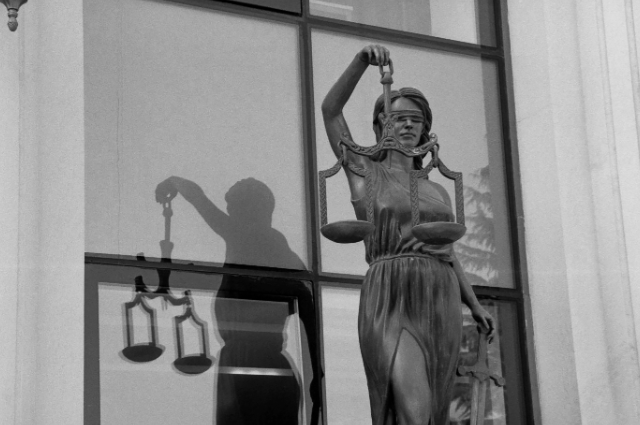
When a decade-old allegation returns to the headlines, the courtroom must separate public opinion from legal proof. The Tanushree Dutta Nana Patekar controversy reveals why that distinction matters.
In Bollywood, where reputations can be shaped by a single headline, few controversies have raised questions about accountability, evidence and justice as sharply as the dispute between actors Nana Patekar and Tanushree Dutta. What began with an allegation concerning a film shoot in 2008 resurfaced nationally during India's #MeToo movement in 2018. Yet, beyond the headlines and competing claims, an important question remains: what did the courts actually decide?
The answer requires separating three things that are often confused: an allegation, a police investigation and a judicial finding.
A Controversy That Refused to Disappear
The dispute dates back to the filming of Horn Ok Pleassss in 2008. Dutta alleged that Patekar behaved inappropriately towards her while a special dance sequence was being filmed. She also described feeling pressured during the production and subsequently facing an intimidating atmosphere when she attempted to leave the set.
The controversy returned to public attention in 2018, when Dutta spoke about the incident during India's expanding #MeToo movement. Her allegations triggered widespread discussion about workplace safety, the unequal distribution of power in the entertainment industry and the difficulties women may face when reporting misconduct years after an incident.
Patekar denied the allegations. The resulting dispute was no longer simply a disagreement between two film personalities; it became part of a larger national conversation about whether the entertainment industry provided adequate protection and meaningful avenues for complaints.
In October 2018, Mumbai Police registered a case against Patekar and others in connection with Dutta's allegations. The legal process that followed would eventually become as significant to the controversy as the original claims.
What the Police Investigation Found
In June 2019, Mumbai Police submitted a closure report, commonly described as a B-summary report, recommending that the case be closed. Investigators said they had not found sufficient evidence to substantiate the allegations against the accused.
According to contemporaneous reporting, the police examined witnesses, but their statements did not establish the alleged inappropriate conduct by Patekar. Dutta and her lawyer challenged the investigation, arguing that it was incomplete and that relevant witnesses had not been adequately examined.
This disagreement is crucial to understanding the case. A police closure report represents the investigating agency's assessment of the available evidence. It is not automatically equivalent to a final judicial determination that every allegation was false.
The complainant can challenge such a report before the court, which must consider the applicable law and the material placed before it.
The Court's March 2025 Decision
On March 7, 2025, a metropolitan magistrate's court in Andheri, Mumbai, rejected Dutta's challenge to the police closure report and disposed of the proceedings concerning the principal 2008 allegation.
However, the legal reasoning requires careful attention.
The magistrate observed that the alleged incident had occurred in March 2008, whereas the relevant FIR was registered in October 2018. The offences invoked included Sections 354 and 509 of the Indian Penal Code, concerning outraging a woman's modesty and insulting her modesty, respectively.
Under the limitation provisions applicable to the case, the court considered the three years for taking cognisance of the relevant offence. It noted that the complaint had been filed long after that period had expired and that no application seeking condonation of the delay had been submitted.
Consequently, the court held that it could not take cognisance of the alleged 2008 incident after such a prolonged delay under the circumstances before it.
The magistrate also addressed the separate allegation connected with a 2018 incident and found insufficient grounds to proceed against the relevant accused.
These findings provided legal relief to Patekar and the other accused. Nevertheless, an essential distinction must be maintained: the court's limitation ruling did not establish, through a trial on the merits, that the alleged 2008 incident had never occurred.
Indeed, reporting on the order noted that the court did not determine the truth or falsity of that incident because the limitation bar prevented it from proceeding on the allegation.
Why the Difference Matters
Legal language can easily become distorted when it enters public debate. A headline declaring that an accused person has been cleared may be interpreted as proof that an allegation was fabricated. Conversely, a complainant's continued disagreement with a closure report may be presented as proof that the accused committed the alleged act.
Neither conclusion automatically follows.
A criminal court must operate within legal procedures, evidentiary requirements and statutory limitations. A case may end because evidence is insufficient, because prosecution is legally barred, or because a court reaches a conclusion after examining the merits. These are different outcomes, with different implications.
In this instance, the limitation issue was central to the court's treatment of the 2008 allegation. The police had recommended closure for lack of supporting evidence, while the magistrate's order addressed whether the proceedings could legally continue after the substantial delay.
Understanding both developments is necessary to describe the outcome accurately.
Beyond the Headlines
The controversy also exposed a difficult reality about delayed reporting. People may speak publicly about alleged misconduct years after an incident for many reasons, including fear, professional pressure or changing social circumstances. At the same time, legal systems impose procedural limits intended to ensure fairness and reliable adjudication.
Balancing these considerations is not straightforward. The law must protect the rights of complainants while also safeguarding the rights of accused persons. Neither public sympathy nor public hostility can replace a proper legal assessment.
For the film industry, the case remains a reminder of the importance of safe working environments, transparent complaint procedures and responsible responses to allegations. These safeguards matter regardless of a person's professional standing or popularity.
The Final Word
The Tanushree Dutta Nana Patekar controversy demonstrates why court decisions must be read rather than merely repeated.
The police recommended closure after reporting insufficient supporting evidence. In March 2025, the magistrate rejected Dutta's challenge and disposed of the proceedings, with the limitation period playing a decisive role in the treatment of the 2008 allegation. The court did not conduct a trial that conclusively established whether that alleged incident had occurred.
Ultimately, justice is not measured by the volume of public debate but by the accuracy of the legal process and the fairness with which its conclusions are understood. In a controversy shaped by celebrity, reputation and competing narratives, recognising what a court decided and what it did not decide is essential to an informed public discussion.
References:
- The indian express
- Hindustan Times
- India Today.