
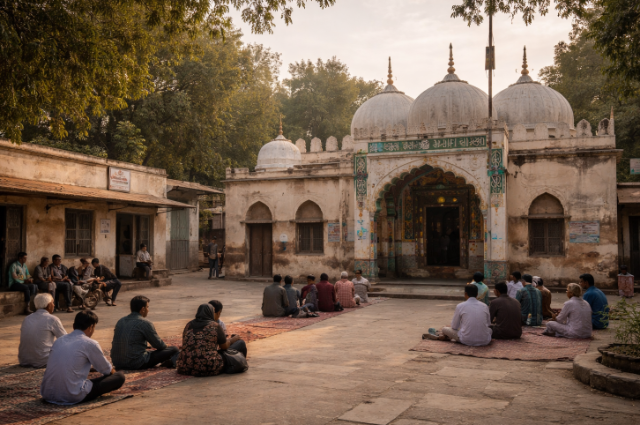
At the edge of Unava village in Gujarat’s Mehsana district, there is a courtyard where questions line up barefoot. They arrive before dawn, clutching fear in one hand and faith in the other. Some speak to walls, some to shadows, some to an invisible authority only they can hear. Their families call it possession. Medicine calls it schizophrenia, bipolar disorder, or hysteria. The place itself refuses to choose a side.
Mira Datar Dargah does not look like a hospital. It smells of incense, not antiseptic. It echoes with prayers, not diagnostic codes. And yet, quietly, stubbornly, it has become one of the most effective mental health intervention sites in rural India.
This shrine is dedicated to Hazrat Saiyed Ali Mira Datar, a martyr believed to have dominion over spirits. Across the country, it is known half in reverence, half in desperation as the “Supreme Court” for jinn possession. Thousands come seeking verdicts on their suffering. They do not come for therapy. They come for liberation.
What they receive, unexpectedly, is both.
The Problem With Telling People They Are Wrong
Mental health policy has long suffered from an arrogance problem. It assumes that truth, once spoken, will automatically be accepted. In rural India, this assumption collapses quickly. A psychiatrist may explain neurotransmitters, chemical imbalances, and treatment protocols, but the listener hears something else entirely: You are mad. Your gods are irrelevant. Your suffering is imaginary.
So they do not come.
Instead, they go where their language is spoken, places like Mira Datar, fluently. Faith healers, or Mujavirs, do not argue with belief. They inhabit it. They name the fear, dramatise it, give it a face. A jinn is terrifying, yes, but at least it is comprehensible. At least it belongs to the moral universe of the family.
For decades, doctors sat in empty clinics while shrines overflowed with untreated mental illness. The two worlds stared at each other across a chasm of mistrust.
Until someone decided not to build a bridge but a door.
The Divine Referral
The innovation was disarmingly simple. A family would bring a patient to the Dargah. The Mujavir would perform the ritual, recite prayers, conduct the exorcism, and acknowledge the presence of a stubborn spirit. And then, instead of dismissing the family or demanding repeated rituals, he would hand them a slip of paper.
“To make the dua work faster,” he would say, “you must take this dava from the clinic next door.”
No confrontation. No correction. No humiliation.
Just a reframing.
The pill was not an antipsychotic. It was a spirit-weakening medicine. The clinic was not a hospital. It was part of the healing ritual. Science did not replace faith; it disguised itself as faith’s ally.
This was not deception. It was a translation.
And it worked.
The Social Worker Who Refused to Choose Sides
The architect of this quiet revolution was not a psychiatrist or a policymaker. He was a social worker named Milesh Hamlai.
Hamlai did not arrive at Mira Datar armed with theories. He arrived with grief. His own brother suffered from schizophrenia, and Hamlai had watched his family be torn between medical logic and social stigma, between pills that promised stability and neighbours who whispered about madness. He understood that the real illness was not just in the mind it was in the space between belief and care.
When he founded the NGO Altruist in Ahmedabad, Hamlai made a radical decision. He would not educate patients first. He would educate healers.
Doctors, he realised, were not the gatekeepers. Mujavirs were.
So he sat with them. He listened. He did not mock their cosmology or challenge their authority. Instead, he reframed the narrative: some spirits, he suggested, were unusually strong. Prayers alone could exhaust a healer. Medicine, then, was not a competition; it was ammunition.
At first, the resistance was fierce. Healers feared losing their livelihood. Doctors feared losing credit. Both feared losing power.
Hamlai offered them something more valuable relevance.
Ego as the Real Disorder
The most difficult negotiation was not about belief. It was about credit.
Who gets praised when a patient recovers?
In a rare act of institutional humility, the doctors agreed to disappear from the story. If a patient improved, they would say, “It is the Dargah’s blessing.” The Mujavir would smile. The family would return home relieved. The pills would continue quietly.
This surrender of recognition became the program’s secret weapon. By letting faith take the bow, science secured the encore.
Psychologically, the model is elegant. It resolves cognitive dissonance by refusing to trigger it. It follows the logic of Lewin’s Change Model not by unfreezing belief systems, but by flowing within them. The Mujavir, as gatekeeper, confers trust. The referral slip, though free, carries symbolic value. The patient complies not out of fear of illness, but out of devotion.
Healing, in this space, is culturally validated.
When Culture Stops Being the Problem
Since 2008, more than 38,000 patients have been treated through this collaboration. The numbers matter, but the economics matter more. Families who once spent months in Unava paying for rituals, lodging, and repeated ceremonies now recover faster. Debt is avoided. Life's resume.
The Supreme Court of India has cited the project as a model for other states. International journals study it. Television documentaries marvel at it. But its deepest success remains largely invisible: it restores dignity.
Patients are not told they are irrational. Families are not told they are ignorant. Faith is not told to step aside.
Instead, everyone is invited into a shared illusion, one that heals.
The Philosophy of the Blessed Pill
There is an uncomfortable question hiding beneath this success: Is it ethical to let people believe a pill weakens spirits?
Perhaps the better question is: Is it ethical to let them suffer because we insist on being right?
Truth, in healthcare, is not only about accuracy. It is about accessibility. A treatment that cannot be accepted is not a treatment; it is an argument.
At Mira Datar, culture does not block the cure. Culture becomes the cure.
The shrine teaches us something modern systems often forget: people do not live in textbooks. They live in stories. If healing cannot enter those stories, it will remain locked outside, no matter how advanced it is.
In this sacred sanctuary, science learned to kneel not in surrender, but in respect. And in doing so, it stood taller than it ever had before.
Between prayer and prescription, a third space emerged. Not a compromise, but a collaboration. Not superstition versus science, but suffering versus hope.