
A well does not usually make headlines. In Gujarat’s Morbi district, however, an unusual well has drawn attention for a reason that sounds almost paradoxical: its water level appears to invite comparisons with the movement of the sea.
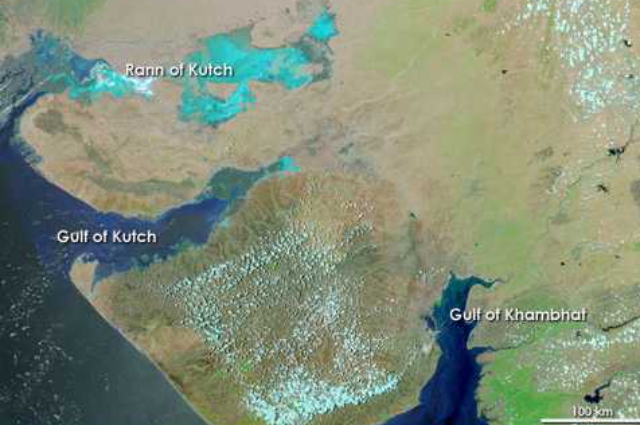
The phenomenon has fuelled a local theory that the well may be responding to tidal activity. While such a connection requires scientific verification before it can be established as fact, Morbi’s geographical setting provides an important reason why the theory has attracted interest. The district lies within the wider influence of the Gulf of Kutch, where the Arabian Sea pushes deep into the land and produces pronounced tidal variations.
The key question is not whether seawater is literally flowing into the well with every tide. Rather, scientists would need to determine whether changes in the water table inside the well correspond with tidal cycles through underground geological pathways.
Geography puts the theory on the map
Morbi is located in the Saurashtra region of Gujarat, relatively close to the Gulf of Kutch. The gulf is a long, narrow marine inlet connected to the Arabian Sea, and its shape can amplify tidal movements in certain areas.
That geography matters because groundwater does not always behave like an isolated underground pool. Aquifers can be connected through layers of porous rock, fractured formations and sediments. Where groundwater systems occur relatively close to coastal waters, fluctuations in sea level can sometimes influence underground hydraulic pressure.
This does not automatically mean that a coastal well contains seawater. The relationship can be indirect. A rise or fall in external water pressure may transmit through underground formations and produce measurable changes in a groundwater source.
That possibility is what gives the Morbi well’s behaviour a potentially interesting scientific dimension.
What exactly is the “tidal theory”?
Tides are primarily caused by the gravitational influence of the Moon and, to a lesser extent, the Sun. Along coastlines, their effects are visible as the regular rise and fall of seawater.
Underground, the picture is more complicated.
If an aquifer is hydraulically connected to a coastal environment, changes in tidal pressure can theoretically produce small fluctuations in groundwater levels. Such responses are more likely where geological conditions allow pressure to travel efficiently through connected formations.
For the Morbi well, therefore, the tidal theory would mean that its water level is responding, directly or indirectly, to periodic changes associated with coastal tides.
But an apparent correlation is not proof. Rainfall, groundwater extraction, irrigation, soil characteristics, seasonal changes and local geology can all influence the level of a well.
Why Morbi makes the theory intriguing
Morbi’s coastal proximity provides the first piece of the puzzle, but geology would provide the stronger evidence.
The distance between a well and the sea alone cannot establish a tidal connection. Two wells located at similar distances from the coast could behave very differently because they sit above different geological structures.
The underground composition of the region, including layers of clay, sand, fractured rock and other formations, determines how easily water and pressure can move. A relatively impermeable layer could isolate groundwater, while a permeable or fractured formation could create pathways for hydraulic communication.
This is why the well needs to be studied as part of its geological setting rather than as an isolated curiosity.
Science can settle the mystery
Testing the tidal theory would not require speculation. Researchers could install a water-level logger in the well and record fluctuations continuously over several weeks or months. The data could then be compared with officially recorded tidal cycles along the nearby Gulf of Kutch.
If the well repeatedly shows fluctuations matching tidal periodicity, the relationship would become more scientifically compelling.
Researchers would also need to examine rainfall records, pumping activity and other possible causes. Measurements of groundwater chemistry and salinity could provide additional clues about whether marine influence exists.
A consistent time relationship between tides and groundwater levels would be particularly significant if it continued even when rainfall and local water use remained relatively stable.
A mystery worth measuring
The Morbi well illustrates how an ordinary-looking groundwater source can raise an unusual scientific question. Its proximity to the Gulf of Kutch makes a tidal influence plausible enough to investigate, but plausibility is not confirmation.
The distinction matters. Stories about mysterious wells can quickly become folklore, while scientific observations require measurements that can be repeated and independently examined.
For now, the tidal theory remains a hypothesis awaiting evidence. Yet that uncertainty is precisely what makes the phenomenon interesting. Beneath Morbi’s surface lies a hidden network of water-bearing formations whose behaviour may reflect conditions far beyond the well itself.
If future monitoring demonstrates a reliable relationship between the well and the tides of the Gulf of Kutch, the finding could offer a fascinating example of how coastal forces can influence groundwater far from the visible shoreline.
Until then, the well remains less a proven natural wonder than a question waiting for the right instruments and the right data to answer it.
References:
- Times of India
- Gujarat samachar
- Sandesh