
A Morning That Shook the World
On the early morning of December 7, 1941, a wave of Japanese aircraft descended upon Pearl Harbor, the main base of the United States Pacific Fleet in Oahu, Hawaii, launching one of the most devastating and unexpected attacks in military history. Within a matter of hours, battleships were ablaze, aircraft were destroyed on the ground, and thousands of American servicemen and civilians lost their lives. The attack, designed to cripple the U.S. Navy and secure Japan’s domination over Southeast Asia, instead became a defining moment in world history—a day President Franklin D. Roosevelt famously called “a date which will live in infamy.”
Pearl Harbour is more than a historical event; it is a turning point that reshaped global power dynamics. By destroying a significant portion of America’s naval strength, the Japanese sought to delay U.S. intervention in the Pacific, giving themselves free rein to expand their empire. Yet, the very audacity of the strike galvanised the American public, ending years of isolationist sentiment and propelling the United States fully into World War II. The consequences were immediate and far-reaching: the U.S. declared war on Japan the next day, Germany and Italy joined the conflict, and the global balance of power began to shift irrevocably.
This article delves into the intricate layers of that fateful morning, exploring the historical context of U.S.–Japan relations, the meticulous Japanese planning, the failures of intelligence and preparation on the American side, and the staggering human and material toll. Beyond the attack itself, it examines the political, military, and societal consequences that followed, the investigations and controversies surrounding responsibility, and the enduring legacy of Pearl Harbour in both American memory and global history. By tracing these threads, we can understand not only the tactical and strategic dimensions of the attack but also its profound impact on the course of the twentieth century.
Origins of Conflict: U.S.–Japan Relations Before 1941
The roots of the Pearl Harbour attack lie deep in the complex and often tense relationship between the United States and Japan during the first half of the twentieth century. Japan’s ambitions for regional dominance in East Asia increasingly collided with American economic and political interests, setting the stage for conflict. Japan’s aggressive expansion began in 1931 with the invasion of Manchuria, where Tokyo established the puppet state of Manchukuo to secure vital resources and strategic influence. This bold move directly challenged the principle of territorial sovereignty upheld by the League of Nations and drew sharp condemnation from the United States, which was increasingly invested in maintaining stability in the Asia-Pacific region.
By the mid-1930s, Japan’s ambitions had extended into full-scale warfare with China. The 1937 Marco Polo Bridge incident marked the beginning of the Second Sino-Japanese War, a brutal conflict that drew international attention. The United States responded cautiously at first, providing humanitarian aid and limited financial support to the Chinese Nationalists under Chiang Kai-shek. By 1938, the U.S. extended its first formal loans to China to bolster its resistance against Japanese advances. While these measures fell short of direct military intervention, they sent a clear signal to Tokyo that American support for China would continue. Japan perceived this as a direct threat to its imperial objectives, heightening animosity toward the United States.
In response to Japan’s continued aggression, the United States took increasingly forceful economic measures. Beginning in 1940, Washington began restricting exports of critical materials, including oil, scrap iron, and steel, essential to Japan’s war industry. By July 1941, following Japan’s occupation of French Indochina and its alignment with Germany and Italy under the Tripartite Pact, the U.S. froze Japanese assets, severed commercial relations, and imposed a full embargo on oil shipments. For Japan, a nation heavily dependent on imported oil for its military and industrial operations, this action was perceived as a strategic blockade, threatening the very survival of its expansionist agenda.
While economic pressure mounted, Japanese politics shifted dramatically. Militarists gained increasing influence within the government, sidelining moderates who favored diplomacy. Leaders such as Prime Minister Hideki Tōjō advocated for decisive action to secure Japan’s dominance in the Pacific, viewing U.S. sanctions and support for China as intolerable provocations. Within this climate, Admiral Isoroku Yamamoto, commander in chief of Japan’s Combined Fleet, warned that any conflict with the United States would be costly and prolonged, given American industrial capacity and military potential. Yet, despite his caution, he reluctantly supported a preemptive strike as a strategic necessity to neutralise the Pacific Fleet and allow Japan free rein to expand in Southeast Asia.
Diplomatic efforts continued even as tensions reached a breaking point. Negotiations between Tokyo and Washington persisted through the autumn of 1941, but the gap between Japanese demands and American expectations proved insurmountable. Japan insisted on recognition of its territorial acquisitions and a halt to American aid to China, while the United States demanded Japanese withdrawal from China and Indochina. By late November, it became apparent that no agreement could reconcile these positions, leaving Japan with the stark choice of either abandoning its expansionist ambitions or resorting to military action.
In retrospect, the clash that erupted at Pearl Harbor was not an isolated incident but the culmination of a decade-long deterioration in U.S.–Japan relations. Strategic competition over China, economic confrontation through embargoes and sanctions, and the ideological ascendancy of militarists in Tokyo all contributed to an environment in which war became increasingly likely. Despite the warnings of figures like Admiral Yamamoto, the Japanese leadership concluded that a decisive strike against American naval power was the only viable path to secure their imperial objectives. This convergence of political ambition, economic pressure, and strategic calculation set the stage for the surprise attack that would forever alter the course of history.
Planning the Strike: Japan’s Strategic Calculus
By the fall of 1941, Japanese leaders had concluded that their ambitious expansion into Southeast Asia and the Pacific could not succeed without neutralising the United States’ Pacific Fleet. Central to this decision was Admiral Isoroku Yamamoto, commander in chief of Japan’s Combined Fleet, a seasoned strategist who understood both the capabilities and industrial might of the United States. Yamamoto recognised that Japan could not engage in a prolonged war with America, whose resources and production capacity far exceeded Japan’s. He therefore proposed a bold plan: a surprise aerial strike on the U.S. naval base at Pearl Harbour, aimed at crippling the Pacific Fleet in a single, decisive blow. The strategy was designed not to destroy America’s ability to fight indefinitely but to buy time for Japan to secure vital resources in Southeast Asia—particularly oil, rubber, and tin—without immediate interference from the United States.
The plan required meticulous preparation and innovation. Japan had limited experience with long-range carrier-based operations on this scale, and executing a strike thousands of miles from home demanded intensive training. Pilots practiced torpedo drops in shallow waters to simulate conditions at Pearl Harbour, perfected dive-bombing techniques, and coordinated fighter escort formations. This preparation reflected a radical shift in naval warfare strategy, emphasizing the aircraft carrier over the traditional battleship as the central instrument of naval power—a concept Yamamoto had long championed.
By November 1941, the Japanese strike force was assembled with precision. It included six aircraft carriers—the core of the fleet—accompanied by two battleships, three cruisers, eleven destroyers, and supporting submarines. The carriers alone carried approximately 360 aircraft, including dive bombers, torpedo planes, and fighters, all meticulously loaded and armed for the mission. Commanders were instructed to maintain strict secrecy during the fleet’s approach to Hawaii, traveling more than 4,000 miles to reach a launch point roughly 275 miles north of Oahu. Timing was critical: the attack was planned for early Sunday morning, when U.S. personnel would be least prepared, maximising the potential for surprise and minimising initial resistance.
Despite the confidence surrounding the operation, Japanese leaders fully acknowledged the risks. Intelligence about American fleet dispositions was incomplete, and even a partial failure could provoke a prolonged U.S. counteroffensive. Moreover, Yamamoto and other senior commanders were aware that their own forces would be far from home and vulnerable to logistical challenges, including fuel shortages and potential interception by American reconnaissance. The attack was essentially a high-stakes gamble: success could secure Japan’s expansion and weaken U.S. intervention, but failure could accelerate America’s full entry into the war.
Japan’s leadership also left room for diplomacy to intervene. Official orders allowed for the cancellation of the strike if last-minute negotiations with Washington yielded a satisfactory resolution. In practice, however, by mid-November 1941 it had become increasingly clear that diplomacy would fail. U.S. demands for Japanese withdrawal from China and Indochina were incompatible with Tokyo’s strategic objectives, and any concession would have undermined the militarists’ hold on the government. Consequently, the fleet set sail on November 26, fully committed to the attack.
In hindsight, the planning and execution of Pearl Harbour reflect both the ingenuity and audacity of Japanese strategy. The operation combined advanced naval tactics, unprecedented long-range coordination, and careful timing to maximise its chances of success. Yet it also demonstrated the inherent uncertainty of warfare: despite the meticulous preparation, Japanese commanders knew that the operation was a gamble with far-reaching consequences. This calculated risk would soon become one of the most significant turning points of the twentieth century, fundamentally altering the trajectory of World War II and reshaping the global balance of power.
The Hours Before Impact: Warnings, Signals, and Missed Clues
The surprise and devastation of December 7, 1941, was not solely a result of Japanese cunning; it was also amplified by critical failures in American intelligence, communication, and defensive preparation. In the months leading up to the attack, Washington repeatedly warned commanders in Hawaii of the possibility of hostilities. Yet these warnings were either misunderstood, dismissed, or delayed, leaving the Pacific Fleet vulnerable to the very strike it was meant to deter.
Admiral Husband E. Kimmel, commander of the Pacific Fleet, and Lieutenant General Walter C. Short, commanding the Army forces in Hawaii, had adopted defensive measures primarily aimed at sabotage rather than a direct military assault. Aircraft were stationed close together on airfields, anti-aircraft defences were limited, and the fleet itself remained concentrated along Battleship Row—ideal targets for an air raid. Although both officers received “war warnings” from Washington in October and November 1941, they interpreted these messages as general alerts rather than indications of an imminent large-scale attack.
Several specific incidents in the hours before the assault illustrate the lapses in American preparedness. On the morning of December 7, radar operators at Opana Point detected a large incoming formation of aircraft. However, their reports were dismissed by officers who assumed they were observing a flight of American B-17 bombers arriving from the mainland—a tragic misidentification that prevented timely defensive action. Earlier that morning, the minesweeper USS Condor sighted a Japanese midget submarine near Pearl Harbor, and the destroyer USS Ward reported engaging and sinking another. Kimmel, awaiting confirmation and constrained by incomplete intelligence, took no significant steps to ready the fleet for immediate attack.
Communication delays from Washington further compounded the problem. Final diplomatic dispatches, signaling that Japan had effectively broken off negotiations and that war was imminent, were only decoded and relayed to Hawaii after the Japanese planes had already begun their assault. Even when these warnings reached American commanders, they lacked the specificity and urgency necessary to prompt full defensive mobilisation.
Underlying these operational failures was a fundamental underestimation of Japanese capability. U.S. military planners assumed that a strike against Hawaii would be strategically illogical for Japan, believing Tokyo would not risk provoking the United States into full-scale war. This misjudgment led to complacency and inadequate coordination between the Army and Navy intelligence services, leaving critical vulnerabilities unaddressed. The lack of integrated command and failure to interpret available intelligence in context meant that, despite numerous clues, Pearl Harbour remained a sitting target.
In hindsight, the hours preceding the attack reveal a chain of missed opportunities that magnified the Japanese strike’s effectiveness. The combination of overconfidence, miscommunication, and fragmented intelligence created an environment in which warnings existed but were insufficiently acted upon. Kimmel and Short were later criticized for these failures, yet the broader responsibility also rested with Washington, where intelligence interpretation, dissemination, and inter-service coordination were fragmented and often ineffective.
Ultimately, the Japanese exploit of these lapses demonstrated both the value and limitations of preemptive strategy. While Tokyo meticulously planned its attack for maximum surprise, its success was amplified by the inability of the United States to recognise and respond to the warning signs. The tragic events of December 7 would later serve as a lesson in the critical importance of timely intelligence, clear communication, and joint coordination in modern warfare—a lesson that reshaped U.S. military doctrine in the decades to follow.
The Attack: Minute-by-Minute Reconstruction of December 7, 1941
The morning of December 7, 1941, began like any other Sunday at Pearl Harbour, with sailors on leave, aircraft lined up on the airfields, and battleships moored in neat formation along Battleship Row. Yet, beneath the calm, the Japanese strike force was already approaching from the north, carrying out one of the most meticulously planned naval operations in history. At 7:55 a.m., the first wave of Japanese aircraft—comprising nearly 200 planes including dive bombers, torpedo bombers, and high-altitude bombers—descended upon the unsuspecting U.S. Pacific Fleet. Within minutes, the serene harbour transformed into a scene of chaos and destruction.
The initial targets were the airfields, including Hickam, Wheeler, and Ford Island. Dozens of American aircraft were parked wingtip to wingtip, a defensive measure intended to prevent sabotage. The Japanese dive bombers and strafing fighters quickly destroyed these planes, leaving little chance for them to take off. At Wheeler Field alone, 126 planes were on the ground; 42 were destroyed, 41 damaged, and only 43 remained serviceable. The loss of air support crippled any immediate defensive response, allowing the strike to focus on the ships in the harbour.
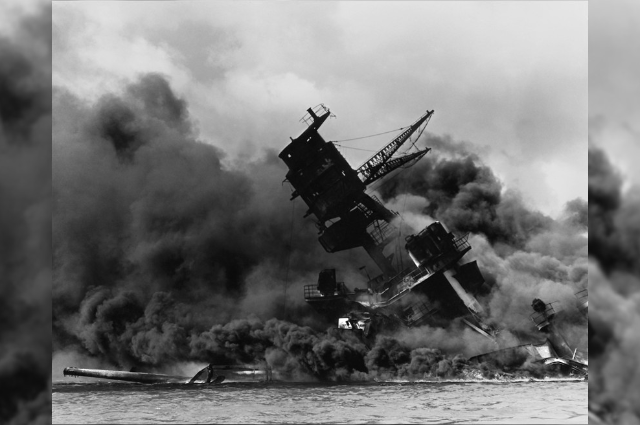
Battleship Row, the symbolic and strategic heart of the Pacific Fleet, became the primary target. At 8:10 a.m., a single 1,760-pound bomb penetrated the forward magazine of the USS Arizona, causing a catastrophic explosion that tore the ship apart and killed over 1,100 men in an instant. Simultaneously, USS Oklahoma was struck by four torpedoes in rapid succession, rolling over completely and trapping hundreds of sailors inside. Other battleships, including USS California and USS West Virginia, were torpedoed and began to settle beneath the harbour waters, while USS Nevada, despite sustaining a torpedo hit, attempted to get underway to clear the channel but was forced aground after additional bombing. USS Tennessee, USS Maryland, and USS Pennsylvania also suffered significant bomb damage, though some remained afloat. Across the harbour, destroyers and cruisers faced similar devastation, while anti-aircraft crews fired furiously, often from inadequate positions, in a desperate attempt to repel the attackers.
Amid the devastation, acts of extraordinary bravery emerged. Sailors and airmen rushed to fires, manned anti-aircraft guns, and attempted to save their ships, often at great personal risk. Small boats ferried wounded from burning ships, and medics worked tirelessly under strafing fire to aid the injured. Though many lives were lost, these acts of courage prevented even greater destruction and offered a human testament to resilience in the face of overwhelming odds.
Around 8:50 a.m., the second wave of Japanese aircraft struck. While smaller than the first and less coordinated, the second wave continued the bombardment of the airfields and remaining ships. USS Nevada, still trying to escape, was heavily targeted and grounded to prevent obstructing the channel. USS Pennsylvania was set ablaze, and destroyers moored nearby were reduced to wrecks. Even as the second wave inflicted heavy damage, Japanese losses were minimal, and their forces withdrew at approximately 9:00 a.m., having achieved a near-total element of surprise.
The human toll was staggering. In less than two hours, more than 2,400 Americans were killed, including civilians, with over 1,100 men aboard the USS Arizona alone. Thousands more were wounded, and the destruction of nearly 20 warships and 300 aircraft represented a crippling blow to the Pacific Fleet. Japanese losses were comparatively light: between 29 and 60 aircraft were destroyed, five midget submarines were lost, and fewer than 130 personnel were killed. Crucially, however, all three American aircraft carriers—the USS Enterprise, USS Lexington, and USS Saratoga—were at sea and thus escaped destruction, preserving the core of the U.S. Navy’s offensive capability.
The attack on Pearl Harbor was not only a tactical surprise but also a psychological shock. Sailors were trapped under burning decks, families mourned sudden losses, and entire units were incapacitated in the first moments of the assault. Yet, despite the devastation, the response of American personnel demonstrated both courage and quick thinking. Firefighting crews battled blazes aboard ships, medical teams triaged the wounded, and surviving sailors manned guns to defend remaining vessels. These actions, combined with the survival of the aircraft carriers, would later prove vital in America’s counteroffensive in the Pacific.
The attack ended as abruptly as it began. By mid-morning, the skies over Pearl Harbour were quiet, leaving behind smoldering ships, sunken hulls, and a stunned population. The meticulously planned Japanese assault had achieved immediate tactical success, but strategically it failed to destroy the American fleet entirely or break U.S. resolve. Within hours, news of the attack had spread across the nation, transforming public opinion and setting the stage for America’s entry into World War II.
Pearl Harbor remains etched in history not only for its destruction but for the stories of heroism, improvisation, and resilience displayed in those fateful hours. The attack exemplified the deadly effectiveness of surprise and technological coordination while highlighting the human cost of unpreparedness and underestimation. It was a morning that shook the world, a moment when strategy, courage, and tragedy converged in a way that would forever alter the course of history.
Aftermath of Destruction: Losses, Survival, and Strategic Outcomes
The immediate aftermath of the Pearl Harbour attack revealed the full scale of the tragedy. More than 2,400 Americans lost their lives, including sailors, soldiers, and civilians, while 1,178 others were wounded. The death toll was compounded by the catastrophic destruction of key naval assets. Battleships USS Arizona and USS Oklahoma were completely lost, while USS California, USS West Virginia, USS Nevada, USS Tennessee, USS Maryland, and USS Pennsylvania sustained severe damage, with many sinking or grounding in the harbour. Nearly 300 aircraft stationed on airfields were destroyed or disabled, leaving the U.S. Pacific Fleet initially without critical air support.
Despite the enormous losses, a few strategic factors mitigated the long-term impact of the assault. Notably, all three U.S. aircraft carriers—the USS Enterprise, USS Lexington, and USS Saratoga—were absent from Pearl Harbour at the time, conducting missions in the Pacific. Their survival preserved the United States’ capacity to project naval air power, which would prove decisive in battles such as Midway and throughout the Pacific campaign. Additionally, vital infrastructure remained intact. Japanese forces failed to destroy the island’s oil storage facilities, repair yards, or submarine base, ensuring that the fleet could be rebuilt and resupplied. This oversight would prove critical in allowing the U.S. Navy to recover more quickly than the Japanese anticipated.
American forces, though initially stunned, began organizing a response almost immediately. Survivors rescued the wounded, fought fires aboard burning ships, and attempted to salvage damaged vessels. Anti-aircraft units, though unable to prevent the initial devastation, maintained defensive positions and continued firing during the Japanese withdrawal. The human resilience demonstrated in these chaotic hours laid the groundwork for an organised recovery and eventual counteroffensive.
Strategically, the attack achieved its short-term objective of crippling battleship strength and inflicting psychological shock. However, it failed to deliver a decisive blow to the U.S. Navy as a whole, leaving carriers, repair facilities, and fuel reserves untouched. This allowed the United States to maintain both a naval presence and the industrial capacity to rebuild rapidly. Within days, American forces had regrouped, assessed losses, and begun planning retaliatory measures, signaling that while Pearl Harbour was a tactical victory for Japan, it ultimately galvanised U.S. resolve.
The aftermath of December 7, therefore, represents a dual narrative: one of unprecedented destruction and loss, and another of survival and latent strategic advantage. While the attack devastated personnel and equipment, the endurance of critical assets and the resilience of U.S. forces ensured that the assault, though shocking, did not determine the outcome of the Pacific War. Instead, it marked the beginning of America’s full-scale mobilisation, transforming a nation initially caught off guard into a global military power ready to challenge Japan and its allies.
America Responds: National Shock and Roosevelt’s Leadership
The attack on Pearl Harbor sent shockwaves through the United States, sparking a profound sense of outrage, grief, and determination. For many Americans, the sudden and devastating strike shattered the illusion of security and ended years of debate over isolationism and neutrality. Across the nation, citizens reacted with a mix of disbelief and resolve, unified by the recognition that the country had been directly attacked and that inaction was no longer an option.
President Franklin D. Roosevelt addressed the nation on the evening of December 8, delivering a speech that would become iconic. He declared December 7, 1941, “a date which will live in infamy,” capturing the gravity of the assault and framing it as a deliberate act of aggression by a foreign power. In carefully measured but resolute language, Roosevelt called upon Congress to declare war on Japan, emphasising the necessity of responding to protect national security, honour the fallen, and uphold global principles of justice and freedom. His words galvanised public sentiment, transforming anger and fear into collective purpose.
Congress responded swiftly, voting almost unanimously to declare war on Japan. Only one representative, Jeannette Rankin of Montana, voted against the resolution, consistent with her pacifist stance. Within hours, the United States had formally entered World War II, signaling a dramatic shift in American foreign policy and marking the end of two decades of a largely isolationist posture. The Pearl Harbor attack had unified public opinion in support of a full-scale war effort, eliminating lingering debates over neutrality.
The consequences of this decision were immediate and far-reaching. Germany and Italy, Japan’s Axis partners, declared war on the United States in response, further drawing America into the global conflict. Mobilisation began almost instantly: factories were repurposed to produce war materiel, shipyards accelerated construction of naval vessels, and millions of men and women joined the armed forces. Industrial workers, including previously marginalised groups, were recruited into the labour force, contributing to the massive production surge that would underpin Allied victory in the coming years.
Roosevelt’s leadership during this period demonstrated the power of decisive communication and moral clarity. By framing Pearl Harbour as both a national tragedy and a call to action, he unified a nation and set in motion the machinery of total war. The attack not only transformed military strategy but also reshaped American society, economy, and international engagement, heralding an era in which the United States would emerge as a central actor on the world stage. In the days and weeks following December 7, the country mobilised its people, resources, and resolve, turning shock and grief into an unparalleled national effort that would define the nation’s role in World War II.
Investigations, Responsibility, and Historical Debate
The shock and devastation of Pearl Harbour immediately prompted inquiries into how such a surprise attack could occur. The first official investigation, known as the Roberts Commission, was appointed by President Franklin D. Roosevelt on December 17, 1941, just ten days after the attack. Headed by U.S. Supreme Court Justice Owen J. Roberts, the commission sought to determine accountability for the disaster. Its findings were clear and immediate: primary responsibility rested with Admiral Husband E. Kimmel, commander of the Pacific Fleet, and Lieutenant General Walter C. Short, commander of U.S. Army forces in Hawaii. Both were relieved of duty, and their careers effectively ended. The commission criticised their perceived failures in preparation, deployment, and readiness, particularly the decision to keep aircraft tightly packed on the airfields and ships clustered in the harbour.
Subsequent military reviews, however, produced differing conclusions. Naval and army boards convened to reassess the Roberts Commission findings often shifted partial responsibility toward Washington, emphasising systemic failures rather than individual negligence. The reports highlighted issues such as fragmented intelligence channels, delayed transmission of critical warnings, and insufficient inter-service coordination. These analyses underscored the complexity of the failure, suggesting that Kimmel and Short had acted within the limitations imposed by incomplete information and unclear directives from higher command.
A more extensive congressional investigation in 1946 further explored the events leading to December 7. This inquiry examined the roles of the War and Navy Departments, intelligence agencies, and the mechanisms for sharing information between Washington and field commands. Findings emphasized miscommunication, bureaucratic inefficiency, and the underestimation of Japanese capabilities. The investigation concluded that Pearl Harbour was less the result of deliberate negligence than of a systemic inability to process and act on the intelligence available.
Parallel to these official investigations, alternative theories arose. One of the most debated was the so-called “Back Door to War” theory, popularised by Rear Admiral Robert Theobald in his 1954 book The Final Secret of Pearl Harbour. Theobald argued that President Roosevelt intentionally provoked Japan into attacking, holding the Pacific Fleet in Hawaii as a strategic lure to justify U.S. entry into the war. While this theory generated public interest and controversy, historians have largely rejected it, citing extensive declassified documents showing Roosevelt’s repeated efforts to delay conflict and pursue diplomacy.
Today, scholars generally interpret Pearl Harbour as a case of systemic failure rather than a deliberate conspiracy. The attack succeeded due to a combination of Japanese strategic planning, misjudgment of enemy capabilities, intelligence shortcomings, and the fragmented coordination between military branches. While Kimmel and Short were initially scapegoated, modern analysis recognises the broader context: the U.S. military and government were unprepared to interpret or respond effectively to the rapidly evolving threat in the Pacific. This understanding reframes the tragedy not as a product of personal culpability alone but as a cautionary lesson in communication, preparedness, and strategic foresight.
Pearl Harbour continues to provoke debate, but consensus has shifted toward a nuanced appreciation of the interplay between human error, bureaucratic limitations, and the unprecedented audacity of the Japanese attack—a reminder that history often resists simple explanations.
Long-Term Impact: Pearl Harbour’s Role in Shaping World War II and Beyond
The attack on Pearl Harbour not only thrust the United States into World War II but also catalysed profound transformations in military strategy, industrial capacity, and global politics. One immediate effect was a reevaluation of naval doctrine. Battleships, long considered the core of maritime power, proved vulnerable to air assault, while aircraft carriers emerged as the decisive instruments of modern naval warfare. The lessons learned at Pearl Harbour directly influenced the U.S. Navy’s strategic emphasis on carrier task forces, culminating in pivotal victories at Midway and the series of “island-hopping” campaigns across the Pacific. These operations allowed the United States to gradually seize strategic positions, neutralise Japanese strongholds, and gain dominance in the Pacific theatre.
Equally transformative was the unprecedented scale of American industrial mobilisation. In the wake of the attack, the nation rapidly converted peacetime factories into war production centres, producing ships, aircraft, tanks, and munitions at a record pace. This surge in industrial output proved decisive for the Allied war effort, allowing the United States to sustain multiple theatres of operation simultaneously and supply its allies with critical resources. The Pearl Harbour attack thus became a catalyst for an economic and military expansion that reshaped the nation’s capabilities and confidence.
The strategic and political consequences of Pearl Harbour extended far beyond the immediate theatre of war. The United States assumed a central role in global affairs, transitioning from a largely isolationist power to a decisive leader in the Allied coalition. Postwar, this shift laid the groundwork for American political, economic, and military influence in shaping international institutions, security alliances, and postwar reconstruction. The attack also spurred advancements in intelligence and early-warning systems. Recognising the catastrophic cost of misjudged threats, the U.S. military invested heavily in code-breaking, radar, reconnaissance, and integrated intelligence networks, innovations that continue to underpin modern defence systems.
Pearl Harbour’s impact resonates in both military and cultural memory. The surprise attack demonstrated the importance of readiness, coordination, and technological adaptation, influencing military doctrines worldwide. It also reinforced the connection between civilian industrial strength and military capability, shaping the concept of total war. Beyond strategy, Pearl Harbor symbolized national resilience, commemorated annually as a reminder of sacrifice and vigilance.
In sum, Pearl Harbor was more than a single military strike—it was a turning point that reshaped warfare, accelerated U.S. industrial and military power, and altered the trajectory of global politics. The lessons learned from that morning continue to inform strategy, intelligence, and national security priorities, ensuring that the reverberations of December 7, 1941, extend well into the present day.
Legacy and Memory: How Pearl Harbour Lives On
More than eight decades after the attack, Pearl Harbour continues to resonate as a defining moment in American history. The USS Arizona Memorial, built over the sunken battleship in 1962, serves as a solemn reminder of the lives lost and the sacrifice of those who perished that day. Each year on December 7, memorial ceremonies draw veterans, families, and the public to honour the fallen, reflecting a national commitment to remembering the tragedy and its lessons. These commemorations reinforce the human cost of war while highlighting stories of courage, resilience, and solidarity amid devastation.
Veterans’ oral histories provide a powerful connection to the past. Accounts from sailors, airmen, and civilians convey the chaos, bravery, and heartbreak experienced on that morning, preserving personal perspectives often absent from official reports. These testimonies inform scholarly research, educational programs, and museum exhibits, ensuring that the human dimension of Pearl Harbor remains central to its memory. By sharing these experiences, generations of Americans and people worldwide gain insight into the realities of wartime service and the stakes of national defense.
Pearl Harbor has also become a cultural touchstone. It is taught extensively in schools as a pivotal event in World War II, illustrating both the consequences of strategic misjudgment and the importance of national preparedness. Films, documentaries, literature, and even diplomatic narratives have portrayed the attack as a moment of profound loss that catalysed American resolve and reshaped global history. Through these depictions, Pearl Harbor serves as both a cautionary tale and a story of resilience, embedding itself in collective memory and public consciousness.
The enduring significance of Pearl Harbour lies not only in its historical impact but in its symbolic resonance. It embodies national unity in the face of adversity, the courage of those who served, and the consequences of global conflict. Memorials, stories, and commemorations ensure that the lessons of December 7, 1941, are not forgotten, reminding current and future generations of the cost of unpreparedness and the enduring value of vigilance, sacrifice, and resilience. In this way, Pearl Harbour lives on—not just as a historical event, but as a cornerstone of cultural memory and national identity.
Lessons From a Day of Infamy
The attack on Pearl Harbour stands as one of the most consequential turning points in twentieth-century history. In a single morning, the United States was thrust from relative isolation into a global conflict, forever altering the trajectory of World War II and reshaping international relations. The devastation underscored the lethal combination of meticulous planning, strategic audacity, and the vulnerability of even the most advanced military forces when warnings are misinterpreted or ignored.
Beyond its immediate military and political impact, Pearl Harbor offers enduring lessons about vigilance, intelligence coordination, and the limits of diplomacy. The failures in communication and preparedness reveal how fragmented information and underestimation of adversaries can magnify disaster, while the survival of key assets and the nation’s rapid mobilisation demonstrate the power of resilience and strategic foresight.
December 7, 1941, also serves as a lasting reminder of the human cost of war. The bravery of sailors, airmen, and civilians in the face of overwhelming odds exemplifies courage under fire, while the commemorations and memorials preserve the memory of sacrifice for future generations. Pearl Harbour remains a touchstone for military planners, policymakers, and the public alike—a day of infamy that teaches the vital importance of readiness, unity, and the responsibility to learn from history.
References
- https://www.britannica.com
- https://www.britannica.com
- https://www.britannica.com
- https://www.britannica.com
- https://www.britannica.com
- https://www.nps.gov