
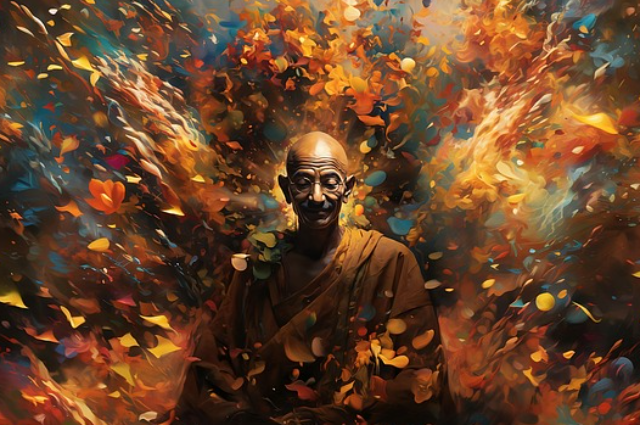
Image by Raoul Stolzlechner from Pixabay
Introduction: Why Gandhi Still Matters to Rural India
Mahatma Gandhi is often remembered through statues, currency notes, and ceremonial tributes, but reducing him to a historical icon obscures his deeper significance. Gandhi was not merely the leader of India’s freedom struggle; he was a moral philosopher, a political thinker, and above all, a figure whose vision of India was rooted in its villages. For Gandhi, the village was not a backward remnant to be modernised away, but the ethical and economic foundation of the nation. His ideas continue to shape debates on democracy, development, and social justice—especially in rural India, where the majority of Indians still live.
Central to Gandhi’s thought was the concept of Gram Swaraj, or village self-rule. He imagined India as a network of self-sufficient, self-governing villages where power flowed from the bottom up rather than being concentrated in distant capitals. In this vision, villages were spaces of dignity, participatory democracy, local economies, and social harmony. Rural employment, decentralised governance, community responsibility, and moral restraint were not policy tools alone but expressions of a larger ethical worldview. Gandhi believed that if India’s villages were strong, just, and self-reliant, the nation itself would be resilient.
In contemporary India, however, Gandhi’s relationship with rural life is increasingly contested. Over the past decade, debates have intensified around the removal or dilution of Gandhian symbols and values from public institutions and welfare schemes, most notably attempts to rename or restructure programmes like the Mahatma Gandhi National Rural Employment Guarantee Act (MGNREGA). Changes in school textbooks, shifts in public memory, and symbolic gestures that retain Gandhi’s image while sidelining his ideas have raised concerns among scholars, activists, and sections of civil society. These developments are often presented as administrative reforms or acts of “decolonisation,” but critics argue that they signal a deeper ideological project.
This leads to the central question of this article: Is Gandhi being gradually erased from India’s villages—not physically, but ideologically? The concern is not whether Gandhi’s statues will disappear or his name will be forgotten overnight, but whether the values he championed—non-violence, pluralism, decentralisation, and moral politics—are being systematically weakened in rural policy and public discourse.
This article undertakes a political, historical, ideological, and social analysis of this question. It examines Gandhi’s original vision for rural India, the ideological tensions between Gandhian thought and contemporary nationalism, the rewriting of history and symbols, and the real-world implications for villages and democracy. The approach remains neutral but critical, seeking not to romanticise Gandhi uncritically, but to assess what is at stake when a nation redefines its relationship with one of its foundational moral voices.
Gandhi and the Village: The Core of His Political Philosophy
At the heart of Mahatma Gandhi’s political philosophy lay an unwavering faith in the Indian village. Unlike many nationalist leaders who viewed villages as symbols of stagnation and poverty to be overcome through rapid industrialisation, Gandhi saw them as the moral and social foundation of India. His vision of freedom was not limited to the transfer of power from colonial rulers to Indian elites; it was about transforming everyday life at the grassroots. This vision found its clearest expression in the idea of Gram Swaraj, or village self-rule.
Gram Swaraj was Gandhi’s alternative to centralised, top-down governance. He imagined an India composed of thousands of self-governing villages, each functioning as a “complete republic” with autonomy over its affairs. Power, in this model, would flow upward from the village rather than downward from the state. Local councils, or panchayats, would manage resources, resolve disputes, and ensure social justice. For Gandhi, political freedom without local self-governance was incomplete and hollow. True swaraj meant that ordinary villagers had control over decisions that affected their lives.
Decentralisation was inseparable from Gandhi’s emphasis on self-sufficiency. He believed that excessive dependence on centralised industries and distant markets created exploitation, inequality, and moral decay. Instead, villages should strive to meet most of their basic needs locally—food, clothing, tools, and services—through cooperative effort. This was not a rejection of all technology, but a call for appropriate technology that served human needs without destroying social bonds. Gandhi’s advocacy of khadi and village industries symbolised this belief in small-scale, human-centred economics.
Equally central to Gandhi’s village philosophy was the dignity of labour. He rejected the hierarchy that valued intellectual or urban work over manual labour. Spinning, farming, cleaning, and other forms of physical work were, in his view, morally equal and socially necessary. By encouraging everyone, including the educated elite, to engage in manual labour, Gandhi sought to break caste barriers and restore respect for work traditionally assigned to the oppressed. His economic ideas were therefore deeply ethical, rooted in what is often described as “moral economics,” where production and consumption were guided by need, restraint, and social responsibility rather than profit alone.
Rural employment and local livelihoods were crucial in this framework. Gandhi was acutely aware that unemployment and underemployment in villages eroded self-respect and social stability. Ensuring meaningful work within villages was not merely an economic goal but a moral imperative. Although schemes like MGNREGA emerged decades after his death, their emphasis on the right to work in rural areas reflects Gandhian concerns about dignity, security, and decentralised development.
Gandhi famously asserted that “India lives in her villages,” a statement that was both descriptive and normative. It recognised that the majority of Indians lived in rural areas, but also insisted that the soul of the nation resided there. Ignoring villages, he warned, would mean building an India disconnected from its people. This belief placed him in sharp contrast with models of development that prioritised large-scale industrial growth, urban expansion, and centralised planning. Gandhi feared that uncritical industrialisation would deepen inequality, displace communities, and concentrate power in the hands of a few.
For Gandhi, villages were not idealised utopias; he was aware of their injustices, including caste oppression and gender inequality. Yet he believed that these evils could be confronted and reformed only through empowered, self-aware communities. In this sense, villages were the moral backbone of Gandhi’s India—not because they were perfect, but because they offered the possibility of a humane, participatory, and ethically grounded civilisation. Undermining the village, in Gandhi’s thought, was ultimately a threat to the moral health of the nation itself.
Gandhi’s Vision vs. Hindu Nationalism: An Ideological Conflict
The growing tension between Gandhian thought and contemporary Hindu nationalism is not accidental; it is rooted in a fundamental ideological incompatibility. Mahatma Gandhi’s political and moral philosophy was built on secularism, religious pluralism, and ethical restraint, while Hindu nationalism, as articulated by organisations such as the Rashtriya Swayamsevak Sangh (RSS), prioritises cultural homogeneity, majoritarian identity, and a strong, centralised nation-state. The conflict between these two worldviews explains why Gandhi’s legacy remains deeply contested in present-day India.
Gandhi’s secularism was not based on the exclusion of religion from public life but on equal respect for all faiths. He believed religion should inform personal morality without dominating political power. For Gandhi, India was inherently plural: Hindus, Muslims, Christians, Sikhs, Buddhists, and others were co-owners of the nation. His commitment to religious harmony was not merely rhetorical; it shaped his political action. Gandhi consistently opposed communal politics and warned that privileging one religious identity over others would destroy the moral unity of India. In his view, nationalism that excluded minorities was a betrayal of both religion and democracy.
This pluralism is clearly reflected in Gandhi’s idea of Ram Rajya, a concept often misunderstood or deliberately reinterpreted. When Gandhi spoke of Ram Rajya, he did not mean a Hindu state governed by religious law. He used the term metaphorically to describe a just and ethical order—one based on equality, justice, and moral governance. Gandhi explicitly stated that his Ram Rajya was compatible with Islam and other faiths, and that it had nothing to do with theocratic rule. In contrast, contemporary Hindutva discourse frequently invokes Ram Rajya as a civilisational Hindu ideal, closely linked to religious symbolism, cultural dominance, and political power. This shift transforms a moral metaphor into a sectarian political project.
Non-violence and Hindu–Muslim unity were central pillars of Gandhi’s politics. Gandhi believed that violence corrupted both the oppressor and the oppressed, and that lasting political change could only be achieved through ethical means. His insistence on non-violence was inseparable from his efforts to maintain communal harmony, especially during periods of intense religious conflict. Gandhi saw Hindu–Muslim unity not as a strategic necessity but as a moral obligation. He fasted, negotiated, and risked his life to prevent communal bloodshed, particularly during the Partition. This unwavering commitment placed him at odds with ideologies that viewed Muslims as outsiders or perpetual threats to the nation.
Modern Hindu nationalist ideology, particularly as developed by the RSS, rests on a different conception of the nation. Influenced by thinkers such as V.D. Savarkar, Hindutva defines India primarily as a Hindu nation, where cultural and national identity are closely tied to Hindu heritage. While proponents argue that this is cultural rather than religious, critics point out that it inevitably marginalises minorities whose histories, practices, and loyalties are portrayed as secondary or suspect. The emphasis on discipline, hierarchy, and cultural uniformity stands in contrast to Gandhi’s emphasis on moral persuasion, diversity, and voluntary cooperation.
Gandhi’s inclusiveness poses a challenge to any majoritarian nation-state because it limits the power of the majority. His insistence on minority rights, ethical politics, and moral accountability restrains the state’s ability to mobilise identity for political gain. In a Gandhian framework, the strength of a nation is measured by how it treats its weakest members, not by the dominance of its majority. This directly contradicts political strategies that rely on polarisation and identity-based mobilisation.
The idea of a Hindu Rashtra is therefore fundamentally incompatible with Gandhi’s vision of India. Gandhi rejected the notion of a religious state, regardless of which religion held power. He believed that true freedom required a state guided by moral principles, constitutional values, and respect for diversity. While contemporary politics may continue to invoke Gandhi symbolically, his core ideas—pluralism, non-violence, decentralisation, and ethical restraint—remain deeply unsettling to a project that seeks to redefine India as a culturally uniform, majoritarian nation. It is this unresolved ideological conflict that underlies the ongoing struggle over Gandhi’s place in modern India.
The Assassination of Gandhi and Its Historical Meaning
The assassination of Mahatma Gandhi on 30 January 1948 was not merely a tragic act of violence against an individual; it was a defining moment in independent India’s political and moral history. Gandhi was shot at point-blank range during his evening prayer meeting in New Delhi by Nathuram Vinayak Godse, a Hindu extremist. The killing occurred barely five months after India’s independence, at a time when the nation was struggling to recover from the trauma of Partition, communal violence, and mass displacement. Gandhi’s death symbolised the violent rejection of the values he had consistently upheld—non-violence, religious coexistence, and moral restraint in politics.
Nathuram Godse was not an isolated fanatic acting without ideological influence. He had been associated with the Rashtriya Swayamsevak Sangh (RSS) in his early years and was an active member of the Hindu Mahasabha, a political organisation that promoted a Hindu nationalist vision of India. Godse and his associates viewed Gandhi as appeasing Muslims, particularly because of his insistence on Hindu–Muslim unity and his opposition to retaliatory violence against Muslims after Partition. Gandhi’s efforts to ensure financial commitments to Pakistan and his refusal to endorse communal revenge were interpreted by his critics as betrayal of Hindu interests.
Although Godse claimed during his trial that he had left the RSS before the assassination, later testimonies complicated this assertion. His brother, Gopal Godse, who was also convicted in the conspiracy, later stated that the Godse brothers had never truly severed their ties with the RSS. Regardless of formal membership, the ideological environment in which the assassins operated was shaped by Hindu nationalist thought that framed Gandhi as an obstacle to the creation of a Hindu nation.
The Indian government’s response in the immediate aftermath is historically significant. Sardar Vallabhbhai Patel, India’s first Home Minister and a senior leader of the Congress, expressed deep concern about the role of extremist organisations. In letters addressed to leaders of the Hindu Mahasabha and the RSS, Patel acknowledged that while the case was sub judice, government reports had confirmed that the atmosphere created by these organisations, particularly the RSS, had contributed to the tragedy. As a result, the RSS was temporarily banned, and its activities were placed under scrutiny. Patel’s correspondence makes it clear that Gandhi’s assassination was seen not as an isolated crime, but as the outcome of sustained ideological hostility.
Gandhi’s murder was therefore fundamentally ideological rather than personal. Godse did not act out of individual grievance but out of political conviction. He rejected Gandhi’s vision of a plural, inclusive India and sought to eliminate what he perceived as a moral and ideological barrier to Hindu nationalism. In this sense, the assassination represented an attempt to silence a worldview that challenged majoritarian politics.
The unresolved nature of this ideological conflict continues to shape Indian politics today. While Gandhi is officially revered as the “Father of the Nation,” the ideas that led to his assassination have not disappeared. Debates over nationalism, secularism, minority rights, and historical memory echo the same fault lines that existed in 1948. Attempts to marginalise Gandhi’s ideas while retaining his symbolic presence suggest that the struggle between his vision and its opponents remains unfinished. Understanding the assassination as an ideological act is essential to understanding why Gandhi’s legacy continues to be contested in contemporary India.
Rewriting History: Textbooks, Memory, and National Narrative
History is not only a record of the past; it is a powerful tool through which nations shape identity, values, and political legitimacy. In India, school textbooks have long played a crucial role in constructing a shared national narrative rooted in pluralism, anti-colonial struggle, and constitutional democracy. Since 2014, however, significant changes in educational content have raised concerns about the deliberate reshaping of historical memory, particularly in relation to Mahatma Gandhi, communal violence, and the rise of Hindu nationalism.
One of the most noticeable shifts has been the revision of National Council of Educational Research and Training (NCERT) textbooks. These changes have often been justified as part of syllabus “rationalisation” or the removal of “excess content,” especially after the COVID-19 pandemic. Yet the pattern of deletions suggests more than administrative streamlining. Several references that presented Gandhi as a critic of Hindu extremism and majoritarian politics have been removed or diluted. Statements highlighting Gandhi’s warning that India could be destroyed if it became a country only for Hindus no longer appear in some textbooks. This erasure weakens students’ understanding of Gandhi as a moral critic of communal nationalism rather than merely a benign freedom fighter.
Equally significant is the softening or deletion of material related to communal violence and the political consequences of Gandhi’s assassination. Earlier textbooks contained references to the ban imposed on the RSS after 1948 and discussed the ideological climate that enabled Gandhi’s murder. In recent revisions, such references have either been removed or stripped of context. While the assassination itself is still mentioned, the ideological background and state response are often absent, reducing a complex political event to a neutral historical fact. This selective presentation limits students’ ability to critically engage with the causes and consequences of communal extremism in independent India.
These changes are often described by critics as “saffronisation” of history—a term used to describe the infusion of Hindu nationalist ideology into educational and cultural narratives. Saffronisation does not necessarily involve the fabrication of facts; rather, it operates through emphasis, omission, and reinterpretation. Certain figures, events, and perspectives are foregrounded, while others are marginalised or erased. The focus increasingly shifts towards glorifying ancient Hindu civilisation, valorising cultural nationalism, and presenting a simplified, conflict-free version of India’s past. In this process, Gandhi’s pluralist politics and his critique of religious majoritarianism become inconvenient.
Education is one of the most effective means through which collective memory is shaped. Textbooks do more than impart information; they frame how young citizens understand their nation, its conflicts, and its values. When students are not exposed to debates around secularism, communalism, and dissent, they are less equipped to recognise these issues in contemporary society. By limiting engagement with Gandhi’s moral and political struggles, the education system risks producing a generation that reveres him symbolically but remains disconnected from the ethical challenges he posed to power and prejudice.
The risks of selective history are long-term and profound. A sanitised past can normalise exclusion in the present. When communal violence is downplayed and ideological accountability is avoided, society becomes less capable of confronting intolerance and injustice. Moreover, reducing Gandhi to a non-controversial national icon strips him of his role as a moral conscience—someone who questioned authority, challenged majorities, and insisted on ethical limits to nationalism.
In rewriting history, the danger is not merely distortion but impoverishment of democratic imagination. A nation that teaches its children a narrowed version of its past may struggle to uphold the pluralism and constitutional morality required for its future. The contest over textbooks, therefore, is not just about history—it is about the kind of India that is being imagined and passed on to the next generation.
Renaming Welfare Schemes: Symbolism and Political Messaging
In public policy, names are never merely administrative labels; they carry ideological meaning, historical memory, and political intent. The naming of welfare schemes, in particular, serves as a symbolic bridge between the state and its citizens. It communicates whose ideas the state claims to represent and which values it seeks to institutionalise. In India, the recent trend of renaming government programmes has therefore drawn attention not only for its administrative implications but also for its deeper political messaging.
The Mahatma Gandhi National Rural Employment Guarantee Act (MGNREGA), enacted in 2005, is one of the most significant social welfare legislations in independent India. It guarantees 100 days of wage employment to rural households and is legally enforceable as a right. Beyond its economic impact, MGNREGA carries strong symbolic weight. By invoking Gandhi’s name, the scheme explicitly aligns itself with his vision of rural dignity, decentralised development, and the moral obligation of the state to ensure livelihoods. It reflects Gandhi’s belief that meaningful work is essential to human dignity and social stability, particularly in villages.
In recent years, there have been repeated attempts to rename, rebrand, or structurally alter MGNREGA. Proposals to replace Gandhi’s name with generic or ideologically aligned titles have been justified on grounds of administrative efficiency, national branding, or “new India” narratives. While the scheme itself has not been repealed, changes in terminology, delayed fund allocations, and altered implementation priorities have raised concerns about its gradual dilution. Critics argue that such measures weaken not only the programme’s effectiveness but also its moral and historical anchoring.
MGNREGA is not an isolated case. It fits into a broader pattern of removing the names of Jawaharlal Nehru, Indira Gandhi, Rajiv Gandhi, and Mahatma Gandhi from public schemes and institutions. Programmes once associated with post-independence nation-building have been rebranded under new titles that emphasise individual leadership, cultural nationalism, or abstract development goals. Supporters of this approach argue that it corrects an imbalance created by decades of Congress dominance and reduces the personalization of governance. However, opponents contend that the selective removal of certain names—particularly those linked to secularism and pluralism—reveals an ideological agenda rather than a neutral reform.
MGNREGA symbolically represents Gandhi’s village-centred philosophy in ways that go beyond nomenclature. The scheme is decentralised in structure, implemented through local bodies, and focused on rural assets and employment. It embodies the principle that development should begin at the grassroots and that the state has a responsibility to protect the vulnerable. In this sense, Gandhi’s name is not ornamental but conceptually appropriate. Removing it risks disconnecting the scheme from the ethical framework that originally justified it.
This raises a critical question: is renaming welfare schemes merely an administrative decision, or does it constitute ideological erasure? If names are changed without altering the values they represent, the impact may be symbolic but limited. However, when renaming coincides with reduced emphasis on rights-based welfare, decentralisation, and social justice, it suggests a deeper shift. Symbolic changes can gradually reshape public perception, making certain ideas seem outdated or irrelevant.
Ultimately, the politics of renaming is about memory and legitimacy. By redefining which figures and ideas are publicly honoured, the state influences how citizens understand their past and imagine their future. In the case of MGNREGA, the debate is not simply about a name but about whether Gandhi’s vision of rural India—as a space of dignity, rights, and moral responsibility—still holds a central place in India’s development narrative.
Media, Silence, and the Manufacturing of Consent
The role of media in shaping public understanding of political change is crucial, particularly in a democracy where consent is often manufactured not only through persuasion but also through silence. In contemporary India, the transformation of the media landscape has significantly influenced how debates around Gandhian values, historical memory, and ideological shifts are presented—or avoided altogether. Corporate ownership, political proximity, and commercial pressures have altered the media’s capacity to function as a critical watchdog.
A large section of corporate and electronic media has increasingly aligned itself with the priorities of the ruling establishment. Prime-time debates frequently focus on spectacle, nationalism, and identity-driven narratives, leaving little space for substantive discussions on welfare, decentralisation, or moral politics—core elements of Gandhian thought. When changes such as the renaming of welfare schemes or textbook revisions occur, they are often framed as technical or developmental updates rather than ideological interventions. This framing discourages deeper public scrutiny and reduces complex political questions to administrative decisions.
As a result, critical debate on Gandhian values has steadily declined in mainstream discourse. Gandhi is routinely invoked in ceremonial contexts—on national holidays, currency notes, or official speeches—but rarely engaged with as a political thinker whose ideas challenge power, majoritarianism, and centralisation. This selective remembrance allows the state to retain Gandhi’s symbolic legitimacy while sidelining his ethical and political critique. The absence of sustained media engagement normalises this contradiction.
Repetition plays a key role in this process. When symbolic changes—such as renaming schemes, revising textbooks, or altering public narratives—are repeatedly presented as routine or inevitable, they gradually lose their controversial character. Over time, what once appeared exceptional becomes ordinary. The public becomes accustomed to shifts that, in another context, might have sparked widespread debate. This slow normalisation is one of the most effective ways in which ideological change is absorbed without overt resistance.
Social media further complicates this landscape. While it offers alternative platforms for dissent, it is also a space where misinformation, selective history, and emotionally charged narratives thrive. Simplified portrayals of Gandhi—as weak, outdated, or responsible for national “failures”—circulate widely, often detached from historical evidence. Algorithm-driven amplification ensures that polarising content reaches large audiences, reinforcing ideological echo chambers rather than encouraging critical reflection.
In such an environment, silence itself becomes a form of political approval. When media institutions fail to question or contextualise changes affecting foundational values, they tacitly legitimise them. Consent is not always won through explicit agreement; it is often produced through the absence of dissenting voices. The marginalisation of Gandhian ideas in public debate, therefore, is not only the result of ideological opposition but also of a media ecosystem that increasingly treats silence as neutrality. In reality, this silence plays an active role in reshaping public consciousness and redefining the boundaries of acceptable political thought.
Public Response: Opposition, Civil Society, and Intellectual Resistance
The gradual marginalisation of Gandhian values in public policy and historical narrative has not gone uncontested. Opposition parties, civil society organisations, scholars, and grassroots movements have repeatedly raised concerns, framing these changes as threats to India’s democratic and constitutional foundations. While these responses vary in scale and effectiveness, they represent an important countercurrent to the dominant political narrative.
Opposition parties, particularly the Indian National Congress, have taken the lead in protesting attempts to rename or dilute welfare schemes associated with Mahatma Gandhi. Parliamentary disruptions, public demonstrations, and symbolic acts—such as satyagrahas invoking Gandhi’s methods—have been used to highlight what they describe as ideological erasure. Leaders have argued that removing Gandhi’s name from schemes like MGNREGA is not a neutral administrative act but part of a broader effort to rewrite the moral basis of welfare politics. Other opposition parties, including regional and left-leaning groups, have echoed these concerns, linking them to larger issues of federalism, decentralisation, and social justice.
Civil society and the academic community have played a crucial role in articulating the deeper implications of these changes. Historians have warned that textbook revisions and selective memory undermine critical historical understanding and weaken democratic culture. Economists and development experts have highlighted the practical consequences of weakening rights-based welfare programmes, particularly in rural areas. Activists working on employment, food security, and rural development argue that policies inspired by Gandhian principles are essential for protecting vulnerable populations in times of economic distress.
The issue of MGNREGA has attracted attention beyond India’s borders. Prominent global economists and scholars have publicly defended the programme, describing it as one of the world’s most ambitious social safety nets. They have emphasised its role in reducing poverty, stabilising rural economies, and strengthening democratic accountability through legally guaranteed rights. Such statements underscore that the debate is not merely symbolic but has real implications for democratic governance and human development.
At the grassroots level, resistance has often taken symbolic and localised forms. Rural workers’ unions, social activists, and non-governmental organisations have organised protests, public meetings, and awareness campaigns to defend MGNREGA and other welfare schemes. Gandhi’s imagery—his spinning wheel, portraits, and slogans—continues to be used as a tool of moral appeal. These acts draw on Gandhi’s legacy not as nostalgia but as a language of resistance rooted in non-violence and rights.
Despite these efforts, resistance faces significant limitations. Fragmentation among opposition parties, shrinking space for dissent, and limited media coverage reduce the reach and impact of critical voices. Many protests remain episodic and struggle to sustain long-term public engagement. Additionally, the government’s ability to frame dissent as partisan or anti-national weakens broader solidarity.
Nevertheless, these acts of resistance remain vital. They keep alive alternative visions of India’s future and challenge the normalisation of ideological change. Even when limited in immediate impact, opposition from civil society and intellectuals serves as a reminder that Gandhi’s ideas continue to inspire critical engagement and democratic questioning.
What Happens If Gandhi Is Erased from the Villages?
The erasure of Gandhi from India’s villages would not merely be a symbolic loss; it would have tangible moral, political, and social consequences. Gandhi’s presence in rural India has never been confined to statues or scheme names alone. It has functioned as an ethical framework that shaped ideas of governance, welfare, and coexistence. Removing this framework risks creating a moral vacuum in rural life, where power operates without the restraint of ethical accountability.
One of the most immediate consequences would be a weakening of moral standards in rural governance. Gandhian ethics emphasised service, transparency, and responsibility at the grassroots. Local self-government was meant to be guided by moral authority rather than coercive power. In the absence of these values, governance risks becoming transactional and hierarchical, dominated by patronage networks and political loyalty rather than community welfare. This shift undermines trust between citizens and institutions, particularly in villages where state presence is already fragile.
A related consequence is the gradual shift from rights-based welfare to charity-based politics. Gandhian-inspired programmes like MGNREGA treat employment and livelihood as rights guaranteed by the state, not favours bestowed by political leaders. If this philosophy is replaced by discretionary welfare, citizens become beneficiaries rather than rights-holders. Such a model strengthens political dependence and weakens democratic agency, especially among rural poor who are most vulnerable to economic and social pressures.
The impact on communal harmony could be equally serious. Gandhi’s emphasis on interfaith coexistence and moral persuasion played a crucial role in containing communal tensions in rural India. Villages have historically been spaces where different communities lived in close proximity, relying on cooperation for survival. Eroding Gandhian values risks normalising suspicion, polarisation, and identity-based mobilisation. Once communal divisions are institutionalised at the village level, they become deeply entrenched and difficult to reverse.
The loss of ethical politics also affects participatory democracy. Gandhi believed that democracy was not merely a system of elections but a way of life rooted in dialogue, dissent, and shared responsibility. Village assemblies and local institutions were meant to be spaces of collective decision-making. Without this ethical foundation, participation risks becoming ritualistic, with real power concentrated elsewhere. Citizens may vote, but they are less likely to shape policy or hold authority accountable.
In the long term, the erosion of Gandhian values in villages threatens the health of Indian democracy itself. Rural India constitutes the demographic and moral backbone of the nation. If villages become sites of inequality, polarisation, and passive citizenship, democratic institutions at the national level will inevitably weaken. Gandhi’s erasure, therefore, is not about forgetting a historical figure; it is about losing a moral compass that once anchored India’s democratic experiment.
Conclusion: Gandhi as Memory, Conscience, and Warning
This article began with a central question: Is Gandhi being gradually erased from India’s villages—not physically, but ideologically? The evidence examined across history, policy, education, media, and political discourse suggests that while Gandhi remains omnipresent in symbols and ceremonies, the ideas that defined his vision of India are increasingly being sidelined. The issue, therefore, is not one of absence, but of selective remembrance.
Gandhi was never meant to be preserved as a statue, a photograph, or a scheme name alone. He was a living idea—restless, uncomfortable, and deeply demanding. His insistence on non-violence, decentralisation, religious pluralism, and moral accountability challenged both colonial power and native majoritarianism. To remember Gandhi truthfully is to engage with his critique of authority, his defence of the weakest, and his refusal to separate ethics from politics. When his name is retained but his principles are ignored, remembrance turns hollow.
The contrast between symbolic respect and ideological rejection is increasingly visible. Floral tributes at Rajghat coexist with policies and narratives that undermine Gandhi’s core beliefs. His image appears on currency notes even as the values he stood for—minority protection, village autonomy, and ethical restraint—are diluted in public life. This selective appropriation allows Gandhi to be celebrated without being followed, honoured without being heard.
Albert Einstein once remarked that future generations might scarcely believe that such a man of flesh and blood walked upon the earth. His words now sound less like admiration and more like a warning. When Gandhi is reduced to myth while his ideas are erased from everyday governance, society risks transforming a moral force into a harmless legend. The danger lies not in forgetting Gandhi’s face, but in forgetting why his ideas were radical, necessary, and transformative.
The question, then, is not whether Gandhi belongs to the past, but whether India’s future can sustain itself without him. Villages without ethical governance, welfare without rights, nationalism without pluralism, and democracy without moral limits are fragile foundations for a diverse republic. Gandhi’s relevance lies precisely in his ability to remind power of its limits and society of its responsibilities.
Can India afford to forget Gandhi without forgetting itself? The answer will be determined not by monuments or anniversaries, but by whether his ideas continue to inform how the nation governs, remembers, and imagines its future. The choice before India is not between Gandhi and modernity, but between a democracy guided by conscience and one driven solely by power.
References
Textbook Changes & Historical Memory
- Omissions and revisions in India’s school textbooks — Examines how NCERT content has been altered in recent years, often aligning with the ideological line of the ruling party. Omissions and revisions in Modi years: How India’s school textbooks are being rewritten (The News Minute)
- Deleted textbook content on Gandhi and RSS context — Shows how references to Hindu extremists’ dislike for Gandhi and the RSS ban were removed from political science curricula. Deleted from NCERT textbooks: Hindu extremists’ dislike for Gandhi, RSS ban after the assassination (YouTube)
MGNREGA Renaming & Political Debate
- Congress to hold nationwide protests over renaming MGNREGA — Covers opposition mobilisation and symbolic protests against replacing the scheme and removing Gandhi’s name. Congress To Hold Nationwide Protest Over Decision To Rename MGNREGA (NDTV)
- Shashi Tharoor on MGNREGA renaming controversy — Tharoor’s criticism of the removal of Gandhi’s name, arguing it undermines the programme’s identity. Renaming MGNREGA Takes Out Heart Of Entire Scheme: Shashi Tharoor (NDTV)
- Priyanka Gandhi condemns scheme renaming and dilution — Priyanka Gandhi voices concern that changing the name and structure weakens rural employment guarantees. ‘Immoral To Remove Bapu’s Name’: Priyanka Gandhi Slams MGNREGA Name Change Move (ABP Live News)
- Opposition backlash over new G-RAM-G Bill — Reports on objections from multiple opposition leaders alleging a “BJP-RSS conspiracy” to dismantle MGNREGA. MGNREGA renaming row: New VB-G RAM G Bill sparks Opposition backlash; Kharge flags proposal part of 'BJP-RSS conspiracy' (Times of India)
Current News on Protests & Political Movements
- Punjab assembly resolution criticising removal of MGNREGA’s name as ‘anti-Dalit’ — Legislative pushback against renaming. G Ram G ‘anti-Dalit’, restore MGNREGA: Punjab assembly passes resolution (TOI)
- State leaders oppose new employment law, raising federalism concerns — Karnataka CM urges halt to VB-G RAM G Act and criticises removal of Gandhi’s name. CM urges PM to halt VB-G Ram G Act, cites threat to MGNREGA (TOI)
- Workers and grassroots protests against MGNREGA repeal — Labor organisations mobilise in villages to resist the new scheme. Workers protest against scrapping of MGNREGA (TOI)