
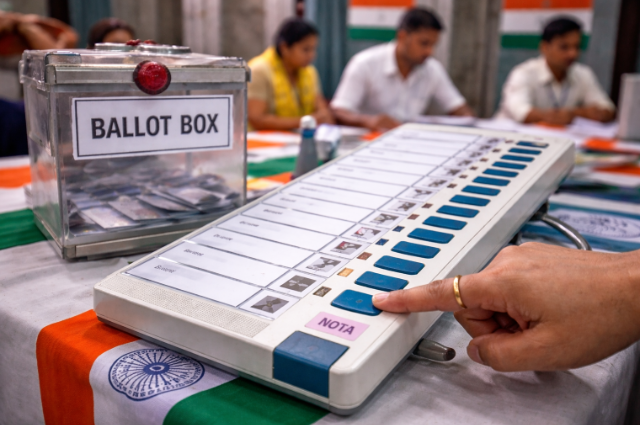
In the crowded and complex world of democracy, people come across situations where they have no good options at all. To say the least, these situations are not easy for the citizens, and therefore, many of them choose NOTA as a sign of their moral purity. It is not infrequently referred to as a "protest vote"—an act of refusing the "lesser evil" reasoning and calling for better candidates to be put forward.
Nevertheless, a rigorous examination of election math and political viability exposes the grim reality: Presently, NOTA does not batter the bad and instead gives the worst a cuddle. By withdrawing from the battle of the evils, the NOTA voter actually demarcates a lower threshold for the most controversial candidate to emerge victorious.
The Mathematical Trap: A "Toothless" Protest
The main misconception about NOTA is that it still holds some legal might. In India and many other countries, NOTA is considered a symbolic act rather than a decisive one.
According to the current regulations, even if NOTA is the largest vote-getter in a certain area, the candidate with the second-largest number of votes will be the winner. If a large number of logical and moderate voters choose "None of the Above" (NOTA) because they consider the main candidates to be equally bad, they will unwittingly reduce the number of voters. This "dilution effect" implies that although the moderates are expressing their opinion, the candidate who is usually the most divisive and depends on a small but committed base just needs to get his core supporters to vote. As a result, such extreme candidates get the benefit, as their loyal voters are more prone to take part than the disenchanted moderates are.
Rejecting the "lesser evil" option, the voter directly gives a mathematical edge to the "greater evil" that the latter's supporters never envision NOTA as one of the choices.
"Polarization Engine" Activation
The "Lesser Evil" doctrine holds that in dealings involving two imperfect choices, it is the citizen's duty to pick the one that will cause the least harm. When a voter does not accept this and goes for NOTA, he/she is no longer an obstacle to the radicalisation of the political environment.
The so-called "worst" candidates in any election—those identified for their corrupt practices, facing criminal charges, or making divisive comments—depend on people staying indifferent and splitting their votes. They realise that the majority of the population will not support them. Their approach is straightforward:
Solidify their tiny, radical support.
Disgust the other electorate so much that they either do not go to the polls or vote NOTA.
In this case, NOTA is not a weapon against the system; it is a device through which the system silences the righteous.
The Legend of the "Message to Political Parties"
Those in favour of NOTA claim that a large number of neutral votes convey a "strong message" to the parties to provide better candidates. History and statistics have a different story to tell.
It is not shame that motivates the political parties, but winning. If a party manages to win an election with 30% of the vote and NOTA gets 15%, the party does not introspect its moral defects—it celebrates its victory. As long as NOTA do not lead to a re-election or a ban on the disqualified candidates, it continues to be a "silent scream" that the political machine can easily ignore.
The Moral Hazard of Neutrality
Dante Alighieri made it clear that the worst places in hell are for those who do not take sides in moral crises. While an election might not be a divine comedy, the stakes are still very high.
The option of "the lesser evil" is considered a harm reduction measure. It admits that neither candidate is ideal, but one may be a bit better than the other in terms of protecting civil liberties, the economy, or the environment. On the other hand, NOTA is a sign of surrender. It enables the voter to have his hands "clean" while the most dangerous candidate takes over power.
The Need for "Right to Reject"
NOTA must be empowered if it is not to be merely an ally to the worst candidate. Until the law is modified so that a NOTA win means a re-poll that is mandatory and where the previous contestants are not allowed to fight again, it still virtually remains a gift to the candidate with the most disciplined (and often most radical) base—this is the frontrunner.
In 2026, as we are moving toward more and more polarised political arenas, the "lesser evil" is not a compromise of integrity—it is a tactical defence of the future. Voting is not like a Valentine's gift; it is like chess. And in chess, not making a move will lead to a quicker checkmate.
Real Life Incident of Indore Case
The Indore case from the Indian elections in 2024 is a glaring illustration of how the None of the Above (NOTA) option could prove to be a self-destructive weapon, and paradoxically, it could aid the very candidates whom the protests may be directed against.
Here's the synopsis of the reasons why NOTA is frequently labelled as the "Worst Candidate’s Best Friend":
The "Indore Stunt"
In Indore, the leading opposition candidate withdrew just before the election, thereby allowing the ruling party to be without a serious opponent. The opposition encouraged people to cast their votes for NOTA as an act of rebellion. Though NOTA garnered an unprecedented 2.18 lakh votes (the highest in history), it had no effect in law whatsoever. The BJP candidate was still victorious by a huge margin of 11.7 lakh votes.
The Illusion of Power
The main problem is that in India, NOTA is more of a "symbolic" vote than a "functional" one.
No Re-polls: Even if NOTA tops the poll, the next candidate with the highest number of votes is declared the winner.
Wasted Leverage: By opting for NOTA, the voters deprive themselves of the chance to support a smaller, independent candidate who may actually have been able to give the front-runner a run for his/her money.
Splitting the Dissatisfaction
In hard-fought contests (as in Latur or Gopalganj), NOTA is frequently the recipient of more votes than the actual winning margin. When the discontented voters vote for NOTA instead of a less popular candidate, they, to a certain extent, decrease the "threshold" for the most divisive candidate to clinch victory.
The Key Takeaway
Until we have a proper "Right to Reject" law—where a NOTA win leads to a new election with completely new candidates—the protest vote will just be a statistical footnote. It is like a safety valve that allows the steam to escape without really doing anything to the engine.
References
- Association for Democratic Reforms (ADR): For data on how NOTA percentages impact victory margins in Indian elections.
- Supreme Court of India (PUCL vs. Union of India, 2013): The original judgment that introduced NOTA as a tool for "voter participation."
- The Hindu Business Line: The demand for a "Right to Reject" and analysis on the "toothless" nature of NOTA.
- Journal of Electoral Studies: Research on the psychological vs. mathematical impact of neutral voting in multi-party democracies.