
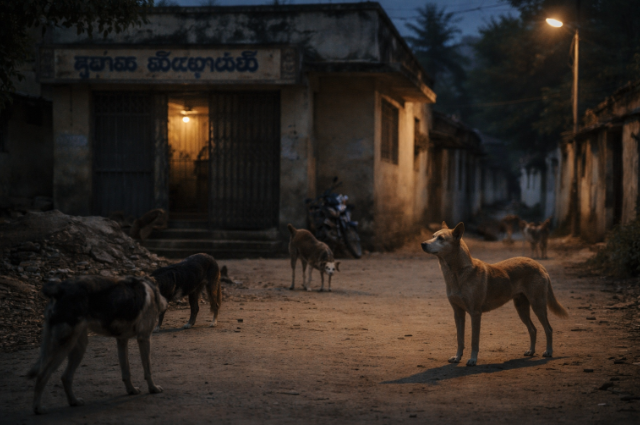
In the rural heartlands of Telangana, a silent & grim operation has been unfolding behind the closed gates of Gram Panchayats. While the national discourse on stray dogs is dominated by legal battles in the Supreme Court & debates over Animal Birth Control (ABC) rules, a different, more lethal reality exists on the ground. Driven by public pressure & a lack of infrastructure, many local leaders, Sarpanches, have resorted to “secret” culling operations, effectively bypassing the highest law of the land to eliminate what they perceive as a “stray dog menace”.
The Legal Shield: The Supreme Court & ABC Rules
To understand the gravity of the “secret” culling, one must first look at the law. The Supreme Court of India, through various judgements & the Animal Birth Control (Dogs)Rules, 2023, has made it explicitly clear: stray dogs can’t be relocated or killed.
The law mandates a “Catch-Neuter-Vaccinate-Release”(CNVR) policy. Dogs must be captured humanely, sterilised, vaccinated against rabies, & most importantly, released back into the exact location where they were found. This legal framework is designed to stabilise the dog population while maintaining ”herd immunity” against rabies. However, for a Sarpanch in a remote Telangana village, these rules often feel like a distant luxury that doesn’t solve the immediate problem of a child being bitten in a local alley.
The Desperation of the Sarpanch
In Telangana’s decentralised governance, the Sarpanch is the first point of contact for every grievance. When a stray dog bites a villager or kills livestock, solely the local leader directs the fury of the community.
The pressure is immense. Rural areas often lack the funds, specialised vehicles, & veterinary surgeons required to implement a formal ABC program. Faced with a choice between following a complex legal mandate that takes years to show results or providing an “instant solution” to an angry mob, many leaders choose the latter. This has led to the emergence of the “secret culling” phenomenon.
The Modus Operandi: How the Bypassing Occurs
The bypassing of the Supreme Court’s mandate is rarely an overt act of rebellion; it is a covert operation of convenience.
Telangana's local governments often choose to manage the stray dog situation by illegal means, usually making it look like "relocation." They engage private catchers who receive payment for every dog they catch. However, these dogs aren’t taken to the shelters but are usually terminated at deserted places or disposed of in junk yards. Poisoning, especially with meat or biscuits, is another usual practice, done at night to avoid being noticed and consequently to avoid public outrage. On top of that, the dead animals are often buried in large pits or thrown into rivers and lakes, thus making it harder for animal rights groups and officials to get their hands on any evidence. Sometimes, the deaths are reported as "accidental" road accidents or are simply put down to mysterious diseases, thus keeping the local governments' deniability intact.
Case Studies: Recent Incidents in Telangana
Telangana has seen several high-profile incidents that hint at this systematic bypassing of the law :
From Mahabubnagar comes alarming news where mass graves of poisoned dogs with dozens buried are reported; local officials in the villages sometimes encounter silence when asking about it. This dark case is not stand-alone, as activists have constantly referred to the High Court the same concerns in Siddipet and Nalgonda. In these regions, Gram Panchayats have passed resolutions that might look like they permit dog removal but are, in fact, legally invalid since they contradict the Prevention of Cruelty to Animals Act. This kind of dog abuse and the fight for justice depict a very grave issue that requires instant attention and human-like intervention to cope with.
The Failure of the System
The “secret” of the Sarpanch is actually a symptom of a larger systematic failure.
The animal welfare programs in rural zones are mainly affected by the most serious problem of financial support, since almost all Gram Panchayats do not have any specific budget provisions for such programs. The lack of funds is made worse by a drastic difference in infrastructure; the situation is so bad that the rural parts will be the last ones to get the facilities that are already found in the urban areas, like Hyderabad, where there are Animal Birth Control (ABC) centres. Sarpanches are powerless to legally take care of the stray dog populations if sterilisation services are not available within a reasonable distance. Additionally, the public attitudes in these areas that have become very deep-rooted often prefer killing dogs as a solution. Moreover, the Supreme Court's detailed discussions on animal rights are not able to be heard in the local culture and language hence the Supreme Court's discussions are not able to be heard in the local culture and language.
The Human-Animal Conflict: A Real Crisis
It is important to acknowledge that the fear in these villages is not unfounded. Telangana has seen tragic incidents where children have lost their lives to stray dog attacks. These tragedies create a climate of fear where the law is seen as an obstacle to safety. When the state fails to provide a functional, legal solution (like a robust vaccination & sterilisation drive), it creates a vacuum that “secret culling” inevitably fills.
Moving forward: Beyond the Secret
To stop the illegal killing of dogs & uphold the Supreme Court’s mandate, the approach must change from “policing” Sarpanches to “empowering” them.
The Telangana government should tackle the rabies and stray animals management issue through a multi-faceted approach, which would be both humane and effective. To begin with, the Sarpanches in rural districts would not have to resort to the inhumane method of culling, as a sterilisation mobile unit would be right there for them as a legal and ethical alternative, plus animal welfare would be the responsibility of the state. Thus, smaller villages would be relieved from the financial burden of Animal Welfare. Community awareness programs would be the backbone of this whole endeavour, as they would not only inform the people about the uselessness of culling— which is frequently ineffective due to the "vacuum effect" where new animals occupy the place of the old ones killed—but also convince them to adopt vaccination as the only effective means of rabies eradication.
The “Sarpanch’s Secret” is an open secret in the corridors of rural power. While the Supreme Court provides the legal vision of a compassionate India, the lack of ground-level support in states like Telangana has turned local leaders into reluctant lawbreakers. Until the gap between high-court mandates & village-level resources is bridged, the silent war against stray dogs is likely to continue in the shadows.
References & Further Reading
- The Animal Birth Control (Dogs)Rules,2023:[Gazette of India]
- Supreme Court of India (Animal Welfare Board of India vs. People for Elimination of Stray Troubles) :[Official Judgement Site]
- News Report on Telangana Dog Culling : [The Hindu-Stray Dog Issue in Telangana]
- Animal Rights Activism in Telangana : [People for Animals(PFA) Hyderabad]
- Legal Perspectives : [Live Law – Supreme Court on Stray Dog Management]