
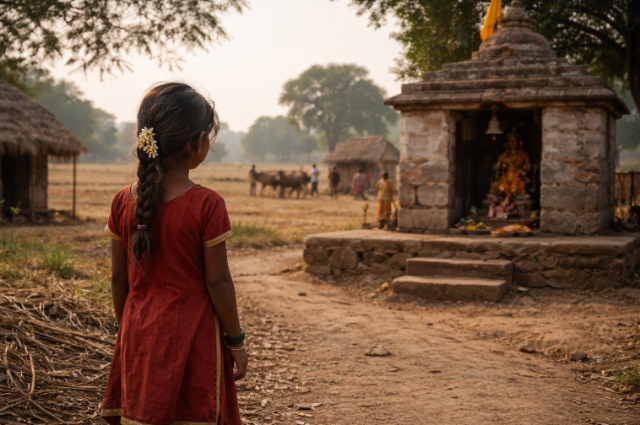
A Sacred Vow, A Stolen Childhood
In the rural hinterlands of South India, particularly in the states of Telangana, Andhra Pradesh, and parts of Karnataka, a centuries-old practice persists beneath the surface of modernity, a practice which religious tradition disguises yet which maintains its operational status as an exploitive system. The Jogini system designates young girls from Dalit and lower-caste backgrounds as permanent sacred servants who will dedicate their lives to a village deity. The ritual appears to be a spiritual offering, but it actually forces girls to experience permanent social rejection, financial hardship and sexual exploitation. The most haunting aspect? Many families surrender their daughters willingly, not out of devotion, but out of desperation. The family members think that offering their daughter to the goddess will help them avoid divine punishment, which would bring disaster to their family. The tragic phrase, Sold for Salvation, represents the grim paradox which defines this practice.
Understanding the Jogini System
The term Jogini refers to a girl or woman who dedicates herself to serve a goddess through a ceremonial marriage, which usually involves Yellamma, who represents the Mother Goddess or Devi. The girl, sometimes as young as five or six, is married to the deity, not a human partner. This initiation process establishes her as a holy being who possesses both sacredness and dishonour, which creates a condition of social exclusion from her community. The temple requires her to fulfil her duties as a dancer during religious festivals, while male villagers, including landlords and priests, use their belief that sexual contact with a Jogini will bring them religious benefits or protection from bad luck to exploit her.
The roots of this tradition trace back to pre-colonial times when certain regions granted elevated status to female temple servants known as Devadasis. The Devadasi system transformed into a system of institutionalised sexual servitude during British colonial rule and social upheaval, which marked its downward progression. The Jogini system emerged in Telangana and Andhra Pradesh as a cultural practice that lost its former status yet continued to enable caste discrimination against women.
Case Study: The Story of Lakshmi from Warangal District
The village suffered a drought when Lakshmi (her name changed for privacy protection) reached her seventh birthday. The family farmed their small landholdings but achieved no agricultural success during two consecutive growing seasons. His medical condition forced his father to seek treatment, which resulted in mounting medical expenses. The village priest came to their house with a solution when he said that they needed to dedicate their youngest daughter to Goddess Yellamma because this act would make the rains return and save their family.
Lakshmi's mother cried during the ceremony while she described it to other people. The woman told the local NGO about her situation when she said that she had no other options at that time. The believers thought their actions were sacred. The believers thought their actions would keep their other children safe.
At the age of seven, Lakshmi was dressed in red, adorned with bangles, and married to the deity in front of the entire village. At twelve, she received attention from older men who believed they had the right to enter into relationships with her. By the age of fourteen, she became pregnant.
The twenty-three-year-old Lakshmi currently resides in a temporary structure which the Warangal women's rights organisation has established. She is raising two children, both born out of sexual coercion. With social worker assistance she acquired reading and writing skills, which enable her to generate a small income through her tailoring business. The social worker faces continuous social discrimination. People in the market call me the slur Dasari, according to what she said. People refer to my children as bastards. The public well prohibits us from collecting water.
Lakshmi belongs to a small group of privileged people. The Juginis total in the thousands who remain unrecognized while they lack basic rights to education, healthcare, and judicial protection.
Legal Framework and the Struggle for Change
India has made legislative efforts to eradicate the Jogini system. The Andhra Pradesh Devadasis (Prohibition of Dedication) Act, 1988, criminalised the dedication of girls to temples. The newly established Telangana state approved the Telangana Jogini System (Prohibition of Dedication) Act, 2018, which established stronger penalties and created rehabilitation programs for victims.
The process of implementing the solution faces significant obstacles. Local authorities often choose to ignore problems because of their cultural beliefs or their corrupt practices. Community-led initiatives face challenges because many families believe that the ritual holds spiritual importance. Rehabilitation programs suffer from two main problems, which are a lack of funding and a lack of consistent execution. Ex-Juginis face challenges because they struggle to find work, and they become socially isolated, which leads to economic hardship.
The NGOs Sthree Jagruthi & Samskar and Nirupama Foundation have helped to rescue and rehabilitate women. The organisation operates shelter homes while it offers vocational training and advocates for changes in policies. Their grassroots campaigns focus on educating communities about the illegality and inhumanity of the practice, often using street theater and local radio to spread awareness.
A Path Forward: Education, Empowerment, and Enforcement
The elimination of the Jogini system needs multiple strategies for its success.
The legal system requires enhancement through its execution because district authorities need to enforce dedication prohibition regulations. Police officers and child protection units must undergo training programs that teach them how to recognise and solve cases without delay.
The community needs religious leaders and elders to challenge the false belief that dedicating a girl will bring divine blessings. Educational campaigns can show various ways to demonstrate dedication without using women as instruments.
The solution to poverty needs to become the primary focus. People choose extreme solutions when their families face severe economic needs. The combination of microfinance programs and educational opportunities for girls creates a positive impact on communities that face economic challenges.
Survivor Support Networks: The former Juginis require extended support through counselling services, healthcare provisions legal assistance and vocational training programs.
The conclusion shows that salvation should not endanger the life of a child. The Jogini system demonstrates how traditional practices without ethical boundaries become instruments of social control. Families who sell their daughters for salvation demonstrate that their faith shows through their desperate actions. True devotion does not demand the sacrifice of a child's future.
India has advanced its efforts to identify and combat backward social customs. The society will not achieve equality until all girls can live their lives without facing exploitation through established social customs. The empowerment of daughters serves as the first step toward achieving social salvation.
References and Further Reading:
- National Human Rights Commission of India – Report on Devadasi and Jogini Systems
- Sthree Jagruthi – NGO Working Against the Jogini System
- The Hindu – Article: "The Forgotten Women of the Jogini System"
- Human Rights Watch – India: End Abuse of ‘Devadasi’ Women
- Government of Telangana – Jogini System (Prohibition of Dedication) Act, 2018
- UN Women India – Ending Violence Against Women in India