
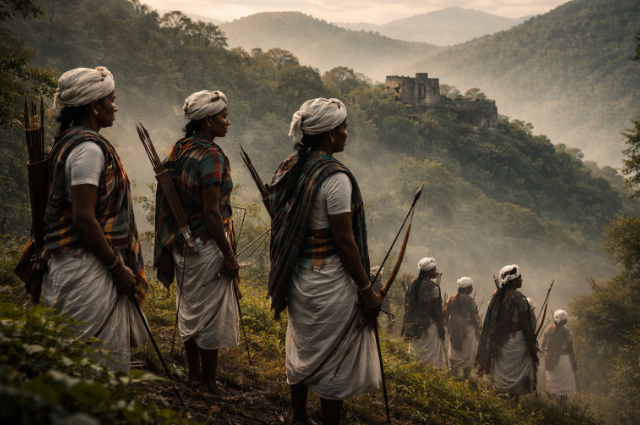
The victors often write history, but it is curated by the patriarchal. In the vast tapestry of India’s resistance against colonial & medieval incursions, the names of Rani Lakshmi Bai or Kittur Chennamma shine brightly. Yet, tucked away in the oral traditions of the tribal heartlands & forgoyyen archives of guerrilla resistance lies a story so formidable it challenges the very foundations of military history: The 12th Year War (also known as the Jani Shikaar tradition) & the legendary female battalions of the Oraon tribe.
This is the story of women who did not just support a war effort but led a generational defence strategy that repelled invaders for centuries – a military feat that remains one of the most successful examples of asymmetric warfare in the Indian subcontinent.
The Genesis: A Siege of 12-Year Intervals
The “12th Year War” refers to a series of legendary confrontations between the Oraon (Kurukh) tribe of the Chota Nagpur plateau & invading forces, most notably the Mughal commanders during the 16th & 17th centuries. According to historical folklore & tribal records, the invaders realized they could not defeat the fierce Oraon warriors in open forest combat. Instead, they devised a strategy to attack during the Sarhul festival – a time when the tribal men were traditionally intoxicated & celebratory, leaving the settlements vulnerable.
What the invaders didn’t count on was the Rohtasgarh Fort’s female defense force. Led by a woman named Princess Sinigi Dai, the women of the tribe refused to flee. Recognizing that the men were in no condition to fight, Sinigi Dai & her companions – Enagi Dai & Kaili Dai – devised a brilliant ruse. They donned male attire, wrapped turbans around their heads, smeared their faces with ash & soot, & took up the traditional weapons of the tribe.
The Strategy: Deception & Ferocity
For 12 years, the Mughal forces attempted to take the Rohtasgarh Fort. Each time they attacked, a “battalion of men” who fought with such ferocity that the imperial army was forced to retreat met them. The brilliance of the 12th Year War lay in its psychological warfare. The women knew they could not win a prolonged siege against the might of an imperial army in a conventional standoff. Instead, they utilized:
- Uniformity: By dressing exactly like the male warriors, they prevented the enemy from realizing the tribe’s demographic vulnerability.
- Guerrilla Tactics: They used the hilly terrain of the plateau to launch lightning strikes, disappearing back into the fort before the enemy could gauge their numbers.
- Cyclical Resistance: The legend suggests that these defences happened in 12-year cycles, where the women stood as the primary line of defences while the men recovered or engaged in ritualistic duties.
The deception was finally broken when a spy noticed that these “warriors” washed their faces after battle using both hands – a traditional female habit – unlike the men who used one hand. However, by the time the secret was out, the legend of the “Female Battalion” had already secured the fort’s place in history.
Jani Shikaar: The Living Memory
Unlike many historical events that fade into dusty textbooks, the 12th Year War is commemorated every twelve years in the states of Jharkhand, Odisha & Chhattisgarh through the ritual of Jani Shikaar. During this festival, Oraon women dress in men’s clothing, carry traditional weapons like spears & bows, & go on a ceremonial hunt. It is the only festival in the world where women take over the role of the hunter, symbolizing their ancestors’ role in the 12th Year War. This tradition serves as a living archive, ensuring that the military prowess of Sinigi Dai is never forgotten by the community.
The Military Significance of the Oraon Women
In modern military terms, the “Female Battalion” of the Chota Nagpur plateau represents an early form of Total Defense. While European history celebrates the “Spartan Mothers,” the Oraon women went a step further – they were the active combatants who maintained the sovereignty of their land when the traditional military structure (the men) was compromised.
Their resistance is significant for several reasons :
- Gender Neutrality in Combat : Centuries before modern armies debated putting women in front-line roles, these tribal societies practiced it out of necessity & tactical brilliance.
- Asymmetric Success : They successfully held off a technologically superior force (the Mughals) using environment-based deception.
- Cultural Preservation: The war was not just for land but for the preservation of their way of life, which the invaders sought to tax or convert.
Why Has History Forgotten Them?
The exclusion of the 12th Year War from mainstream Indian history is a result of “Double Marginalization”. Firstly, the history of tribal (Adivasi) resistance was often side-lined by British colonial historians who viewed tribal uprisings as “law & order” problems rather than legitimate wars of independence. Secondly, within the narrative of Indian resistance, the focus remained on royal houses (Rajputs, Marathas, Mughals), leaving the grassroots, egalitarian defence systems of the Chota Nagpur tribes in the shadows. Furthermore, because the history was preserved primarily through Munda & Oraon oral traditions, it lacked the written chronicles that academic historians typically rely upon. However, the persistence of the Jani Shikaar for over 400 years offers a “cultural proof” that is as undeniable as any parchment.
The Legacy in 2025
Today, as India focuses on “Nari Shakti” (Women Power) & integrates women into all wings of the Armed Forces, the story of Sinigi Dai & the 12th Year War serves as a powerful historical precedent. These women were not “auxiliaries”; they were the vanguard.
The 12th Year War teaches us that the defence of a nation is not the sole province of a professional soldier class, but the collective responsibility of a community. The Oraon female battalion proved that with strategic deception & sheer courage, the marginalized could defeat the mighty.
The 12th Year War is more than a tribal legend; it is a testament to the enduring spirit of Indian women. Princess Sinigi Dai & her battalion of disguised warriors represent a chapter of military history that demands a place in the national consciousness. They remind us that the “Female Battalion” we are now only hearing about has actually been guarding the soul of the country for centuries. As we look toward the future of defense & social equality, we must look back at the Rohtasgarh Fort & the women who, every twelve years proved that a warrior’s heart knows no gender.
. . .
References:
- Jharkhand State Culture Department : Documentation on the Jani Shikaar Festival & its Origins
- Tribal Research Institute (TRI), Ranchi : Historical archives regarding the Oraon (Kurukh) resistance against medieval incursions.
- “The Oraons of Chota Nagpur” by S.C.Roy : A seminal anthropological work that details the social structure & folklore of the tribe.
- National Commision for Scheduled Tribes (NCST) : Papers on the Contribution of Tribal Women in India’s History.
- Gazetteer of India : Historical records of the Rohtas District & the legends of the Rohtasgarh Fort defense.