
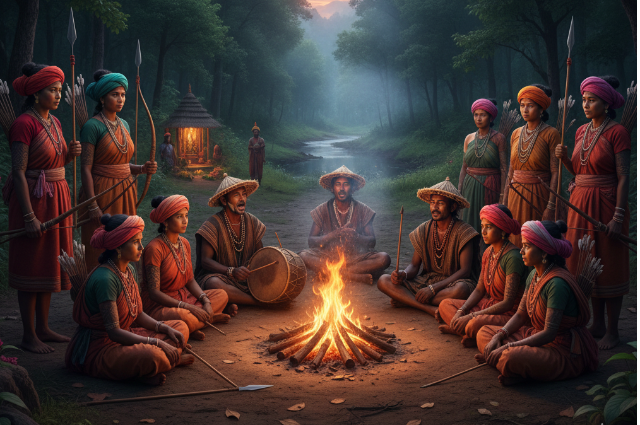
India is often celebrated as a land of a thousand festivals, yet beyond the mainstream glare of Diwali & Holi lies a deeper, ancient rhythm that beats in the heart of its indigenous heartlands. For the tribal communities of the Indian subcontinent, time is not merely a linear progression of months & years; it is a sacred cycle tied to the moon, the earth & ancestral memory. As we move through the mid-2020s, a quiet but intense anticipation is building within several tribal belts. The year 2029 stands as a significant marker on the cultural horizon, promising the return of rituals so rare they occur only once in a decade or more.
The Twelve Year Pulse: Jani Shikar (Mukka Sendra)
At the forefront of the 2029 countdown is the Jani Shikar, or Mukka Sendra, a legendary festival of the Oraon tribe primarily residing in Jharkhand, Odisha, & Chhattisgarh. This is perhaps one of the most unique tribal events in the world, occurring only once every 12 years.
The ritual is a profound celebration of female resilience & leadership. Legend has it that tribal women once defended the Rohtasgarh fortress from invaders by dressing as men& fighting with incredible ferocity. To honour this history, once every 12 years, Oraon women shed their traditional roles, don male attire – complete with turbans & traditional weapons like bows, arrows & spears - & embark on a symbolic hunt. They traverse from village to village, hunting domestic animals like pigs& goats, which are then shared in a massive communal feast that reinforces kinship & tribal identity. For the Oraon community, 2029 will not just be a year on the calendar; it will be the return of their “women’s revolution, a time when the societal hierarchy is powerfully inverted.
The Shamanic Echoes of the Northeast
In the misty hills of Arunachal Pradesh, the countdown involves more localized, yet equally rare, shamanic revivals. While many tribes like the Galo & Nyishi have annual harvest festivals like Mopin or Nyokum, they also possess “contingency rituals”- ancient ceremonies revived only during times of great cosmic or societal imbalance.
A prime example is the Ali-Ternam ritual of the Galo community. Often dormant for decades, these rituals are “lockdown” ceremonies designed to ward off malevolent spirits or pestilence. While some were revived during the global health crises of the early 2020s, tribal elders & shamans (Nyibus) often use long-term astrological alignments to determine major community purification rites. As 2029 approaches, researchers & indigenous scholars are looking toward the “Night Chants” of the Galo, where shamans perform night-long prophecies to maintain the cosmic order, a tradition that remains one of the most enigmatic oral histories in the world.
Rituals of Earth & Water: The Central Belt
For the Gond & Baiga tribes of Central India, 2029 aligns with specific harvest & tattooing cycles that define their social structure. The Baiga, known for their elaborate Godna (ritual tattooing), often reserve complex patterns for generational shifts. These tattoos are not mere art; they are believed to be the only “jewelry ” a soul carries into the afterlife. Similarly, the Koya people spread across Telangana & Andhra Pradesh, maintain elaborate water – centric rituals that coincide with the 12-year Pushkarams, which are widely known. The internal Koya tribal ceremonies- often involving secret offerings to river deities-occur in a parallel, more secluded timeline. The year 2029, following the major biennial Medaram Jatara in 2026 & 2028, will likely see the Koya returning to their most secluded forest shrines for rituals that have remained largely undocumented by the modern world.
Why 2029 Matters: The Preservation Crisis
The “countdown” to 2029 is more than just a wait for a party; it is a race against time. India’s tribal heritage is under immense pressure from modernization & urban migration. Many of the languages that carry these rituals, such as those of the Hallaki Vokkaliga in Karnataka, are considered “vanishing” as younger generations abandon ancient customs.
The Indian government has recognized this urgency. Through initiatives like the Tribal Business Conclave 2025 & the Aadi Mahotsav, there is an ongoing effort to transform tribal heritage into sustainable livelihoods. However, the rarest rituals- the ones that happen only once every 12 years – can’t be “marketed”. They exist in the sacred spaces of the akhara (communal ground) & the deep forest.
A Journey into the Ancient
As we look toward 2029, the anticipation serves as a reminder of India’s “Intangible Cultural Heritage”- a living pulse that evolves through generations. For the traveller or the cultural enthusiast, the next few years are a period of preparation. To witness the Jani Shikar or the deep forest chants of the Northeast is to step into a different dimension of time.
These rituals are a testament to the fact that culture is not static; it is a shield against erasure & a platform for self –determination. When the drums finally beat in 2029 for the Oraon women or the Galo shamans, it will not just be a performance of the past – it will be a fierce, vibrant claim on the future.
. . .
References: