
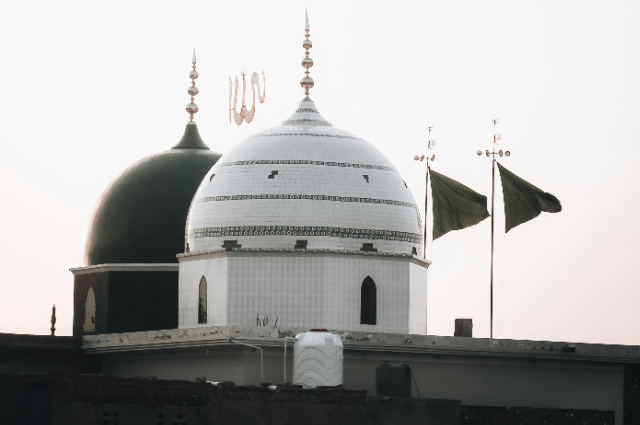
There is a small village in Gujarat where faith and psychiatry quietly shake hands every day. In Unava, in Mehsana district, stands Mira Datar Dargah, a centuries-old shrine dedicated to Hazrat Saiyed Ali Mira Datar. Locals call it the “Supreme Court” for spirit possession. Families arrive from across India with sons who shout at shadows, daughters who stop speaking, mothers who collapse without warning, and fathers who wander away from home. They come carrying plastic bags, blankets, hope, fear, and a single belief: something supernatural has taken over the body of someone they love.
Clinically, many of these patients are living with paranoid schizophrenia, conversion disorder, or bipolar disorder. Socially, they are living with stigma. Culturally, they are living inside a story where jinns, curses, and divine tests feel more real than dopamine receptors and neurotransmitters. And this is exactly why most mental-health programs fail in rural India. Because they try to replace faith with science. Unava succeeded because it refused to do that. Instead of asking people to abandon belief, it gently walked inside it.
Every day, the same pattern unfolds. A family brings a patient to the dargah. The Mujavir, the traditional faith healer, performs a ritual. Prayers are recited. Sacred water is sprinkled. The air is heavy with incense and desperation. Then something unexpected happens. The Mujavir hands the family a small referral slip and says, “The spirit is strong. To make the dua work faster, you must take this dava from the clinic next door.”
Not instead of prayer. Along with prayer. The patient walks a few steps across the compound into a modest government-supported clinic and receives antipsychotic medication. But here is the genius: the medicine is framed not as treatment for mental illness, but as a “spirit-weakening pill.” The prayer works better, they are told, when the body is strengthened by medicine.
No arguments. No lectures. No confrontation between religion and psychiatry. Just collaboration. This deceptively simple idea was created by Milesh Hamlai, a social worker from Ahmedabad and founder of Altruist. He didn’t arrive with medical degrees or academic theories. He arrived with lived experience. His own brother had schizophrenia. He had seen what families go through the oscillation between hospitals and holy places, the crushing costs of repeated rituals, the shame that keeps people silent, and the exhaustion of loving someone whose mind is slipping away.
Hamlai noticed something painfully obvious that nobody else seemed willing to address: psychiatrists were sitting in empty clinics while the dargah was overflowing with mentally ill patients. The problem wasn’t access. It was a belief. People weren’t refusing care because they were ignorant. They were refusing care because their cultural explanation of suffering was spiritual, not medical. And no amount of posters about chemical imbalance was going to undo generations of faith. So Hamlai flipped the strategy. Instead of educating patients, he educated healers.
At first, the Mujavirs resisted. They saw doctors as competitors. If medicine worked, wouldn’t people stop coming for prayers? There was also fear of losing authority and income. The shrine wasn’t just sacred; it was part of an informal economy built around rituals, rooms, and offerings. Hamlai didn’t argue. He listened. Then he reframed. He told them the spirits were stubborn. Some cases were too violent or difficult for rituals alone. The clinic could handle those, making the healers’ work easier. Medicine, he said, wasn’t replacing prayer; it was ammunition for prayer.
Slowly, trust formed. What emerged was the “divine referral” system. Mujavir became the gatekeeper. And in social psychology, whoever controls the gate controls access. Families who would never listen to a psychiatrist in a white coat would unquestioningly follow the instructions of a spiritual authority. The workflow became seamless. Ritual first. Referral next. Treatment after. Improvement follows.
Even more remarkable was the ego management. Doctors agreed to let the healers take credit. If a patient improved, the doctor would say, “It is the dargah’s blessing.” This deliberate surrender of recognition became one of the project’s strongest pillars. In community psychology, humility is rare and powerful. The impact has been staggering. Since the initiative began in 2008, over 38,000 patients have received psychiatric care through this model. It has become so effective that the Supreme Court of India cited it as a best-practice example for other states. But statistics don’t tell the real story. The real story is a mother who no longer has to chain her son at home. It’s a young woman who returns to college after months of dissociation. It’s a family that avoids sinking into debt because they don’t have to spend weeks living near the shrine, paying for endless rituals. Its dignity, quietly restored.
Psychologically, the model works because it avoids resistance. Instead of triggering cognitive dissonance by challenging belief systems, it reframes medication as part of those systems. Instead of demanding change, it integrates change. Kurt Lewin would call it an elegant example of change management: unfreeze nothing, rearrange everything.
There were challenges, of course. Some healers feared losing “customers.” Others worried about who would receive credit for cures. Both were resolved not through force, but through negotiation and empathy. The clinic took on the most difficult cases. The healers kept spiritual authority. Everyone won, especially the patients.
What makes this story extraordinary is not the medical component. Antipsychotics exist everywhere. Government clinics exist everywhere. What Unava proves is that treatment doesn’t fail because medicine is weak. It fails because systems ignore culture. Mental health doesn’t live in textbooks. It lives in families, villages, language, belief, and shame. And when programs crash into those realities instead of flowing with them, people fall through the cracks.
In Unava, nobody asks patients to choose between Allah and antipsychotics. They are both allowed. And in that permission lies healing. This model also quietly challenges a deeper assumption: that progress must look Western, sterile, and secular. Here, progress wears incense smoke and referral slips. It speaks the language of dua and dava. It understands that in many parts of India, healing begins not with diagnosis, but with meaning. “When culture becomes the cure" isn’t just a poetic phrase. It is a public-health strategy.
It reminds us that community work is not about proving who is right. It is about reducing suffering. It teaches future social workers, psychologists, and forensic professionals that sometimes the most powerful intervention isn’t a new drug or policy, it's respect. Respect for belief. Respect for local authority. Respect for the slow, fragile way trust is built. In a world obsessed with innovation through technology, Unava offers something quieter and far more radical: innovation through empathy.
Reference: