
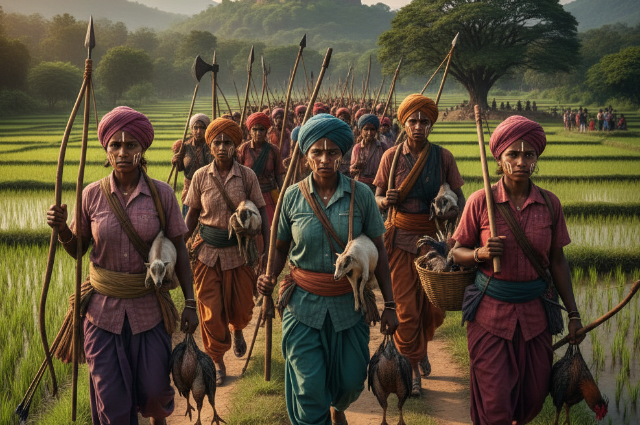
The story of Shikar Jani reveals how indigenous women use silence as a means of resistance. It shows a special way Adivasi women deal with patriarchy by taking on the roles of men for a day. On that day, they dress like men and go hunting in groups, using sticks, spears, axes, bows, and arrows. This act challenges the usual ideas about what women can and cannot do.
It tells the tale of a famous battle where women from the Oraon, or Kurukh tribe, fought bravely to protect their community from an invading army. They successfully defeated the enemy not once, but twice.
The battle happened at Rohtasgarh fort, which is now in Rohtas district of Bihar. According to folk songs and historians, Rohtas was once the main place of power for the tribe, a key fortified capital of the Oraon kingdom. There are different stories about who the enemy army was. Some claim it was the Cheros, others say it was the Turkish general Bakhtiyar Khalji’s army, and some believe it was the Mughals.
According to oral history, a milkmaid named Lundari from the Ahir caste told the enemy about the attack on the night of Sarhul, an important festival for the Oraon people, which marks the start of spring.
It was believed that after a long day of rituals and celebrations, people would be drunk on hariya (a traditional rice beer) and too sleepy to defend themselves.
So, while the men were asleep, it was the women who were awake and preparing for the night when the alarm was raised about the approaching enemy.
They were in a desperate situation, for the men were too drunk to fight. Led by the Oraon princess Sinagi Dai and her friends Champai Dai and Kaili Dai, the women dressed as men and armed themselves. Folk songs have kept this brave history alive and are still sung today. One of them goes like this:
(O see the king's daughter Sinagi Dai has come, and along with her Champai and Kaili and all the ladies, with turbans on their heads and bows and arrows in their hands, they become like men)
In traditional Oraon society, alcohol consumption is not restricted to men. It is now puzzling as to why only the men fell asleep and not the women. While it is hard to say for sure, there are several possible reasons. The most obvious is that women were busy with domestic tasks like cooking and cleaning, which kept them up late. Another more interesting idea is that women handled their alcohol better. Since Adivasi societies are mostly oral, it is difficult to know exactly who the invaders were or when these battles took place.
However, whoever they were, it is remembered that the Oraon women fought bravely and forced them to retreat twice. They even used chilies in some way to blind the enemy, who were surprised at the intensity of the fight. They caught Lundari, the one who had given away the information, and accused her of lying. She then claimed it was the women who had driven the enemy away.
When the enemy approached to take a closer look, the women hid behind bushes and saw them washing their faces at the riverbank.
They noticed that the soldiers were using both hands, whereas men are said to use only one. After confirming that they had been defeated by women, the enemy became upset and gathered their forces to attack again. This time, the Oraon women suffered a loss, but the leaders—Sinagi Dai, Champai Dai, and Kailli Dai—helped save many lives by guiding people through a secret passage.
It is said that the captured women were tortured severely, including being branded with hot iron rods on their bodies.
The enemy marked them on their foreheads with three dots in a row to show the three battles they had fought, including the final one they lost. Originally meant as a symbol of shame, the three dots eventually became a sign of the women's courage and bravery. In later years, women started to wear them proudly as traditional tattoos.
The most recent celebration of Jani Shikar was in 2017.
Over time, the festival has evolved and now includes not only the Oraon tribe but also sister tribes like the Munda, Santhal, Ho, and Kharia.
During the hunt, women walk from village to village in their neighboring areas to look for animals like ducks, hens, pigs, and goats.
In the past, women were free to hunt any animal they wanted, but now villagers choose specific livestock for the hunt. Earlier, women wore traditional men's clothing, similar to a lungi, but now they wear pants and shirts.
At the end of the day, the women return to the akhra with their catch and are joined by the men.
The leaders are welcomed back with garlands. In some villages, the women share their share and go home happy, while in others, a community meal is prepared and eaten together, followed by singing and dancing late into the night.
In modern times, Adivasi women are often seen as silent and passive victims, whether from land grabbing by corporations or brutal actions by the state.
A festival like Jani Shikar is a powerful reminder of their strength and resilience.
. . .
References:
- https://www.taylorfrancis.com
- This article has been adapted from an academic paper written by Anju Toppo (2018) in the Journal of Adivasi and Indigenous Studies.