
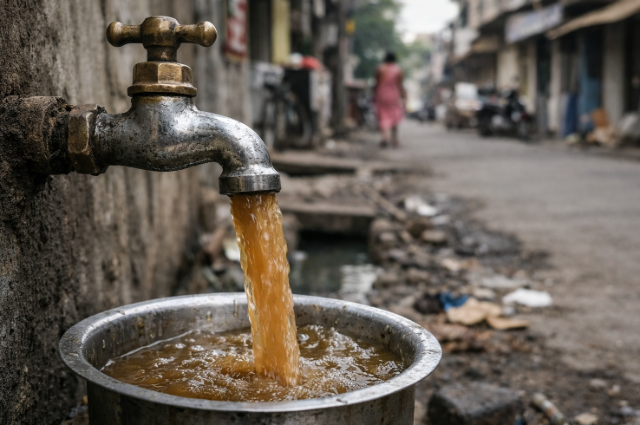
Indore is a city that people look up to when it comes to managing a city in India. It has been named the city in the country many times. This made it a great example of what can be done when the city government works well, the people get involved, and the politicians really want to make things happen. All of that changed when the people of Indore found out that their water was contaminated at the end of 2025, and it was still a problem in the new year. The water contamination crisis in Indore has really damaged the city’s reputation. Indore’s water contamination crisis is a deal. As of January 1 2026, the city is dealing with a problem of waterborne disease. This is an issue because it shows that the city is not as clean as people thought. At first, it seemed like an accident. When you look closer, you see that it is actually a result of people not doing their jobs, ignoring warnings and being careless. The waterborne disease is a problem, and it is clear that the city has been doing a bad job of taking care of this issue. The city has a disease, and it is a serious problem that needs to be fixed.
Public health experts all think that these kinds of outbreaks do not happen all of a sudden. When a lot of people get gastroenteritis, it usually means that the water people drink from has been contaminated for a time. The people who looked into this problem at the Indore Municipal Corporation found out that this is what happened. They found a problem with the water system that should not have been allowed to happen in a city that says it has good sanitation. The main pipeline that carries drinking water was leaking under a toilet at a police checkpoint. This is a serious issue with the water system that people use to get their drinking water. The experts who investigated this problem at the Indore Municipal Corporation found that the main drinking water pipeline was leaking directly beneath a toilet at a police check post, which is a big mistake. This is really bad. The toilet was built without a tank or a safety tank. This means that dirty water from the toilet can go into the soil around it. The dirty water can also get into the water line that is already damaged. The toilet is a problem because it does not have a septic tank or a safety tank. Raw sewage from the toilet is going into the soil and into the water line.
This was not a problem with the system; it was a big mistake that went against the basic rules of keeping people healthy. The pipes that carry drinking water and the pipes that carry sewage are supposed to be completely separate, with many layers of protection to stop them from getting mixed up, even if there is a leak. But in Bhagirathpura, drinking water pipelines and sewage systems were not separated as they should be, so those protections were not there to keep people safe. The drinking water pipelines and sewage systems are very important, in Bhagirathpura the drinking water pipelines and sewage systems were not set up correctly. The toilet is placed over a water pipeline. This is an idea. There is no safety tank to prevent accidents. People did not find the leak. Fix it on time. All these things together show that there were mistakes in the planning of the toilet, the construction was not checked properly, and the regular checks were not done correctly. The toilet and the water pipeline are a problem because of these mistakes.
The thing that is really worrying about the situation in Indore is not how bad the damage is. What the papers show about what the people in charge knew and when they knew it. This was a time when nothing was done. No one took any steps to deal with the problem. There was no check to find out if the water was contaminated, no change in the water supply, no warnings to people to boil their water and no emergency plan to make the water safe. The paperwork just sat there, not moving, while people, in charge did nothing. Meanwhile, thousands of people drank contaminated water every day. The contaminated water problem was not being addressed.
In India, when something goes wrong, the government often. Fires people at the lower and middle levels of bureaucracy. The big question is, will they also look at the people at the top and see if they made any bad decisions? They need to check if there were problems with money or if the way the government works is not good. For example, some important papers were not signed for over a year. If they do not look at these things, then the people who are really responsible might not get in trouble. The problem is that they might just blame the people and not fix the whole system that caused the problem. The system that allowed the disaster to happen is the issue, and that is what needs to be changed. The bureaucracy system itself the bureaucracy system needs to be looked at.
The problem in Indore is a warning for cities in India. Just because a city looks clean and has streets it does not mean that everything is okay. The city may have streets and nice walls but the water people drink can still be dirty. People often do not think about the water supply system because it is underground. However the water supply system is very important for keeping people healthy. What happened in Indore shows that a city can be considered clean but still have problems with providing safe water for people to drink. The water supply system in Indore is an example of this.
The Indore water contamination crisis is really about what people think is important. People let papers sit around and do nothing while dirty sewage got into the water that people drink. They did not follow the rules for building things until a lot of people died. Nobody was held responsible until it was too late. Lives were lost. This was not because people did not know what to do or because they did not have the tools; it was because they did not care enough, they were not paying attention and they were not doing their job. The Indore water contamination crisis shows that people need to take responsibility and make sure the water is safe to drink.
Indore’s reputation as India’s cleanest city will now be measured not by awards or rankings, but by how honestly it confronts this failure and reforms its systems to prevent a recurrence. Clean cities are not defined by appearances alone; they are defined by the invisible integrity of their infrastructure and the visible integrity of their governance.
. . .
References