
In rural India, most of the mental health institutions fail as they replace faith with science, but the Altruist NGO figured out how to balance and combine both to get people the help they need. The way the whole system works is that a patient comes to the NGO with issues, and the mujavir performs a dua or exorcism ritual. The mujavir provides the family with a referral slip that is designed by the Altruist NGO, the referral slip has the following written on it,'' The spirit is strong. You must go to the clinic in the Dargah and take 'Dava' to weaken the spirit so my prayers can work" The patient then goes to the government -funded clinic and takes the antipsychotics with the belief in mind that the pills are for weakening the evil spirits and, in turn, gets better.
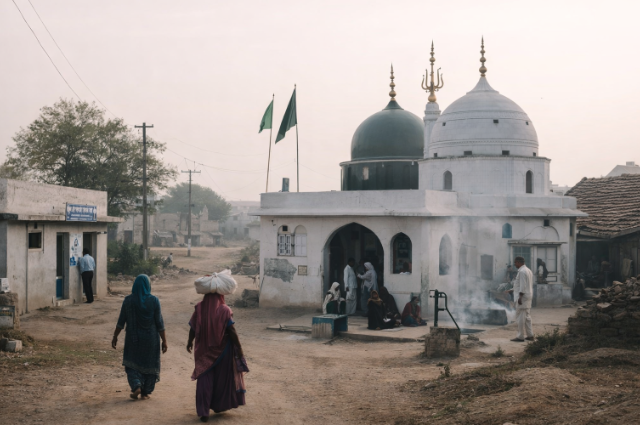
The Mira Datar Dargah in Unava in Mehsana district in Gujarat is a shrine that is dedicated to the martyr Hazrat Saiyed Ali Datar and is known in India as the "Supreme Court " for spirit possession. Thousands come to the dargah seeking relief from the so-called jinns, which most of times are people suffering from mental health issues like Paranoid Schizophrenia, Hysteria or Bipolar Disorder. The founder of the Altruist NGO, Milesh Hamlai, started the NGO as he realised that the dargah was filled with mental health patients seeking help, but their issues wouldn't be solved, as the mental health clinics continued to be empty. He also understood that since the patients didn't understand that their issue was related to the mind, but instead thought that it was spiritual was why they didn't come to the doctors. Milesh decided to educate the healers, or the so-called jinn removers, instead of the patients. His mission was also a result of how he saw his own brother suffer from Schizophrenia; he saw directly how families struggled amid stigma and taboo associated with mental health. His NGO, Altruist, treated more than 38,000 patients, which became so successful that the top court of India used it as an example and model that other states can follow. It took Milesh a lot to convince the mujavirs, as they saw the doctors as a competition and a threat, but somehow he managed to convince them that the "spirits" were so strong that they needed "medical treatment".
Milesh, the social worker, knew how ingrained the beliefs of the people were, so instead he reframed medication as a tool that would help them without breaking their belief system. By coming to an understanding with the mujavir, they opened doors to patients who wouldn't even be willing to trust doctors in their dreams. We can also see how the main intention of the doctors was just to make sure that the patients got the necessary medical care, as according to Milesh's understanding with Mujavir, the doctors didn't get any credit; they only said that it was the dargah's blessing once the patient recovered. The medicines and diagnosis were provided free of cost, which also helped in gaining people's trust.
This model has not only changed mental health access at Mira Datar Dargah, but it also motivated similar collaborations throughout rural India, where customs often clash with modern medicine. Milesh trained over 200 mujavirs about Altruist’s workshops. he empowered them to identify the indicators of schizophrenia or bipolar disorder as ‘powerful jinns or spirits’ which need double intervention; the spiritual rituals were paired with antipsychotics from the medical clinics. Surveys by the NGO show that 70% compliance rate to medication among the patients who were referred was far higher than traditional clinics, which led to a reduction in relapse and hospital admissions. The SC in 2022, asking other states to use it as a model, highlights the mission’s reach and its adaptability. States like Rajasthan and Uttar Pradesh are testing “faith-friendly” mental health outreach programs. Altruist’s approach makes us understand an important lesson; they delivered evidence-based care and necessary care to the patients while also respecting deeply ingrained beliefs, which helped bridge gaps in India’s mental health system, where just 0.75 doctors serve a population of 1.4 billion. According to Altruist's longitudinal statistics, the strategy has increased help-seeking behaviour by 40% in pilot locations by tackling stigma, which is entrenched in traditional myths of divine sorrow. Although there are still issues, such as training scalability and maintaining a steady medicine supply in isolated areas, achievements like Mira Datar's 500+ annual referrals show that it is feasible.
In a postcolonial setting where indigenous healing practices and Western biomedicine intersect, this hybrid paradigm challenges the dichotomies of "superstition" and "science." In the midst of growing mental health loads from urbanisation and pandemics, it fosters equal access to culturally appropriate care that may be scalable through India's Ayushman Bharat initiative.
There are still issues with maintaining training in the face of high mujavir turnover, obtaining antipsychotic supply in underprivileged areas, and using RCTs to assess long-term efficacy. According to Lancet Psychiatry (2024), however, partnerships with Ayushman Bharat Digital Mission offer a statewide implementation that could prevent 10 million untreated cases annually. Altruist provides a model for fair, culturally sensitive care in the Global South by reimagining mental health governance and validating indigenous epistemologies.
References