
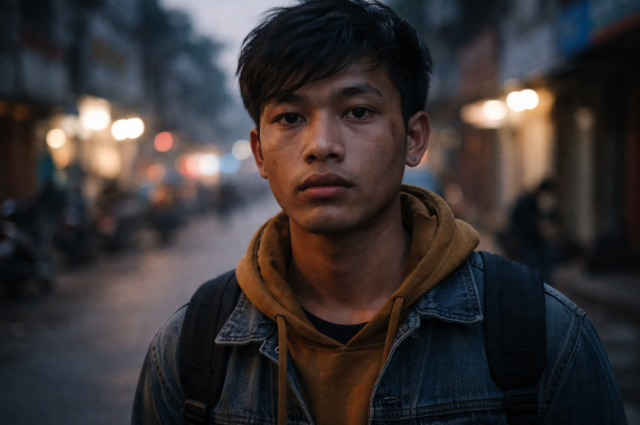
‘We are not Chinese…What certifications should we show?’’ Anjel Chakma said before being brutally killed.
Anjel Chakma, a 24-year-old MBA student from Tripura, on December 9, 2025, in Uttarkhand’s Dehradun, shopped for household items with his younger brother in Selakui locality, when intoxicated men approached him and called him racist slurs (Chinese, Momo). When Chakma objected to it, they attacked him with knives and rods. Chakma fought for his life for 16 days in a hospital in Dehradun and passed away on December 25. Police downplayed the incident, saying that it happened ‘in the heat of the moment’ and ‘jest.’
Anjel Chakma’s case is not the only case, for years, Northern Eastern Indians have faced discrimination based on race, another such case is of Nido Tainam, a 20-year old student, had visited Lajpat Nagar along with his three friends and had inquired about directions to a common friend’s house, he had reached a panner shop when he inquired about his friend’s location and was humiliated and laughed at. He was also physically assaulted and succumbed to his injuries on 30 January 2014. Nido Taniam ‘s postmortem report revealed that he died due to serious internal and external injuries to his head, face, and lungs from a blunt object. The cause of his death was detected as Cerro Pulmonary Oedema.
During the COVID-19 pandemic, a lot of northeastern citizens faced discrimination; people called them racist slurs like chinki,chini, etc. A woman from Manipur living in Delhi was spat on by a man on a scooter who called her ‘‘corona’’. Northeastern citizens reported that people were avoiding them in public transportation, shops, and residential areas. Some were even forced to leave restaurants and rented accommodations. In Gujarat, nine professionals from Nagaland with no travel history were forced into a quarantine facility because people mistook them for Chinese and reported them to be infected.
The identity paradox faced by Northeastern Indians like Chakma and Taniam, where they are constantly forced to prove their ‘‘Indianness’’ even though they have constitutional citizenship. Homi Bhabha’s postcolonial theory of mimicry and otherness can be applied here, Northeastern Indians have East Asian features that create mimicry of ‘otherness’clashing with mainland India’s ‘Indianness’, embodying the paradox of constitutional citizenship and exclusion, proving belongingness echoes Bhabha’s ‘‘almost but not quite’’.Chakma’s plea for a certificate of ‘‘Indianness’’ reveals Bhabha’s ambivalence, where Northeastern Indians occupy a third space, hybrid yet discriminated.
Strict measures should be taken against the perpetrators, as the Northeastern Indians deserve to walk the streets of India without being killed or attacked. They deserve to feel safe in their country and not be treated as outsiders. The voices of the Northeastern Indians need to be heard; the Indian government can’t keep quiet as a state of India burns.
Curriculum should include the Northeastern part of India, which should include their tribes, food, ethnicities and culture. Utmost care should be taken for this inclusion in the curriculum to be unbiased. The people of India should come together and protest against the discrimination against Northeastern Indians and force the Indian government to take action. Strict enforcement of existing laws, such as equality before the law or the right to equality, should be ensured. Social platforms should be used to spread awareness about incidents and to raise a voice against injustice and discrimination. A comprehensive anti-racial law should be enacted, as urged by Tipra Motha Party(TMP) and Bezbaruah Committee; these 2014 recommendations were ignored. One can also support the December 28, 2025, Supreme Court PIL for nodal agencies, special police units in districts and FIR protocols recognising racial bias.
Anjel Chakma’s death is a reminder of how racism does not start with knives but instead with slurs, everyday exclusion and laughter. Putting an end to this violence requires more than just laws; it requires an ethical shift in how India sees its own people. Until Northeastern people are treated not almost Indian but fully and unquestionably Indians, until then, the promise of equality remains unfulfilled.
. . .
References