
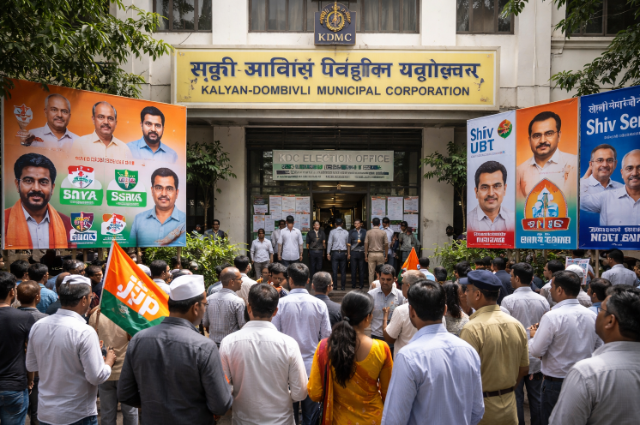
In early January 2026, the Kalyan-Dombivli Municipal Corporation (KDMC) elections took an unprecedented and controversial turn. Twenty candidates from the ruling Mahayuti alliance were declared winners without a single vote being cast. What should have been a routine local body election instead became a political flashpoint, raising serious questions about democratic processes, administrative neutrality, and voter rights.
The reason for these unopposed victories was startling. By the final nomination withdrawal deadline of January 1, 2026, every rival candidate in these 20 wards—belonging to major opposition parties as well as independents—had either had their nomination papers rejected or had withdrawn from the race. With no one left to contest against them, Mahayuti candidates walked straight into office.
Out of the 122 seats in the KDMC, this meant that nearly 16% of the municipal corporation was decided without an election.
Who Benefited?
The political gains were clearly tilted in favour of the ruling alliance:
- Bharatiya Janata Party (BJP): 14 seats
- Shiv Sena (Eknath Shinde faction): 6 seats
According to official withdrawal data, the opposition collapse was widespread:
- 7 candidates from Shiv Sena (UBT)
- 5 from the Maharashtra Navnirman Sena (MNS)
- 6 from the NCP (Ajit Pawar faction)
- 1 from the NCP (Sharad Pawar faction)
- 2 from the Congress
These withdrawals effectively cleared the field for Mahayuti candidates in several key panels and wards across Kalyan and Dombivli.
Familiar Names, Easy Wins
Media reports from NDTV Marathi and The Times of India highlighted several prominent unopposed winners. Among them was Harshal More, son of sitting MLA Rajesh More, who won unchallenged in Ward 28A. In Ward 24, Shiv Sena candidates Ramesh Mhatre, Vishwanath Rane, and Vrushali Joshi secured a clean sweep.
The BJP saw early victories through Asavari Navare in Dombivli (Ward 26C) and Rekha Chaudhary in Kalyan (Ward 18A). One withdrawal that drew particular attention was that of Manoj Gharat, the MNS Dombivli City President. His sudden exit from the race reportedly paved the way for a straightforward BJP win.
While such unopposed victories are not unheard of in Indian elections, the sheer scale and speed at which opposition candidates vanished raised eyebrows across the political spectrum.
“Mandate or Manipulation?”
The opposition was quick to reject the idea that these wins reflected public support. Instead, they labelled the episode a “systemic scam.”
Shiv Sena (UBT) MP Sanjay Raut made the most explosive allegation, claiming that candidates were offered bribes of up to ₹5 crore to withdraw. He alleged that “bags of cash” were delivered to candidates’ homes and demanded an investigation into phone records to identify which ministers or officials contacted candidates in the final hours before withdrawals closed.
Other leaders echoed similar concerns. Samajwadi Party leader Abu Azmi alleged that money and pressure were openly used to force withdrawals, while Shiv Sena (UBT) leader Kedar Dighe questioned how candidates could be declared unopposed when Electronic Voting Machines still include a NOTA (None of the Above) option.
Beyond money, opposition parties accused the State Election Commission (SEC) of selective enforcement. They claimed that opposition nominations were rejected for minor clerical mistakes, while similar errors in Mahayuti papers were ignored—an allegation the SEC has not officially endorsed but has not dismissed either.
The Legal Battle Begins
As public outrage grew, the matter moved to the courts. Social activist Shrinivas Ghanekar filed a petition in the Bombay High Court arguing that voters had been disenfranchised. His argument was simple: even if only one candidate remains, elections should still be held so voters can choose NOTA.
The Aam Aadmi Party (AAP) went a step further, proposing the idea of a “virtual candidate.” According to this demand, if NOTA were to receive more votes than the sole
References
The "Unopposed" Numbers (The Fact Sheet)
- Total Seats Won Unopposed: 20 seats in KDMC.1
- Party Wise: 14 BJP and 6 Shiv Sena (Eknath Shinde).2
- Opposition Drop-outs: A total of 21 candidates from the opposition withdrew, including 7 from Shiv Sena (UBT), 5 from MNS, 6 from NCP (Ajit Pawar), 1 from NCP (Sharad Pawar), and 2 from Congress.
- Wards Involved: Key wards include Panel 24 (Ramesh Mhatre, Vishwanath Rane, Vrushali Joshi), Panel 23 (Deepesh Mhatre, Jayesh Mhatre), and Panel 28A (Harshal More).
Key Quotes: What the Leaders Said
The Opposition (The Accusations)
- Sanjay Raut (Shiv Sena UBT MP): > "This has never happened in the country’s electoral history.3 Bags containing ₹5 crore each were delivered to the candidates' houses to force them to withdraw. Even the State Election Commission has become a 'pet cat' of the government. Investigate who called whom in the last 24 hours—which minister or which office made those calls." (Source: The Hindu / TOI)
- Abu Azmi (Samajwadi Party President): > "There was a lot of pressure on our councillors to withdraw after taking money. Wherever money was distributed, nominations were withdrawn." (Source: Times of India)
- Kedar Dighe (Thane Shiv Sena UBT President): > "If there is a NOTA button on the EVM, how are they declared 'unopposed'? The Election Commission should place the NOTA button against them. That would show how many voters actually oppose them." (Source: NDTV Marathi)
The Ruling Alliance (The Defence)
- Eknath Shinde (Chief Minister): > "This is an endorsement of our party's work and the 'Ladki Bahin' initiative. Those who call themselves 'Brands' will see their 'Band' played in this election. It reflects growing voter confidence even before polling." (Source: Indian Express / NDTV Marathi)
- Keshav Upadhye (BJP Spokesperson): > "The BJP’s momentum continues. Across 8 corporations, 44 candidates are elected unopposed from the BJP alone. This is the result of ground-level work." (Source: X / Times of India)
Institutional & Legal References
- State Election Commission (SEC): Commissioner Dinesh Waghmare confirmed that the SEC will not formally declare these 20 winners until a report is submitted by the Municipal Commissioner.4 They are checking if the withdrawals were due to "duress, pressure, or allurement." (Source: The Hindu)
- The "NOTA" Petition: Activist Shrinivas Ghanekar filed a petition in the Bombay High Court citing a Supreme Court precedent. He argues that voters cannot be deprived of their right to vote just because there is one candidate, as they still have the right to choose NOTA. (Source: NDTV Marathi)
- Congress Disciplinary Action: The Kalyan District Congress expelled two leaders, Laxman Ambhore (Panel 23-D) and Chetan Bhandari (Panel 1-A), for "anti-party activities" after they withdrew their forms without permission, handing easy wins to the Mahayuti.5 (Source: Times of India)