
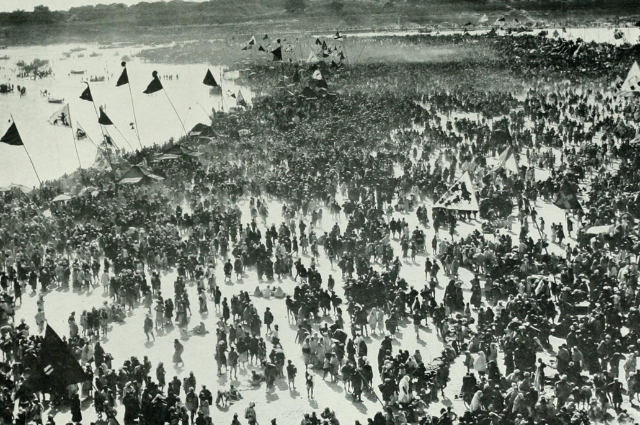
The Shankaracharya controversy started at the Magh Mela in Prayagraj, which is one of the biggest Hindu festivals where millions come together to take a holy dip. At the time of Amavasya, which is one of the most crowded and sacred days of the year, Swami Avimukteshwaranand Saraswati, who calls himself the Shankaracharya of Jyotirmath, was going to the river for a holy dip with a procession of his followers, but the procession was stopped by the Mela administration and police. The administration and police stated that the area was too crowded and that such processions without any permission increase the risk of a stampede.
The administration also questioned Swami Avimukteshwaranand on 20 January 2026, asking him to explain why he was using the title of Shankaracharya in public events when a case with regard to the title has been pending in the apex court since 2022. This meant that legally, his claim to the title still wasn't settled.
This incident was just a simple incident, something that happened due to safety concerns and legal reasons, but it was made something bigger.
Swami and his supporters were unhappy with this; this act was seen as disrespectful and an insult to Swami and the faith. It was alleged that the followers were mistreated by the officials, and the Swami also criticised the administration for a holy event needing official permission.
Different political parties jumped in, giving their opinion on the matter. Some defended the situation, while others saw it as an insult to a religious figure and as hurting the sentiments of the public. The statements of the political parties made the incident look bigger than just a festival disagreement.
The reasons this incident started. This was more than just:
One procession was halted.
The absence of one sacred rite. It got contentious due to several overlapping factors:
- Religious authority: "Shankaracharya" is a title that has spiritual significance.
- Legal ambiguity: He used his title in connection with a Supreme Court case that was still pending.
- Administration vs tradition: while officials cited safety procedures, followers perceived a lack of consideration.
- Political narrative: many parties employed it to convey their own messages.
- Public opinion: followers believed they were being denied access to something holy.
Therefore, this dispute cannot be boiled down to a standard law enforcement response at a religious event. It happened at the nexus of politics, religion, law, and governance—each with its own weight and sensitivities. The Magh Mela is a highly significant event when religious customs are performed in public and communally; it is more than just a festival. Any disturbance in such a setting is certain to elicit intense emotional reactions, particularly on an auspicious day like Amavasya. The holy plunge is a spiritually charged act that devotees believe atones for sins and guarantees heavenly grace; it is neither elective nor ceremonial. Thus, rather than being a practical nuisance, being barred from taking part in it by a procession led by a highly esteemed religious figure was perceived as a spiritual deprivation.
The disputed authority of Swami Avimukteshwaran and Saraswati was at the centre of the dispute. In Hindu philosophy, the title of "Shankaracharya" contains centuries of moral leadership and religious credibility, making it more than just an honorific. A difficult situation where religious belief and the legal system clash arises when such a title is legally contested. Legal legality and respect for the Supreme Court's upcoming decision were the administration's reasons for contesting the title's use. However, the state seemed to be putting itself in a position to judge spiritual legitimacy, and followers saw this intervention as an infringement on religious autonomy.
The administration had good reason to prioritise safety and crowd control. Authorities are under tremendous pressure to stop stampedes at religious gatherings, which have historically resulted in sad deaths. According to this viewpoint, halting an unauthorised procession on the busiest day of the Mela could be considered a preventative action. Nonetheless, the escalation was facilitated by the enforcement's insensitivity and poor communication. Safety procedures run the risk of coming across as dictatorial rather than protective when they are put into place without sufficient interaction with religious leaders and followers.
The situation became much more complex due to political meddling. The issue was no longer limited to the Mela grounds as political parties entered the conversation. It evolved into a weapon for more general ideological conflicts—between state power and religious organisations, between secular government and religious liberty. Political leaders' statements presented the episode in divisive ways, either as an assault on Hinduism or as an essential defence of the rule of law. Public indignation was heightened by this politicisation, which also diverted focus from the initial legal and administrative issues.
The controversy was sustained mostly by public opinion. Many adherents felt their religious freedom was being selectively restricted, which fueled their resentment and suspicion of the government. Partial narratives and emotionally charged allegations spread quickly in an era of instant media dissemination, frequently overshadowing accurate answers. Official explanations were not as effective as the sense of denial—of not being able to access something sacred.
In the end, what started out as an administrative choice pertaining to safety turned into a symbolic struggle for power, legitimacy, and faith in modern-day India. The episode highlights how precarious the equilibrium between religious tradition and contemporary administration is, particularly in settings where millions of people congregate for religious reasons rather than legal ones. It emphasises the necessity of communication, tact, and openness, without which even small-scale actions might become national disputes.
References