
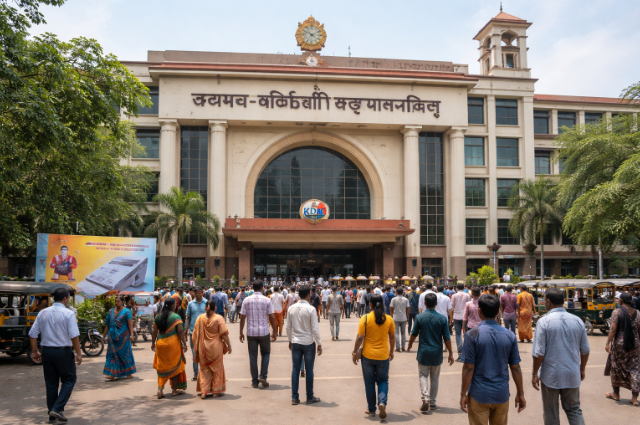
When Democracy Happens Without Voting
In early January 2026, elections to the Kalyan-Dombivli Municipal Corporation (KDMC) became the centre of a major political controversy. Twenty candidates from the Mahayuti alliance were declared elected unopposed after rival candidates either withdrew their nominations or had them rejected before the January 1 deadline.
Out of 122 total seats, nearly 16 per cent of the corporation was filled without polling. No votes were cast in those wards. No EVMs were deployed. The absence of electoral contestation triggered allegations ranging from financial inducements to administrative bias.
While the ruling alliance framed the outcome as a reflection of growing political dominance, opposition parties described it as a structured manipulation of democratic competition. The matter is now under administrative inquiry and judicial scrutiny.
Electoral Outcomes and Political Context
The Mahayuti alliance secured 14 seats for the BJP and 6 seats for the Shiv Sena faction led by Chief Minister Eknath Shinde. These victories followed withdrawals by candidates from Shiv Sena (UBT), MNS, NCP (both factions), and Congress across multiple panels.
Unopposed victories are legally valid under Indian election law if only one candidate remains after the scrutiny and withdrawal stages. However, in competitive urban municipal bodies, such outcomes are statistically uncommon.
Municipal corporations govern urban infrastructure, sanitation, road networks, local taxation, and development contracts worth hundreds of crores annually. Therefore, even a partial block of uncontested seats can significantly affect governance dynamics.
Allegations of Financial Inducement
Shiv Sena (UBT) leader Sanjay Raut alleged that candidates were offered up to ₹5 crore each to withdraw their nominations. If multiplied across 20 seats, the figure would total ₹100 crore, an allegation that has shaped public debate around the elections.
No verified financial evidence has yet been presented publicly. However, the allegation underscores the broader concern of money power in Indian elections.
According to data from the Association for Democratic Reforms (ADR), over 43 per cent of MLAs elected in recent state elections across India declared criminal cases against themselves, and a significant proportion reported assets of crorepati-level. ADR reports consistently highlight the growing role of financial resources in electoral success, particularly in state and local contests.
Administrative Scrutiny and Institutional Neutrality
Opposition parties also accused the State Election Commission of selectively rejecting nominations on technical grounds.
Nomination scrutiny in India is governed by statutory provisions that allow rejection for incomplete affidavits, incorrect documentation, or failure to meet reservation requirements. While legally permissible, such technical scrutiny has historically sparked controversy when applied inconsistently.
In 2017, several nominations were rejected in municipal elections across Maharashtra over affidavit discrepancies, leading to legal challenges. Similar disputes have occurred in Gujarat civic polls and Uttar Pradesh local body elections, where courts later examined whether rejections were procedurally justified.
The SEC has stated that it will withhold formal certification of the 20 KDMC winners until inquiry reports determine whether withdrawals occurred under “duress, pressure, or allurement.”
The NOTA Debate and Legal Interpretation
A petition filed in the Bombay High Court argues that even when a single candidate remains, voters should retain the right to cast ballots and choose NOTA (None of the Above).
NOTA was introduced nationwide following the Supreme Court's 2013 judgment in the case of the Supreme Court of India (People’s Union for Civil Liberties vs Union of India). However, Indian law does not currently mandate re-election if NOTA receives the highest number of votes.
The petition contends that declaring candidates elected without polling deprives voters of symbolic dissent. Legal experts remain divided on whether the constitutional right to vote extends to mandatory polling in uncontested seats.
Niche Analysis: Unopposed Urban Wins and Democratic Competition in India
Why Urban Unopposed Wins Are Rare
Unopposed elections are relatively common in rural panchayats, especially in states like Maharashtra and Gujarat, where “consensus panels” are sometimes formed to avoid political division.
However, urban municipal corporations historically display high levels of competition. For example, in the 2017 elections to the Brihanmumbai Municipal Corporation (BMC), one of India’s wealthiest civic bodies, fewer than 2 per cent of seats were won unopposed despite intense political rivalry.
Similarly, during Gujarat’s 2021 local body elections, while several gram panchayat seats were uncontested, major municipal corporations such as Ahmedabad and Surat witnessed robust multi-cornered contests.
KDMC’s 16 per cent uncontested rate, therefore, stands out within an urban comparative framework.
Case Study: Surat 2021 Municipal Election
In the 2021 Surat Municipal Corporation elections, the Aam Aadmi Party made significant inroads despite being considered an emerging force. The election demonstrated that urban voters often produce competitive and unpredictable outcomes when contests occur.
The contrast between competitive urban contests like Surat and uncontested clusters in KDMC raises important structural questions: are withdrawals purely political calculations, or do systemic pressures shape candidate decisions?
Money Power in Local Elections: Statistical Context
According to ADR analyses of municipal and state elections between 2018 and 2023, the average declared assets of winning candidates have steadily increased. In several state assembly elections, more than 60 per cent of winners were crorepatis.
While these figures do not prove wrongdoing, they illustrate a broader national pattern in which financial capacity plays a decisive role in candidate viability. In local bodies where oversight is weaker than in parliamentary elections, the impact of monetary influence may be even more pronounced.
Democratic Legitimacy and Voter Participation
India’s voter turnout in municipal elections typically ranges between 45 and 60 per cent in urban areas. Lower participation compared to state and national elections already reflects urban voter disengagement.
When seats are filled without polling, participation effectively drops to zero in those wards. Even if legally valid, such outcomes deepen concerns about democratic disengagement and procedural minimalism.
Political theorists argue that democracy requires not only legal compliance but also active contestation. The KDMC episode falls directly into this debate.
A Structural Warning for Urban Democracy
The KDMC controversy is not merely about twenty seats. It represents a stress test for India’s urban democratic institutions.
If investigations confirm coercion or inducement, it would expose serious vulnerabilities in local electoral systems. If no wrongdoing is proven, the episode may still reveal how fragmented opposition politics and procedural technicalities can produce outcomes that appear democratically hollow.
Urban India is expanding rapidly, and municipal corporations manage increasingly complex governance responsibilities. Ensuring transparency, competition, and voter participation at this level is crucial to maintaining democratic legitimacy.
Whether the KDMC withdrawals represent strategic politics, administrative failure, or something more serious remains under inquiry. But the larger lesson is clear: democracy must be seen to function, not merely declared to function.
References:
- Association for Democratic Reforms (ADR) Analysis of Criminal and Financial Background of MLAs in State Elections (2018–2023): https://adrindia.org
- Handbook for Returning Officers (Nomination Scrutiny Rules): https://ecp.gov.pk
- Election Commission of India – Statistical Reports https://en.wikipedia.org
- Summary reference (PRS Legislative Research): https://en.wikipedia.org
- People’s Union for Civil Liberties vs Union of India (NOTA Judgment, 2013) Supreme Court Judgment (Full Text via Supreme Court of India): https://www.alec.co.in
- KDMC Election Coverage (January 2026) The Hindu – KDMC Unopposed Seats & SEC Inquiry https://www.thehindu.com
- Brihanmumbai Municipal Corporation (2017 Election Data) Official Results Archive: https://en.wikipedia.org