
When Life Meets Bureaucracy.
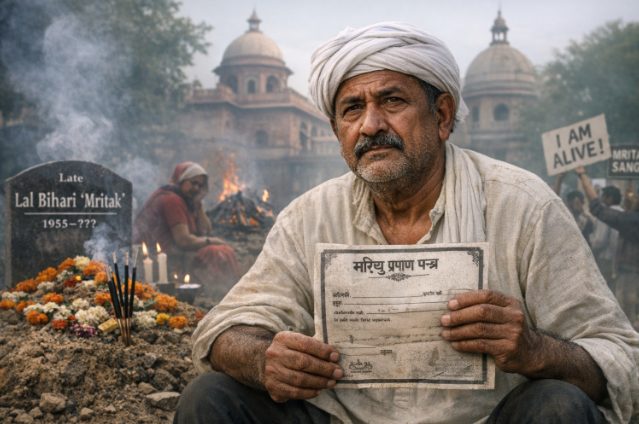
Lal Bihari “Mritak is one of the most remarkable tales in the Indian law. It is a story that contains a mixture of tragedy, black humor, and the struggle of no yield against a system full of corruption. Promoted to death on record at the age of 20, the fight of the 20-year-old Lal Bihari to establish his living position reveals the flaws of the bureaucratic machine of India, as well as arouses a nationwide wave of people who had been mistakenly pronounced dead.
The Death of Lal Bihari (1975)
Suppose you find out that you do not exist on paper. This is what happened to Lal Bihari, a 20-year-old weaver of Azamgarh, Uttar Pradesh, in 1975. One of the last regular efforts to secure a bank loan took a turn when police officials told him that he was legally deceased.
This reason was shocking and disgustingly easy. Lal Bihari was also sponsored by his uncle to buy out the local revenue official (Lekhpal) with some 300 rupees to get the certification of Lal Bihari as a dead person, hence legalizing almost one acre of hereditary land. Lal Bihari had been deprived of his legal identity, claim to property, and the right to access the services of government in a snap on bureaucracy. The fact of how a living citizen can be erased from the records of the state by use of corruption, the administration being opaque, and poor accountability mechanisms has been highlighted by his case.
The Shock of Death: The Comprehension of Paper Deaths.
The fact that a person is declared dead against his or her wishes is a deep one. It also meant that Lal Bihari could no longer access bank services, legal services, and could not even be recognized in society. The law regarded him as no longer a citizen. This is not what is called in Lal Bihari the paper death. In India, people have been fraudulently declared dead, usually involving inheritance issues or land grabbing, or in fraudulent claims to pensions, thousands of times.
The interests in the case of Lal Bihari were personal. He was not able to obtain a bank loan to sustain his life any longer, and his property was taken away against the law. The motive was also evident; his uncle, by announcing his death, obtained the legal possession of the family land. The deception of one of his family members, the collusive bureaucracy, made Lal Bihari find himself in an unreal struggle for survival.
The 19 Years Old “Ghost Life Fighting with a System that refused to notice him.”
Time-honored judicial solutions were not succeeding. The government offices and courts of justice kept passing the buck on each other, with the official records being seen as absolute. Lal Bihari faced institutional insensitivity, and he proceeded to use unconventional but tactical approaches to create awareness.
Innovative Legal and Social Pursuits.
Lal Bihari took his own cousin, the son of the uncle who took away his land, in anticipation of arrest. Police declined, claiming that a legally dead man could not be charged.
He arranged his own funerals, hoping that the state would come and bury him, supposedly as he were dead.
He also forced his wife to claim a widow's pension. After the authorities turned down the claim due to the fact that Lal Bihari was physically present, the claim sought, in writing turning denial into documentary evidence of life.
These were extreme measures, but within them lay more fundamental administrative scoundrel, a system that could proclaim a man dead, but could never pronounce him alive.
Political Games: Weak Democracy as Evidence of Life.
Lal Bihari went a notch higher into politics. In 1989, he submitted nomination papers to run against parliamentary elections with then Prime Minister, Rajiv Gandhi, and subsequently with V.P. Singh. These filings were symbolic, but had the effect of making the Election Commission determine his authenticity, creating official recognition of his existence.
The Name Change
He officially inserted the suffix Mritak (Deceased) into his name, to protest against which he also wrote letters as Late Lal Bihari Mritak. This ironically designed irony pointed out the futility of his legal position, as it maintained the civic interest in his case.
Other such technical absurdities of India are elements of the Indian legal system, like the fact that kite-type kites are an aircraft within the Aircraft Act, 1934, which demonstrates the way the old or literal interpretation of law can lead to the detachment of governance and reality.
Winning After Almost Twenty Years.
Sixteen years, six months, and 23 days later, a District Magistrate, on June 30, 1994, promptly rectified government accounts, and, fair, honest, and truthful, set Lal Bihari free. It is also important to note that he did not reclaim the disputable land immediately and instead forgave his uncle.
At this stage, the fight of Lal Bihari had acquired a larger dimension than individual compensation. It was now a personal mission to reveal the injustice of the system and help other people who were in the same bureaucratic limbo.
Resistance in an institutionalized form: The Mritak Sangh.
Having realized that thousands of people had been erased in the same manner, Lal Bihari organized Mritak Sangh, a body that assisted other people who had been declared dead by the authorities. The association offers legal services, advocacy, and publicity to identity manipulation victims. It is said today to have more than 20,000 members in India.
In 2003, the Ig Nobel Peace Prize was awarded to Lal Bihari because of his prolific after-death activism. Absurdly, the changed state of his legal status made it hard to get a visa to be present at the ceremony, which supported the issue his activism was aimed at.
Statistics and Scale of the Problem Systemically.
Available statistics show that Lal Bihari is not a single case despite his extreme experience. The statistics of national crime published in the 2010s reflected thousands of fraudulent death certificate cases, especially in such states like Uttar Pradesh, Bihar, and Madhya Pradesh. Failure to rectify administrative records usually eliminates victims' access to pensions, property, and financial systems.
The use of digital ID and AI-based verification of identity is reducing paper-based identity fraud, yet digital identity theft will be a major issue by 2026. Civil society associations, such as Mritak Sangh, are very instrumental in steering the path between the de facto and the law, particularly among the marginal societies.
Case Studies Comparative: Citizens Fall Victim to Systems Failure.
A few examples of cases that are not directly linked, though, are illustrative of the general dangers of administrative failure.
In January 2026, an amusement park manager (a retired IAF officer) was killed by hitmen recruited by his sons, and a serving police constable is also involved in the case. This appalling event highlights the risks of corruption and inefficiency of law enforcement and administrative systems in India, akin to the situation of Lal Bihari as he struggled to make his existence legally viable.
This murder that was committed in the form of a natural snake bite was only solved due to forensic imagination, and this indicates that proactive investigations should be made as opposed to procedural lethargy.
The Sarais Act 1867 gave every citizen the freedom to have water and a washroom in a hotel or inn. In modern India, knowledge of and application of this is still weak, and therefore, there is a need to be legally literate and vigilant. Article 21 also enhances these rights as advocated by the Supreme Court.
Such incidents as those of Lal Bihari are an eye-opener to the human price of inaction, rigidity of procedure, and human indifference in the institutions.
Digital India: Paper Deaths to Digital Erosion.
India has been reinforced and undermined by identity security with the emergence of digital governance and AI-based systems. There are many examples of the digital identity and Aadhaar networks being exploited by fraudsters in 2025/2026.
In April 2025, the Delhi police captured those who were part of a scam of counterfeit Aadhaar documentation, which comprised bogus PAN cards, subscriber IDs, and deceptive Aadhaar updates concerning stolen biometric data.
In 2025, a biometric hacking team in Uttar Pradesh was caught with the identities of more than 1500 Aadhaar cards in 12 states, revealing that digital identity systems can be compromised at large scale.
AI-enhanced spoofing, deepfake technology, and cloned biometric credentials have also been adopted by cybercriminals to generate synthetic identities through which fraudsters in exams and other impersonation offenses commit their crimes.
A 2025 industry alert pointed to the presence of phishing PAN 2.0 scams aimed at stealing Aadhaar and bank accounts with the help of fake emails, which indicates that even the simplest digital modes of communication are used to use personal identity information to gather it.
Professional digital arrest scam examples have seen their victims threatened with lawsuits of fabricated nature that make them send them large amounts of money, proving that identity details and any psychological conditioning can result in losses of huge amounts of money.
To overcome these threats, the Unique Identification Authority of India (UIDAI) made tougher standards of Aadhaar verification in 2025, which involves the real-time integration of databases in order to discourage fake enrolments and interference.
Lessons from a Life Erased and Reclaimed.
The case of Lal Bihari Mritak, who transitioned to legal death and later became a national figure of opposition, depicts how precarious the legal sense can be when it comes to bureaucratic practices. His tale is no exception, but a caution.
He happened to be wiped out by a 300-rupee bribe, but he has been brought back through this, innovation and civic bravery. Lal Bihari made erasure empowerment: it was a mock funeral, an election nomination, a personal injustice, and collective advocacy.
His legacy is obvious in the age of AI, digital identities, and databases of people: the rights do not become lacking because they are not written down; they become lacking because the institutions do not want to acknowledge them and to practice them. The life of Lal Bihari teaches us that it is the vigilance that the citizens are really secure by, rather than by technology.
. . .
References:
- Lal, B. (n.d.). Lal Bihari Mritak. Wikipedia. https://en.wikipedia.org
- Government of India, Ministry of Law and Justice. (1867). The Sarais Act, 1867. India Code. https://www.indiacode.nic.in
- Times of India. (2026, January 2). Sons hire hitmen to murder ex-IAF officer https://timesofindia.indiatimes.com
- Wikipedia contributors. (n.d.). Kerala snakebite murder. Wikipedia. https://en.wikipedia.org
- Improbable Research. (2003). Ig Nobel Prize winners: 2003. https://improbable.com
- Rai, S. (2025, April 7). How UP-based gang tampered Aadhaar biometrics, altered thousands of digital identities across 12 states. The Times of India. https://timesofindia.indiatimes.com
- The Hans India. (2025, April 28). Fake identity racket busted in Delhi; three arrested with stash of fraudulent documents. https://www.thehansindia.com