
Beyond the Conventional Narrative of Beggary
The issue of begging is generally viewed as an iconic sign of poverty in the urban and rural environments in India; it is commonly linked with the concepts of homelessness, physical disability, and marginalisation. But recent research studies and government campaigns against begging have shown that in a very few instances, those who demand alms do have other considerable things like property, cars and even businesses of no formal nature. These exceptions get back to the orthodoxy, and raise important questions on the belief that the modes of begging in the informal sector of the Indian economy, the orientation of the way in which people donate charity, and the modes by which policy is formed and enacted.
Although the overwhelming majority of individuals involved in begging live in abject poverty, a few exceptional cases have become famous because of their strange mixture of the looming and inconspicuous richness.
The Informal Economic Logic of Begging
In crowded cities like Mumbai and Indore, there is a large population of pedestrians, which is an informal market in terms of alms. Places such as terminals, marketplaces, temples, cross roads etc offers strategic opportunities to get a lot of cash every day. Begging in these places is free, tax-free, and cash-based and daily brings more income than many an unskilled labourer receives.
To give an example, there is a high traffic pleading point which can lead to 1,500 to 3,000 dollars in one day, which, in comparison, is far greater than the average day-to-day wages of low-skilled labour in urban India. Such incomes, over decades, may compete with standard sources of income and invest in property or any other asset. In very exceptional circumstances, such as when cash flows have been utilised by some people not only to sustain themselves but also invest, rent and diversify into other economic pursuits.
Bharat Jain: Mumbai’s Wealthiest Beggar
In congested city centres like Mumbai and Indore, the large number of people on the move is an informal source of alms. Key strategic points such as railway stations, marketplaces, temples, and traffic crossroads regularly furnish high revenues in terms of cash earnings. Begging in these places is not regulated, tax-free, and cash-based, and daily gains may be more than what many unethical workers can earn.
The best-known case is, perhaps, Bharat Jain, who is said to be the richest beggar on the planet. The Jain has been making Thumb requests for over forty years at busy locations like Chhatrapati Shivaji Maharaj Terminus and Azad Maidan in Mumbai. Reportedly, Jain has a net worth of approximately 7.5 crore. Nevertheless, he still asks people to give him alms daily as a personal gratification instead of as a need.
His assets include several houses, which are residential homes such as a 2BHK flat in Mumbai that are worth crores and two shops in Thane that bring him income through rent. His earnings as a beggar have been claimed to be between 60,000 and 75,000 a month, and he is said to be earning 2000-2500 a day in the form of alms alone. Moreover, Jain has relatives who operate a stationery business, and this further diversifies income to the household's economic activity.
This narrative underscores the way informal incomes, or in other words, long-term informal incomes, together with a prudent property investment, can bring immense wealth even in a profession that has long been linked to deprivation. Just in line with the counterintuitive, the family of Jain allegedly urges him to quit his begging behaviours, yet something that happens is that he resists and proves this to be a definite psychological and socio-economic phenomenon.
Mangilal: The Indore Crorepati Beggar
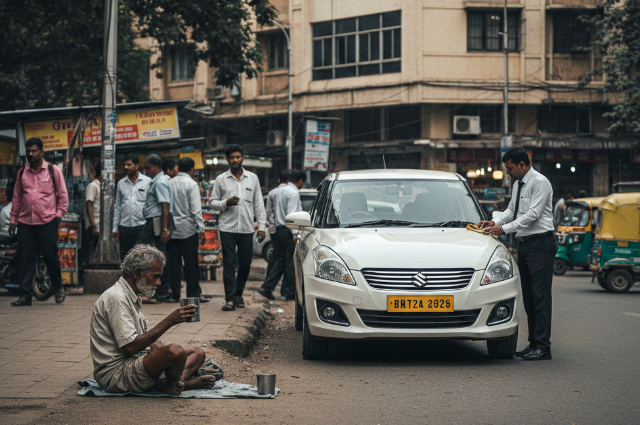
In January 2026, a high-profile case was created by an anti-begging promotion of the city of Indore that disclosed that a man from the community by the name of Mangilal, a frequent frequenter of Sarafa Bazaar, had several affirmations of wealth to his name despite his appearance. The authorities found that Mangilal owned three residential houses, a Swift Dzire automobile that had a driver and three auto-rickshaw against, which he rented to earn more money. He also supposedly used an interest-taking activity where he lent considerable amounts of money to the local traders and charged them interest.
In an atypical way, Mangilal did not beg per se; strangers voluntarily gave him money out of their hands by watching him on his cart in his wheelchair. His daily income from alms was ₹400-1000, but this amount only covered a little bit of his economic endeavour. Basically, the alms added to the money-lending and rental income, generating several parallel income sources.
This was found during the Beggar be Beggar campaign in Indore, where the authorities registered thousands of beggars, advised many to find alternative livelihood and others to permanent rehabilitation asylum. Publicity of the assets of Mangilal was a shocking revelation that contrasted with the secrecy in the acquisition of wealth.
Professional Begging vs. Structural Poverty
To differentiate people who are merely accumulating wealth in isolation from the rest of the population, it is important to identify the larger group of individuals who beg because of abject poverty and marginalisation. The estimates put by the census indicate that there are hundreds of thousands of beggars in India, and the majority of the beggars lack significant assets or other forms of livelihood. Exceptionalism cases of wealthy beggars bring out anomalies in a socio-economic world that is otherwise brutal.
These exceptions are not an institutional trend but reflect the aberrant routes of the informal economy. This may cause a skewed vision of the general population, leading to suspecting everyone who is involved in the act of begging, resulting in policy formulation being directed away from structural poverty eradication.
Government Interventions: The SMILE Scheme
To deal with the multifaceted problem of homelessness and the act of begging, the SMILE (Support for Marginalised Individuals to Livelihood and Enterprise) Scheme by the
Government of India has a special sub-scheme of the Comprehensive Rehabilitation of Persons Engaged in the Act of Begging. This is a program that seeks a Bhiksha Vritti Mukt Bharat (Begging Free India) through the identification of those who are involved in begging, sheltering, medical care, counselling, record keeping, skills training and reintegrating them back into society. By January 31, 2026, more than 30,000 people who are involved in begging have been found and rehabilitated in other cities through this programmed more than 8,000 people.
The SMILE-Beggary national portal and implementation guidelines cover detailed policies of such services as survey and identification, mobilisation to rehabilitation centres, livelihood training, provision of healthcare services, and psychological counselling. Such initiatives aim at lessening reliance on charity and ensuring honourable conditions of self-reliance.
The model of Indore has also been presented in other cities of the country as a model to be applied and a way of rehabilitating, skill development and any violation of the anti-begging laws.
Ethical and Policy Considerations
The presence of wealthy beggars sparks ethical debate about public charity. While spontaneous giving is often rooted in compassion or religious tradition, indiscriminate almsgiving can inadvertently sustain informal behaviours that obscure structural deprivation.
Experts and policymakers argue for redirecting public generosity toward verified rehabilitation programs and NGOs that work on poverty alleviation and skill building. At the same time, approaches that criminalise begging without addressing systemic poverty risk
marginalising the truly needy. A balanced policy must protect the vulnerable while targeting systemic root causes, not just visible street‑level phenomena.
Between Perception and Reality
The stories of individuals like Bharat Jain and Mangilal are anomalies that challenge conventional narratives about poverty and public charity in India. They reveal how, under unique conditions, begging can intersect with informal income, real estate investment, and unregulated financial activity. These cases do not reflect the lived reality of most persons engaged in begging, who remain deeply vulnerable and underserved.
Understanding these rare cases, alongside structured policy responses like the SMILE Scheme, helps illuminate the complexity of begging as an economic behaviour, social phenomenon, and policy challenge. A balanced response must avoid stigmatising the entire begging population while ensuring that welfare resources are targeted efficiently and humanely.
References:
- Economic Times. (2024, December 8). Meet Bharat Jain, the world’s richest beggar: Here's how he turned pennies into a fortune. https://economictimes.indiatimes.com
- Hindustan Times. (2023, July 7). Meet Bharat Jain: World’s richest beggar with a net worth of ₹7.5 crore. https://www.hindustantimes.com
- India TV. (2024). The world’s richest beggar owns flats and shops worth crores in Mumbai. https://timesofindia.indiatimes.com
- Times of India. (2026, January 19). Indore’s richest beggar? A man picked up from the street turns out to be a crorepati; owns houses, cars, and runs a money-lending racket. https://timesofindia.indiatimes.com
- New Indian Express. (2026, January 19). Elderly beggar at Indore’s late-night food hotspot turns out to be a crorepati. https://www.newindianexpress.com
- Press Information Bureau. (2026, February 11). Support for Marginalised Individuals for Livelihood and Enterprise (SMILE) Scheme - Comprehensive Rehabilitation of Persons Engaged in Begging. https://timesofindia.indiatimes.com
- Ministry of Social Justice and Empowerment. (2026). SMILE - Support for Marginalised Individuals for Livelihood and Enterprise. https://socialjustice.gov.in
- Times of India. (2025, July 12). Indore shows the way to a beggar-free city at the national workshop. https://timesofindia.indiatimes.com