
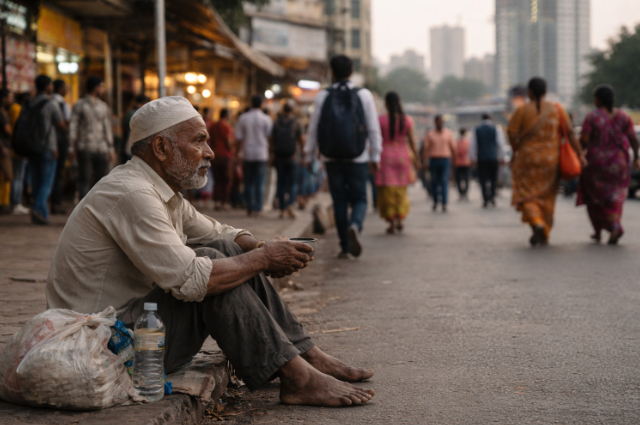
Some stories feel too absurd to be real until you see the bank statements. A man in Mumbai begs daily at a crowded railway station, pockets ₹2,000, then heads home to his ₹1.2 crore flat. Another in Indore pushes a wooden cart for alms while renting out houses, autos, and a car, plus lending money at cutthroat rates. These "crorepati beggars" don't just challenge poverty myths; they erode the instinct to help, turning public charity into a gamble where your ₹10 might fund a Swift Dzire instead of a meal.
Bharat Jain haunts Chhatrapati Shivaji Terminus and Azad Maidan in Mumbai, earning ₹60,000–₹75,000 monthly from high-traffic sympathy more than many salaried jobs. His net worth is ₹7.5 crore, built on a 2BHK flat in Parel worth ₹1.2 crore and two Thane shops yielding ₹30,000 rent each month. Despite family support and assets, he begs on, hooked on the habit that started from financial hardship.
In January 2026, Indore's "Beggar-Free" drive unmasked Mangilal, a facade-using beggar with three city houses, three auto-rickshaws, a Swift Dzire with a driver, and a side hustle lending alms profits to Sarafa Bazaar jewellers at high interest. He even snagged a government one-BHK via welfare, yet persisted, blending fake poverty with real estate savvy. His expose sparked outrage over welfare misuse in Madhya Pradesh.
It starts small: ₹10- ₹20 coins from thousands in busy spots like temples, stations, or festivals pile to ₹1,000- ₹2,500 daily, or ₹30,000- ₹75,000 tax-free monthly. Zero costs free temple food, clothes from donors that let them hoard nearly all, funnelling cash into be- nami properties that appreciate and rent out.
Others, like Kolkata's Laxmi Das, banked decades of earnings into savings; post-death discoveries reveal fixed deposits hidden in beggar shacks. No overhead, high volume, smart flips into realty turn desperation into crores, mocking formal economies.
Begging wires into a loop: easy highs from crowds make quitting harder than salaried drudgery, even with wealth psychology calls it a reinforced habit over survival. Public trust fractures; one crorepati tale makes donors hesitate, starving the truly needy in a "boy who cried wolf" backlash.
Worse, organised syndicates amplify harm. "Begging mafias" in Punjab, Hyderabad, Chennai drug kids, fake disabilities, rent infants—making ₹1.5 lakh crore yearly via exploiting vulnerable, bribing officials for cover. Not choice, but coercion, twisting sympathy into syndicate fuel.
Ditch cash; it bankrolls rackets and moneylending. Shift to in-kind via verified NGOs—food, skills, clothes ensure reach without cycles.
Back SMILE Scheme: As of January 2026, operational in 181 cities, it identified 30,257 beggars, rehabilitated 8,129 via surveys, shelters, vocational training, and medical aid—₹100 crore budgeted for self-reliance over punishment. Partnered with shrines, it targets hotspots, aiming to bring thousands yearly into dignity.
These crorepati tales sting because they blur lines of genuine pain but awareness, schemes like SMILE (Support for Marginalised Individuals for Livelihood and Enterprise), conscious giving rebuild trust, one verified life at a time.
The SMILE scheme provides comprehensive support for beggars in India, focusing on rehabilitation over punishment. Launched by the Ministry of Social Justice and Empowerment, it targets a "Bhiksha Vritti Mukt Bharat" through surveys, shelters, and skill-building. It aims to identify and rehabilitate individuals begging in urban areas, pilgrimage sites, and tourist spots via district administrations, urban local bodies, and NGOs. Key goals include medical care, counselling, education, vocational training, and economic linkages to end dependency on alms.
REFERENCES:
- Meet Bharat Jain: World's richest beggar with a net worth of ₹7.5 crore https://www.hindustantimes.com
- Top 8 richest beggars in India who earn more than you think https://www.indiatimes.com
- Hyderabad Police Bust Begging Racket, Reveal Earning Of Rs 3 ... https://www.ndtv.com
- Organised begging in Punjab https://www.managejournal.com
- SUPPORT FOR MARGINALIZED INDIVIDUALS FOR LIVELIHOOD AND ENTERPRISE (SMILE) SCHEME https://www.pib.gov.in
- Beggars Corporation https://www.beggarscorporation.com
- AAP and Delhi Police finally agree on one thing: there is no begging mafia in Delhi https://scroll.in