
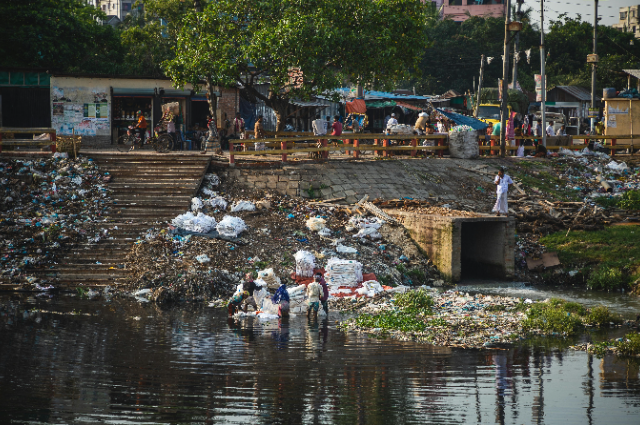
You can survive 40 days without food. But three to five days without water, and your body starts falling apart, your mind goes first, then your organs, then you simply stop. This is not metaphorical in India anymore. This is becoming someone's reality every single day.
India ranks 120th out of 122 countries in the Global Water Quality Index, which sounds like a statistic until you realise it means we are almost at the absolute bottom of the list. We sit just above South Sudan and Central Africa countries that have experienced wars, collapsed infrastructure, complete state failure And yet we are a nuclear power with a space program and tech billionaires. (How did we manage this contradiction?)How did we build skyscrapers while letting our water table drop below the earth?
Here is what NITI Aayog has documented since 2018, and what remains true in 2026: India holds only 4% of the world's freshwater resources but is home to 18% of the world's population. We are not just facing water scarcity. We are facing a structural impossibility: there is not enough water for the number of people living here, and the water we do have is poisoned.
Nearly 600 million Indians face high to extreme water stress. That is almost twice the entire population of the United States, breathing the same air, drinking from the same poisoned sources, waiting for the next dry season to arrive. And every year, approximately 200,000 people die due to inadequate access to safe drinking water not from drinking dirty water and getting sick (though that happens too), but from not having any water to drink at all.
Per capita water availability has dropped to around 1,100-1,400 cubic meters per person per year. The international threshold for water stress is 1,700 cubic meters per person per year. Below 1,000 is considered absolute scarcity. We are now close enough to that lower threshold to see it clearly. By 2050, the projection is that we will fall to 1,191 cubic meters per person, solidly in the scarcity zone.
Nearly 70% of our water is contaminated. Seventy per cent. That means when you turn on a tap in India, there is a 7 in 10 chance that what comes out has something in it that can hurt you, bacteria from untreated sewage, heavy metals, pesticides from groundwater, industrial waste.(And the system keeps operating as if this is normal, as if poisoned water is simply the cost of living in a poor country.)
India extracts more than 25% of the world's total groundwater, more than any other nation on earth. We extract it faster than nature can replenish it. In 2023, we extracted 241 billion cubic meters while only recharging 449 billion cubic meters annually. That sounds like a surplus, but it is not; we are drawing 60% of available groundwater every year, and we cannot sustain this indefinitely.
In some states, the situation is apocalyptic: Punjab extracts 156% of its annual groundwater recharge.Rajasthan extracts 147%.Delhi 90%.They are pumping water from a well that is not replenishing. This is not sustainable. This is not even legal, technically, but enforcement is nonexistent, and desperation overrides law.
Nearly 80% of India's drinking water comes from groundwater, and 80% of rural households depend entirely on it. Half of our irrigation depends on it.Agriculture uses 87% of all extractable groundwater. We have built a civilization that runs on groundwater, and that civilisation is consuming the groundwater faster than the earth can make it. We are drinking tomorrow's water today, and tomorrow is approaching quickly.
NITI Aayog has warned that 21 major Indian cities, including Delhi, Bengaluru, Chennai, and Hyderabad, face the risk of complete groundwater depletion by 2030. "Day Zero" the day when the taps run dry, used to feel like something that happened to other countries in other crises. Now it is a scenario being discussed seriously.
Bengaluru has already been inching toward Day Zero. In early 2024, the city experienced "abnormally high temperatures" that created urban heat islands, intensifying water scarcity to the point where residents wondered if they would run out of water before relief came. The city was too close.
And while cities are drying up, the economy is being hollowed out. A World Bank study projects that India could lose 6% of its GDP by 2050 if water management strategies are not significantly improved. not a small loss.
By 2030, India's water demand is projected to be twice the available supply. You cannot drink twice the water that exists. You cannot irrigate crops with water that is not there. The mathematics is brutal and simple: the demand will crash into the reality of scarcity, and something has to give.
What is haunting about this crisis is not the numbers. It is knowledge. NITI Aayog published the Composite Water Management Index in 2018, documenting that India was experiencing "the worst water crisis in its history." They tracked it across states, measured performance, and created indexes. They knew.
Governments since then have launched schemes such as Jal Shakti Abhiyan, Jal Shakti Ministry, and countless state-level initiatives. But the crisis has worsened, not improved. Gujarat and Andhra Pradesh are occasionally held up as good performers in water management, but even the best states score just 60-80 points on the CWMI, while critical agricultural states like Uttar Pradesh and Rajasthan score in the 20-47 point range.
The system documents the catastrophe. It studies it. It creates reports about it. And then the taps keep running dry and the water keeps getting poisoned and the groundwater keeps falling, and people keep dying.
In a country where everything is documented, where our government creates indices and reports and assessments, we have somehow normalised living on the edge of a water apocalypse. We speak about it in policy papers and international forums while the reality settles into a quiet horror: nearly 600 million people waking up every day knowing that water might not come out of the tap today. That their children might grow up in a country where clean water is not a right but a luxury.
And the question beneath all this is that nobody wants to answer: if we know this is happening, and we know it for years, why are we still acting like we have time?
. . .
References:
- FNB News - India ranks 120 among 122 countries in Water ... http://www.fnbnews.com
- Water Crisis in India – Reasons, Impact, Government ... https://www.pmfias.com
- NITI Aayog Report on Water Crisis https://pib.gov.in
- Composite Water Management Index (CWMI) https://vajiramandravi.com
- Per Capita Water Availability https://www.pib.gov.in
- River and Ocean Pollution in India: A Report https://www.indiancurrents.org
- Groundwater Crisis in India 2030: Causes, Impacts & Solution https://greenglobe25.in
- [Scenarios] India 2050: The Environmental Challenge https://www.institutmontaigne.org
- Geospatial Value Impact – Water Sector https://geospatialworld.net
- 8% GDP loss by 2050: world water crisis & food risk https://timesofindia.indiatimes.com