
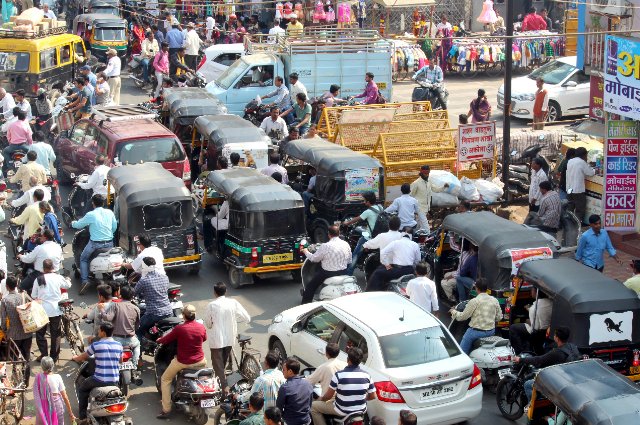
On a normal Tuesday afternoon in Worli, Mumbai, the city’s busy roads turned into a strange political show. The BJP, which is part of the ruling government in Maharashtra, held a protest march in the middle of heavy traffic, claiming to take on the opposition, but the real victim of this protest was not the opposition; it was the common people stuck in jams, late for work, school, hospitals and daily life.
The Worli protest was organised by the BJP and its allies to criticise the Maha Vikas Aghadi (MVA) and the failure of the Women’s Reservation Bill in Parliament. Instead of using large open grounds, the march was held on a main road used by thousands of commuters every day. This blocked lanes, slowed down traffic and turned a short drive into a long wait.
The irony is that the same government that controls the police, permissions and traffic rules chose to cause this disruption. It used the state’s power to protest “the opposition,” even though it was itself in power.
The situation reached a breaking point when a woman, stuck in her car for over an hour, got out and walked into the crowd. She went straight to Maharashtra Water Resources Minister Girish Mahajan and told him sharply, “Get out of here,” and asked the rally to move somewhere else.
Her outburst was soon shared and talked about on social media because many people saw themselves in her. She spoke for those who have no time to sit and watch a political show while their lives are put on hold.
The Worli protest is an example of how a ruling party can act like a protestor while still being in power. It uses the language of fighting for people’s rights, women’s rights, and democracy, but at the same time creates problems for the very people it claims to protect.
When the real opposition later pointed out that the government was blocking roads to protest “the opposition,” the BJP’s reply was mostly about politics, not about public pain. Some leaders said a little inconvenience is normal in a democracy, as if citizens must quietly accept such disruptions for the sake of party shows.
Worli is not just about one traffic jam; it is a warning about how politics is changing. If the government keeps treating roads and neighbourhoods as stages for its own drama, real issues like women’s rights, safe transport, and daily dignity will remain side effects, not priorities.
The woman in Worli did not just shout at a minister; she gave voice to the silent anger of ordinary people. She reminded everyone that in a democracy, the real opposition is not only in the opposition benches, but also in the citizens who are forced to sit and wait while the government protests itself.
Source:
- The Times of India https://share.google