
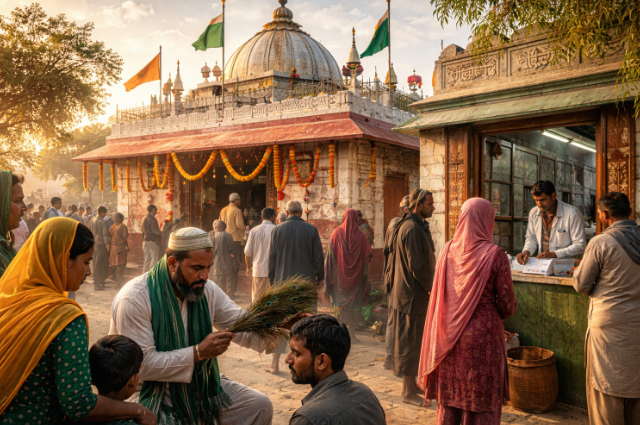
Understanding comes after experience. In Unava village of Mehsana district, Gujarat, thousands experience it yearly at Mira Datar Dargah (India's "Supreme Court" for spirits), drawn by invisible forces they call jinns, we call illness. The shrine to Hazrat Saiyed Ali Mira Datar, martyr saint, draws families desperate for exorcism. Families who feel something is wrong with their loved ones hearing voices, shaking violently, and have eyes. They call it Jinn possession. What looks like possession is often schizophrenia, bipolar disorder, or hysteria. Rural India rejects "doctor logic" for faith. Clinics were empty, and shrines overflowed. Patients scream through exorcisms. Mujavirs (healers) chant duas. Smoke fills the air. Relief comes rarely. Most return worse: bodies weak, minds broken, pockets empty from endless rituals
Milesh Hamlai saw this. Not a doctor, but a brother to a schizophrenia patient (His sibling). His struggle opened eyes; healers were busy, psychiatrists idle. Families chose faith healers over clinics, stigma over science. Logic lost to belief. He founded Altruist NGO (Ahmedabad, 2008) from his personal pain. Not to replace faith but to Partner with it. "Dava and Dua"(medicine and prayer). He didn't replace priests with pills. He made them allies.
The Divine Referral
This project works because it does not try to replace faith with science. It smuggles science inside faith. This is the core innovation.
Mechanism:
Step 1: The Hook
A family brings a patient to the Dargah.
The Mujavir (faith healer) performs the exorcism ritual -Dua, amulets, and prayers.
Nothing is challenged, mocked and corrected.
Trust is established.
Step 2: The Referral
At the end of the ritual, instead of sending the family away, the Mujavir says:
“The spirit is very strong. To make the Dua work faster, you must take this Dava from the clinic inside the Dargah.”
He hands them a Referral Slip designed by Altruist. This single piece of paper changes everything.
Step 3: The Treatment
The family walks into a government-funded psychiatric clinic located inside the Dargah compound, where the patient receives antipsychotic medication. But, they believe they are taking “spirit-weakening medicine.”The medicine works, symptoms reduced, patient improves. No belief system is threatened. Why did this work? because the core psychological principle involved is cognitive reframing. In social psychology, access to a community is controlled by gatekeepers—figures who hold authority, trust, and legitimacy.
At Mira Datar Dargah, the Mujavir is the gatekeeper.
Patients do not trust psychiatrists because doctors are seen as Outsiders, socially distant, and stigmatising.
The Mujavir, however, is perceived as: Spiritually legitimate, Culturally embedded, Morally safe.
By convincing the Mujavir, not the patient, the NGO bypassed the biggest barrier in mental health delivery: trust.
Once the gatekeeper endorses treatment, resistance disappears. The same medicine, prescribed by a doctor alone, would be rejected. Endorsed by a healer, it becomes acceptable.
IMPACT
The impact of the Mira Datar Dargah model is practical and long-term. Since 2008, more than 38,000 patients have received mental health treatment (who would otherwise never have reached a doctor). The project did not stop people from believing in faith healing; instead, it used those belief paths to guide patients toward medical care. People who had remained untreated for years began treatment sooner, which reduced severe symptoms and crises. Families benefited financially because they no longer had to spend large amounts of money on repeated rituals, long stays, and travel, while medicines were provided free. Treatment was accepted without openly labelling patients as mentally ill, which helped avoid shame and social stigma. The model worked smoothly because no group lost authority or respect. Its success has been officially recognised, including by the Supreme Court of India. Overall, the impact shows that mental health care in rural India becomes effective when it fits into existing cultural systems instead of trying to replace them.
References
- Science of the soul: Dava and Dua Project creates ... https://timesofindia.indiatimes.com
- Dava-Dua Program: Combining Psychiatric Medications ... https://madinsouthasia.org
- Dava and Dua Project (DDP), Public Mental Health Model https://augmentahealth.com
- Bringing Dava and Dua together – Nurturing mental health https://www.satyamevjayate.in
- Unique collaboration of modern medicine and traditional ... https://pmc.ncbi.nlm.nih.gov
- Social Impact & Community Development NGO in India https://www.unitedwaymumbai.org
- Faith healers: Support or Barrier to Medical Care? https://pmc.ncbi.nlm.nih.gov
- How can India's faith healers play a role in mental health ... https://www.devex.com
- National Mental Health Survey of India, 2015-16 https://indianmhs.nimhans.ac.in
- From institutions to homes: Evaluation of a housing with ... https://www.sciencedirect.com
- Syed Ali Mira Datar https://syedalimiradatar.com