
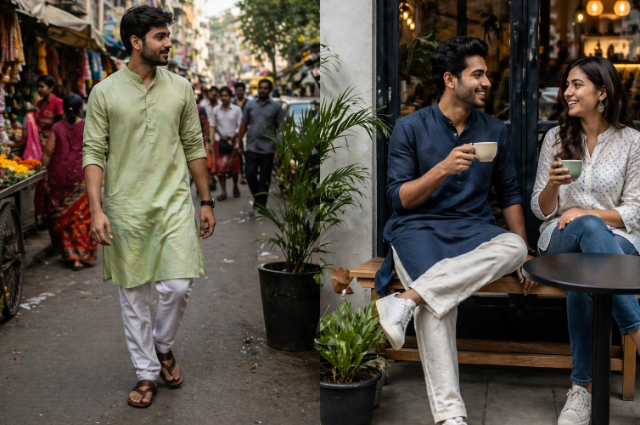
In many Indian cities and towns, something strange happens once a year: the same people who wear jeans, shirts, and T‑shirts every day suddenly appear in kurtas, sarees, and salwars. It is as if the “Indian” version of us is kept in a special box in the wardrobe and only opened on festivals, weddings, and family functions. This habit is what we can call the Kurta Crisis – the problem of treating Indian clothes as special‑occasion costumes instead of normal identity.
Not long ago, many men wore kurtas or dhotis and women wore sarees or salwars every day, not as “fashion” but as comfortable, normal clothing. In many villages and small towns, people still wear simple kurtas, lungis, or sarees for daily work, school, and shopping.
In cities, though, the kurta has slowly
moved into a different category. It is now mostly worn for weddings, Diwali, Eid, Navratri, and other big events. In offices, colleges, and malls, the usual look is jeans, shirts, dresses, and sneakers – styles that feel “global” rather than “Indian.” This makes the kurta feel like a role you dress into once in a while, not a natural part of your daily self.
Many offices and schools expect formal dress, which is usually understood as shirts and trousers, not kurta-pyj or saree. So young people wear Indian clothes only on days when managers or teachers clearly allow it. Jeans, T‑shirts, and sneakers are easy to find, cheap, and linked in media with being cool or modern. Indian clothes are often seen as heavy, difficult to clean, or “too traditional,” even though cotton kurtas and light sarees can be very comfortable in Indian heat.
Festivals and weddings are treated as “must‑wear‑ethnic” days. On these days, wearing a kurta or saree becomes a duty to family and religion, instead of a choice that feels natural every day.
Despite this, many Indians still wear Indian clothes daily, especially in smaller towns and rural areas. Men in villages often wear kurtas, dhotis, or lungis; women wear simple sarees or salwar‑kameez for work, school, or market. In cities like Kolkata, Chennai, or Kerala, you can still see people in cotton kurtas, salwars, or light sarees for daily life, not just for weddings.
Surveys show that more than 80% of Indian women own at least one saree, and over 70% of men have worn a kurta-pyjama to a festival or family event. What is missing is not the clothes, but the habit of wearing them as normal wear. Young people changing the story. Now, a new generation is slowly changing this idea. Many young Indians are mixing kurtas with jeans, sneakers, and jackets, treating the kurta as just another piece of casual clothing. Social media and small homegrown brands are promoting “fusion” styles: kurtas as streetwear, sarees with T‑shirts, salwars with sneakers.
This shows that “Indian” does not have to mean “only for festivals.” It can be part of your daily style, just like your favourite sneakers or denim jacket. When a kurta is worn without any special reason, it stops being a costume and starts feeling like a real part of your identity.
At its core, the Kurta Crisis is not about fashion. It is about how comfortable we feel carrying our “Indianness” in our daily lives. If we only wear Indian clothes on special days, it sends a quiet message: the rest of the week, we are more “global” than “Indian,” more “modern” than “local.”
But if we start wearing kurtas, sarees, salwars, and other Indian clothes in normal everyday ways, it means something different. It means that being Indian is not a one‑day event; it is something that can walk with us every day, on the street, in the office, or on a casual evening out. The simple solution to the Kurta Crisis, then, is not to buy more ethnic outfits, but to wear them – without needing an excuse, a festival, or a permission slip from fashion.
References: