
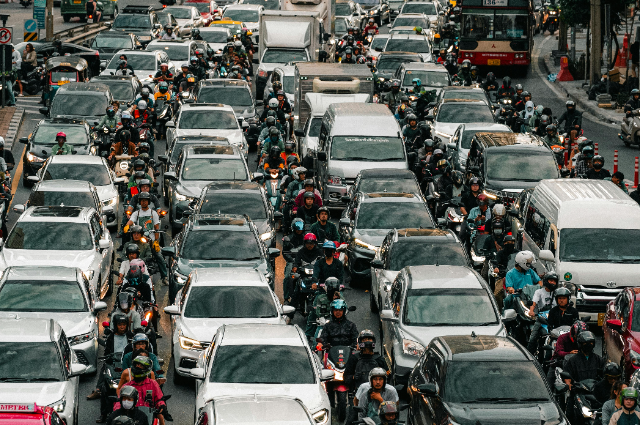
This city tolerates a lot. It tolerates overcrowded trains, broken roads, flooding, delays, construction, detours, long commutes, and traffic that eats up nearly three hours of our day. But every once in a while, someone stands up and says what everyone else is thinking.
This week, that person was a woman, an ordinary citizen on her way to pick up her child from school, who was left stranded in traffic for hours. The disruption was caused by a protest march organised by the ruling BJP. The Maharashtra government was conducting this protest against the opposition over events in Parliament related to the Women’s Reservation Bill, with similar protests happening across the country.
In Mumbai, this march caused a massive traffic jam. People were stuck for over an
hour. For someone trying to pick up their child, that’s not a small inconvenience. Frustrated and angry, this woman stepped out of her vehicle, walked into the middle of the march, found Maharashtra minister Girish Mahajan, and confronted him directly. She also challenged the police and organisers, demanding they disperse and move the protest to an open maidan instead of blocking the road.
Later, Mr Mahajan responded in a press conference. He said she should not have used the language she did, that she should have stayed calm and composed. He added that she even threw a bottle, and that the police were instructed to remain calm while addressing her concerns. He also emphasised that the march had proper permission, the route was pre-decided, and planning was in place.
That last point raises an important
Question: Permission from whom, and to do what exactly?
Let’s go back to last year. When Manoj Jarange Patil led a Maratha reservation rally into Mumbai, it caused major disruption. In response, the Maharashtra government introduced strict rules. Azad Maidan was designated as the only protest location in South Mumbai. Processions elsewhere were restricted to avoid inconveniencing citizens.
Under the 2025 rules:
- Permission for protests lies with a designated police officer
- No protests are allowed after 6 p.m.
- Participation is capped at 5,000 people
- Most importantly, protests cannot interfere with government events or disrupt vehicular and pedestrian movement
These rules apply to everyone. So how was
This protest in Worli was allowed to block roads and disrupt traffic despite clear regulations against exactly that?
In a democracy, the right to protest is fundamental. It’s part of our constitutional freedom of speech and expression. You can mobilise, dissent, and protest—but you cannot hold a city hostage.
That’s what struck a nerve here.
If all citizens are equal, then my right to protest is equal to your right to reach your destination on time. One does not cancel out the other. What angered people was the apparent sense of entitlement—the idea that someone’s protest was more important than everyone else’s time.
This isn’t about one woman or one rally. It’s about power and fairness.
We pay high taxes—on fuel, property, tolls, and services. In return, we expect equal treatment. No one is more important than a mother trying to pick up her child from school. That’s the principle that felt broken.
Mumbai measures everything in time. People here work hard, plan tightly, and rely on precision. Wasting hours in traffic is not something this city forgives.
And Mumbai’s women? They are fighters. Whether in trains, offices, or on the streets, they don’t let themselves be pushed around. This woman embodied that spirit.
Mumbai is also the financial engine of the country. The BMC alone operates with a massive budget. Yet despite this, the city struggles with poor roads, endless construction, dust, overcrowded transport, and alarming accident and fatality rates.
People endure all of this. But to then be told that a political protest is more important than their time—that’s where the line is drawn.
This woman went viral because she represented what many feel but rarely act on. Most of us complain in cars, on WhatsApp, or on social media. She walked up to power and asked, “What is wrong with you?”
That question resonates.
Because daily life in this city is already exhausting—long commutes, unpredictable traffic, constant roadwork. Adding avoidable disruption felt like the last straw.
What made this moment powerful is that she wasn’t an activist or politician. She wasn’t driven by ideology. She was just a mother trying to pick up her child.
And that matters.
At the end of the day, real life matters more than political narratives. People just want to work, care for their families, and return home on time. They don’t want politics interfering with everyday life.
This is about dignity, the idea that every citizen’s time, family, and livelihood matter equally.
So the question remains:
Yes, the minister has the right to protest. But does that justify blocking roads and disrupting lives?
If permission was granted, should the Mumbai police be held accountable? Is there preferential treatment? And if so, why? The police wear a uniform meant to represent fairness and equality.
So what’s slipping? Why does it feel unfair?
Reference:
- The Times of India https://share.google