
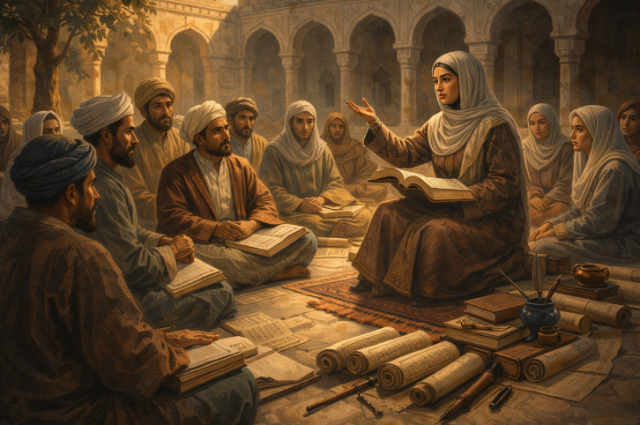
When conversations about women’s education in Muslim societies arise today, they often carry a tone of surprise, if not scepticism, at the idea that women in early Islamic history might have been active scholars. Yet the historical record tells a strikingly different story. From the earliest generations of Islam to the height of the medieval period, women were not simply present in the intellectual life of their communities; many were central to it. They taught, debated, preserved sacred texts, shaped legal traditions, and even influenced artistic movements like calligraphy.
This article revisits that rich but often overlooked history, drawing on classical legal discourse, modern historical research, and the extraordinary life of one scholar: Shuhda al-Kātiba, a 12th-century Baghdadi woman whose intellectual reputation spread across the Islamic world.
Knowledge as a Shared Human Calling: The View from the Qur’an and Early Scholarship
One of the most important starting points for understanding women’s education in classical Islam lies in the Qur’an itself. Nowhere does the Qur’an restrict the pursuit of knowledge to men; in fact, it repeatedly praises those who learn, reflect, and teach. Verses such as “My Lord, increase me in knowledge” became the spiritual foundation for generations of Muslims women included who saw learning as a form of worship.
Classical Muslim scholars also understood knowledge in broad terms. Religious knowledge, of course, was essential for every believer, but the intellectual horizon of early Muslims stretched far beyond theology. Astronomy, medicine, literature, and the natural sciences were viewed as essential for the advancement of society, and many jurists considered them communal obligations. In this worldview, knowledge was not a privilege but a trust, one that both men and women shared responsibility for sustaining.
Hadith Literature and the Complexities of Encouraging Women’s Education
While the Qur’an is unambiguous in its universal call to knowledge, the hadith corpus—the sayings and actions attributed to the Prophet Muhammad presents a more textured picture. There are numerous well-known accounts of women actively seeking knowledge from the Prophet, asking direct questions, and requesting dedicated learning time. The Prophet responded to them with seriousness and respect, and in several cases, he even created special instructional sessions for women who felt overshadowed by male students.
Other traditions highlight specific women, such as A’isha bint Abu Bakr and Shifā’ bint ‘Abdullāh, who became authoritative teachers in their own right. A’isha's sharp intellect and vast memory made her a primary transmitter of the Prophet’s teachings; her students included senior male companions. Shifā’ was known for her literacy and was asked by the Prophet to teach writing and practical skills to his wife Ḥafṣa.
However, the hadith tradition also includes a few weak or fabricated reports that discourage teaching women to write or warn against their public movement. Classical scholars, particularly hadith specialists like Shams al-Haqq al-‘Azīmābādī, rigorously evaluated these narrations and rejected them as unreliable. Their scholarly approach reminds us that the Islamic legal tradition contains internal debates and mechanisms for weeding out questionable material. When judged through those standards, the overwhelming conclusion is that women’s learning was not only permissible but welcomed.
Practices, Not Just Principles: How Social Norms Shaped Women’s Access to Education
Alongside the textual traditions that supported women’s pursuit of knowledge, there were also practical social considerations that shaped how education operated in everyday life. Some scholarly opinions encouraged women to avoid unnecessary travel without a guardian, while others advised limiting prolonged interaction with unrelated men. These views did not prohibit women from seeking education, but they did influence the places and methods through which learning occurred. In response to such norms, many women pursued their studies within the safety of family networks or with trusted teachers. Homes, mosques, and public courtyards naturally evolved into important learning spaces where women could listen to lessons, participate in discussions, and receive instruction. In some communities, mixed gatherings were acceptable, while in others, women attended separate study circles tailored specifically for them.
Far from being isolated or denied opportunities, women navigated these social expectations creatively and effectively. They found numerous pathways to acquire knowledge, and many of them went on to become respected teachers, transmitters, and scholars in their own right.
What Social History Reveals: Women as Scholars, Patrons, and Cultural Influencers
Modern historians have played a crucial role in bringing forgotten women back into the narrative. By examining biographical dictionaries, waqf documents, chronicles, and hadith compilations, scholars have shown that women participated in intellectual life far more extensively than most people imagine.
Many women appear so frequently in the chains of hadith transmission that they became revered authorities, known for precision and trustworthiness. These women were not passive transmitters; they shaped the flow of knowledge between generations. Their intellectual footprints stretch from Medina to Damascus, Baghdad, Cairo, and even Granada.
But their influence was not limited to religious sciences. Women used wealth and endowments to build schools, maintain libraries, and sponsor scholars. They were poets, mystics, spiritual mentors, legal thinkers, and patrons of artistic movements. Through these roles, women helped shape the cultural and intellectual identity of Islamic civilization.
Shuhda al-Kātiba: A Scholar Who Defied the Boundaries of Her Era
Among the most remarkable women in the intellectual history of classical Islam stands Shuhda al-Kātiba, a 12th-century Baghdadi scholar whose life challenges modern assumptions about women’s roles in medieval Muslim societies. Her title al-Kātiba, “the calligrapher,” reflects her celebrated mastery of handwriting, yet her accomplishments reached far beyond the artistic realm. Born into a family of scholarship, Shuhda was introduced early to the world of hadith by her father, who took her to public dictation sessions where leading scholars transmitted prophetic traditions. These early experiences earned her valuable certifications, and by adulthood, she was counted among Baghdad’s most trusted transmitters. Her reputation grew so widely that scholars travelled from distant regions to learn from her. The celebrated historian Ibn al-Jawzī and the renowned jurist Ibn Qudāma were among her students, an extraordinary testament to the authority she commanded in a male-dominated scholarly landscape.
What makes her legacy even more striking is that Shuhda achieved this prominence without holding any formal position in the great madrasas of Baghdad. Instead, she taught in her home, in mosques, and in informal gatherings, showing that true scholarship in medieval Islam flowed not from institutions but from the credibility and brilliance of the teacher. Beyond her scholarly authority in hadith, she also excelled as a calligrapher in the prestigious tradition of Ibn al-Bawwāb, serving as a vital link between his school and later masters such as Yāqūt al-Musta‘ṣimī. Through her, the artistic legacy of two golden eras was preserved and transmitted.
Shuhda’s story, like that of many other learned women in Islamic history, reminds us that the past was far more diverse and dynamic than stereotypes suggest. While certain legal opinions sought to regulate women’s public activity, countless women continued to pursue knowledge, teach, write, and shape intellectual culture. Their contributions were woven into the spiritual, legal, and artistic heritage of the Muslim world. The history of women’s scholarship in Islam is thus not a story of silence, but one of presence, persistence, and profound influence, a legacy that continues to inspire and deserves far wider recognition today.
Beyond the Past: Why These Stories Matter Today
The story of women’s religious education in early Islam is more than a historical curiosity; it challenges the simplified narratives that dominate modern conversations. While legal texts sometimes tried to regulate women’s movements, the lived reality shows women pushing boundaries, participating boldly, and shaping Islamic thought for centuries.
Their contributions—legal, spiritual, intellectual, and artistic—form an essential part of the Muslim world’s heritage. Rediscovering them is not just about celebrating the past; it is about illuminating the possibilities for the present.
The history of women’s scholarship in Islam is not a story of absence. It is a story of presence, persistence, and profound influence.
The story of women’s religious education in early and classical Islam is not one of exclusion but of participation, influence, and resilience. Despite certain legal debates and social expectations, women learned, taught, wrote, endowed institutions, and shaped the transmission of Islamic knowledge across centuries. Figures like Shuhda al-Kātiba remind us that women were integral to the intellectual and artistic foundations of Muslim civilization. Recovering these histories does more than correct misconceptions—it opens a more accurate, inclusive understanding of Islamic heritage and highlights the longstanding contributions of women whose voices helped shape the tradition.