
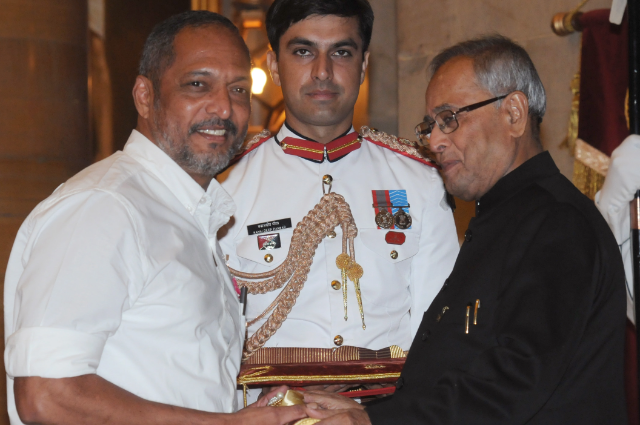
The history of Indian cinema is filled with stars, icons, and matinee idols who captured the popular imagination through formulaic charm, sweeping romances, and larger-than-life heroics. Yet, every once in a long while, an artist emerges who refuses to bow to convention an actor who strips away cinematic artifice to lay bare the raw, unfiltered nerve of human reality. Vishwanath "Nana" Patekar was precisely that kind of force. With a gaze that could pierce through pretence, a voice that could crackle with righteous fury or tremble with profound vulnerability, and an artistic integrity that remained unyielding till his final days, Patekar built a legacy unlike anyone else in Bollywood or Marathi cinema. His life story, stretching from the dusty hoarding boards of Mumbai to the pinnacle of national acclaim, and finally to the parched farmlands of rural Maharashtra, is a testament to resilience, uncompromising authenticity, and a rare golden heart.
The Crucible of Early Hardship: From Poster Painter to Artist
Long before the arc lights illuminated his face and millions chanted his famous dialogues, Nana Patekar’s world was defined by struggle rather than privilege. Born on January 1, 1951, in the coastal town of Murud Janjira in the Raigad district of Maharashtra, his early years carried the quiet burdens of financial instability. When his family's business collapsed due to unfortunate circumstances, young Vishwanath was thrust into the realities of survival.
At just thirteen years of age, he found himself working to support his household. He walked nearly eight kilometres a day to paint movie posters on large commercial hoardings across Mumbai, earning a meagre thirty-five rupees a month a job that often rewarded him with little more than a single meal. Those formative, gruelling years etched a permanent mark on his worldview. They taught him the true value of food, labour, and basic human dignity, shaping a lifelong disdain for superficial luxury and hollow fame.
Yet, even amidst the dust and paint thinners of hoarding scaffolding, Patekar’s creative spirit refused to be stifled. Encouraged by his father’s deep love for classical Marathi plays, young Nana developed an early fascination with dramatic arts. Balancing his labour with his education, he went on to study at the prestigious Sir J.J. Institute of Applied Art in Mumbai, earning a formal grounding in visual aesthetics. This background as a commercial artist quietly bled into his acting career; Patekar approached every character not merely as a set of lines to be spoken, but as a living, breathing canvas to be meticulously shaded with psychological depth.
Stepping onto the Stage: The Birth of a Maverick
Patekar’s entry into the performing arts began on the rigorous platforms of Marathi theatre. The stage offered no retakes, no editing rooms, and no safety nets—it demanded raw vocal projection, immense physical discipline, and absolute emotional truth. Under the guidance of prominent directors like Vijaya Mehta, Patekar honed his craft, learning how to command an audience with a mere twitch of an eyebrow or a pregnant pause.
When he finally transitioned to cinema, he did not fit the conventional mould of a Bollywood hero. With his lean frame, intense eyes, and unconventional face, he was instead embraced by the parallel and arthouse cinema movement of the late 1970s and 1980s. He made his feature film debut in 1978 with the critically acclaimed drama Gaman. Though his early roles were modest, they carried an undeniable gravity. Films like Aaj Ki Awaz (1984), Ankush (1986), and Pratighaat (1987) introduced audiences to a new kind of cinematic anger—not the stylised, romanticised rebellion of mainstream formula films, but the pent-up, authentic frustration of the common man facing systemic corruption.
His performance in Andha Yudh (1987) earned him his first Filmfare Award nomination for Best Supporting Actor, signalling to the industry that a major tectonic shift was underway. But it was the late 1980s and the 1990s that would cement his status as an undisputed titan of Indian cinema.
The Cinematic Explosion: Breaking Moulds and Winning Nations
Patekar’s watershed moment arrived in 1989 with Vidhu Vinod Chopra’s gripping crime drama Parinda. Playing Anna, a psychotic, asthma-ridden underworld don who was as terrifying as he was strangely vulnerable, Patekar delivered a performance that redefined the Bollywood villain. He did not bellow or chew the scenery in traditional villainous fashion; instead, he brought a chilling, unpredictable domesticity to evil. His portrayal earned him widespread critical acclaim, along with his first National Film Award (Best Supporting Actor) and his first Filmfare Award in the same category.
What followed was an extraordinary golden decade where Patekar demonstrated a range that few actors in global cinema could match. He was equally adept at playing the tormented, the righteous, the broken, and the comedic:
The Agony of the Uniform and Directorial Vision: In 1991, Patekar stepped behind the camera to write, direct, and star in Prahaar: The Final Attack. Driven by his profound respect for the Indian Armed Forces, he underwent rigorous military training to portray an army commando. The film stands as a masterclass in cinematic realism, exploring how society often fails the very soldiers who protect it.
The Voice of the Enraged Masses: In 1994, he delivered what many consider the definitive performance of his career in Krantiveer. As Shankar, an unhoused, outspoken drifter pushed to the brink by systemic decay, Patekar delivered thunderous courtroom and street monologues that became cultural touchstones. His electrifying delivery won him the National Film Award for Best Actor, the Filmfare Award for Best Actor, and the Screen Award.
Delicate Human Nuance: Proving he was far more than an angry young man, Patekar played a speech-and-hearing-impaired father in Sanjay Leela Bhansali’s Khamoshi: The Musical (1996). Communicating primarily through sign language and expressive eyes, he portrayed paternal love with a quiet, devastating grace that earned him widespread critical adoration. He also displayed chilling psychological depth as a sadist husband in Agni Sakshi (1996), netting him his second National Film Award for Best Supporting Actor.
The Master of Cool Comedic Timing: In the 2000s, Patekar proved his immense versatility by conquering comedy. As the short-tempered, lovable underworld don Uday Shetty in Anees Bazmee’s blockbuster Welcome (2007), he created an iconic comic persona. Paired alongside Anil Kapoor, his deadpan delivery, eccentric bossiness, and impeccable comic timing turned crime lords into lovable household figures.
The Gritty Encounter Specialist: In Ab Tak Chhappan (2004), Patekar played Sadhu Agashe, a cold, methodical police encounter specialist based loosely on real-life cop Daya Nayak. Stripped of cinematic gloss, his portrayal captured the psychological toll, moral ambiguity, and institutional loneliness of extrajudicial policing.
The Theatrical Swan Song: In 2016, Patekar returned to Marathi cinema to deliver a staggering performance in Natsamrat. Playing Ganpat Belwalkar, a legendary, ageing Shakespearean theatre actor who gives away all his wealth to his ungrateful children only to face destitution, Patekar poured his entire soul into the role. The film broke box office records and won him the Filmfare Award for Best Actor (Marathi), serving as a poignant meditation on art, ego, ageing, and family.
Patekar holds the rare, historic distinction of being one of the only actors to win Filmfare Awards across Best Actor, Best Supporting Actor, and Best Villain categories—a testament to his absolute mastery across the cinematic spectrum. In recognition of his monumental contributions to the arts, the Government of India honoured him with the Padma Shri in 2013.
Duty beyond the Frame: The Soldier and Patriot
Patekar’s obsession with authenticity was never an act; it was rooted in a deep, abiding sense of civic duty and patriotism. His reverence for the Indian military was not confined to celluloid frames like Prahaar. During the 1999 Kargil War, Patekar actively travelled to the front lines to spend time with soldiers, boosting troop morale and sharing in their austere conditions. His continuous association with the armed forces eventually culminated in him being granted an honorary commission as a Lieutenant Colonel in the Territorial Army in 2013. For Patekar, the uniform carried a sacred weight, and he treated the soldiers who wore it as the true heroes of the nation.
The Golden Heart: Choosing People Over Stardom
Perhaps the most remarkable aspect of Nana Patekar’s life was his absolute detachment from the trappings of stardom. While contemporaries built sprawling estates and chased luxury, Patekar famously chose to live a remarkably simple, unpretentious life in a modest Mumbai apartment, often travelling in economy or interacting effortlessly with everyday citizens on local transport.
His commitment to humanity found its most powerful expression outside the studio gates. Deeply disturbed by the recurring tragedies of drought, crop failure, and agrarian distress plaguing rural Maharashtra, Patekar stepped up where systems often failed. Alongside actor Makrand Anaspure, he co-founded the Naam Foundation.
The foundation transformed into a lifeline for thousands of distressed farmer families across Maharashtra. Eschewing tokenism, Naam focused on sustainable, grassroots solutions: reviving dried-up riverbeds, desilting water reservoirs, building check dams, funding children's education, and providing direct financial and psychological backing to widows of farmers who had died by suicide. Patekar poured millions of his own hard-earned rupees into the initiative, famously donating cash awards—such as the prize money accompanying his state honours—directly to drought relief. When he worked on films like Paathshaala (2010), he famously refused his acting remuneration, asking instead that the producers channel the funds directly into charitable organisations. He did not view philanthropy as a PR exercise; for him, helping the vulnerable was a fundamental moral obligation.
Legacy of an Uncompromising Legend
Nana Patekar’s journey from a starving child painting movie posters on Mumbai hoardings to an immortal pillar of Indian culture is a narrative of extraordinary grit. He taught generations of filmgoers that art does not require pretence to be powerful, and that true strength lies in vulnerability, honesty, and empathy.
Whether he was roaring explosive dialogues as a righteous rebel, whispering quiet tragedies as a hearing-impaired father, or standing ankle-deep in cracked, drought-ridden mud to help a struggling farmer, Patekar remained entirely, fiercely himself. He lived as he acted—without a filter, driven by an unyielding fire, and anchored by a golden heart that beat endlessly for the people. His cinematic frames will forever flicker with intensity, and his humanitarian footprint will endure, ensuring that the legend of Nana Patekar remains etched eternally in the collective consciousness of the nation.
References:
- The Hindu. "Nana Patekar (1951–2026): Actor’s Iconic Performances, Awards and Legacy." Last modified October 8, 2026.
- The Indian Express. "Nana Patekar Awards: Achievements & Honours." Accessed October 9, 2026.
- Business Standard. "Nana Patekar Death: List of Awards and Films Featuring His Best." Last modified October 8, 2026.
- Naam Foundation. "Helping the Hands That Feed the Nation: About Us." Accessed October 9, 2026.
- ETV Bharat. "Nana Patekar Played a Key Role in Establishing 'Naam Foundation' to Help Farmers." Last modified October 8, 2026.
- The Statesman. "Beyond the Screen: Nana Patekar’s Quiet Service at Kargil War, from Territorial Army Captain to Lieutenant Colonel." Last modified October 8, 2026.
- India Today. "Nana Patekar's Kargil Story: 60 Days in Uniform and Training That..." Last modified October 8, 2026.
- Ministry of Home Affairs, Government of India. Padma Awards Directory (2013). New Delhi: Government of India, 2013.
- Directorate of Film Festivals, Government of India. National Film Awards Archives (37th, 41st, and 44th National Film Awards). New Delhi: Ministry of Information and Broadcasting, 1990, 1995, 1997.