
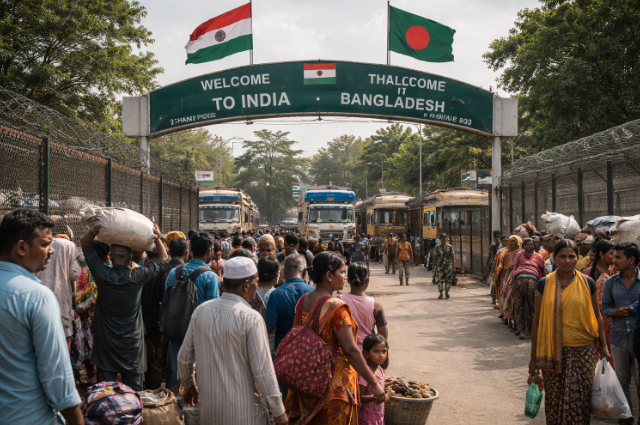
India and Bangladesh have long shared a relationship shaped by history, culture, economic cooperation, and regional security interests. For decades, both countries have worked closely on trade, connectivity, counter-terrorism, and people-to-people exchanges, making their partnership one of the most important in South Asia. However, in 2025, a series of political, economic, and strategic developments have created visible strains in bilateral relations, drawing attention from regional and global observers.
This article analyzes the evolving dynamics of India–Bangladesh relations by analyzing the key causes behind the recent tensions, the challenges faced by both nations, and the possible consequences for regional stability and cooperation. Rather than assigning blame, the discussion aims to present a balanced perspective that highlights multiple viewpoints and encourages a deeper understanding of how neighboring countries can manage disagreements while preserving long-term mutual interests.
Causes of the 2025 Tension
The tensions between India and Bangladesh in 2025 did not appear overnight. They developed slowly, influenced by a combination of political decisions, public sentiment, economic pressures, and regional changes. Like many relationships between neighboring countries, small disagreements gradually became larger concerns when they touched sensitive issues such as identity, security, and national pride.
One important factor has been border management and security concerns. The India–Bangladesh border is one of the longest and most densely populated borders in the world. While both governments cooperate to control illegal crossings, smuggling, and human trafficking, occasional incidents and stricter enforcement measures have caused frustration among border communities. Farmers, traders, and families who depend on easy movement sometimes feel the impact immediately when rules become tighter or when misunderstandings occur between security forces.
Another source of tension has been trade and economic imbalance. India is one of Bangladesh’s largest trading partners, but many Bangladeshi businesses feel that access to Indian markets is still limited in practice. Delays at border checkpoints, changing regulations, and competition from larger Indian companies have raised concerns among exporters and small traders. On the Indian side, there are worries about informal trade and market protection. These economic pressures, when discussed publicly or politically, often create emotional reactions that spill into diplomatic conversations.
Political changes and election-related pressures in both countries have also shaped the tone of relations. Leaders often face strong domestic expectations to appear firm on national interests, especially during politically sensitive periods. Statements made for local audiences can sometimes sound confrontational to the neighboring country, even if the original intention was domestic reassurance rather than diplomatic conflict.
A particularly sensitive issue in 2025 has been the growing influence of religion-based politics and identity debates in both societies. In India, discussions around nationalism, citizenship, and religious identity have continued to shape political narratives and public opinion. Some policies and public rhetoric have been closely watched in Bangladesh, where concerns about the safety, dignity, and regional balance of religious communities occasionally surface in public debate. At the same time, Bangladesh has its own internal political dynamics, where religious groups and identity-based movements sometimes influence public discourse and policy priorities. When such issues are amplified through media and social platforms, misunderstandings can grow quickly across borders, even when official governments try to maintain calm diplomatic language.
There is also the broader influence of regional and global geopolitics. South Asia is increasingly affected by competition among major powers, infrastructure investments, and strategic partnerships. Both India and Bangladesh must balance their national interests while managing relationships with other global players. These shifting alliances can sometimes create uncertainty or suspicion, even between friendly neighbors.
When all these factors are viewed together, it becomes clear that the 2025 tension between India and Bangladesh is not the result of a single disagreement or sudden conflict. Instead, it reflects a layered mix of border concerns, economic expectations, domestic political pressures, and sensitive identity debates. Each issue alone may seem manageable, but when they overlap, they create uncertainty and emotional reactions on both sides. This situation reminds us that relationships between neighboring countries are shaped not only by government decisions but also by public opinion, historical memory, and social change. Recognizing this complexity is important for avoiding oversimplified judgments and for encouraging constructive dialogue rather than confrontation.
Challenges for Both Countries
One of the most immediate challenges for both India and Bangladesh is maintaining border stability and mutual trust. The two nations share one of the longest land borders in the world, touching densely populated regions where migration, smuggling, and accidental crossings are common. Even minor incidents can quickly become politicized, amplified by media narratives and social platforms. For India, securing the border while respecting humanitarian concerns remains a delicate balance. For Bangladesh, repeated border tensions can create public frustration and raise questions about sovereignty and dignity. The lack of consistent communication at local and national levels often allows misunderstandings to grow into diplomatic strain.
Another major challenge lies in economic interdependence and trade imbalance. India is one of Bangladesh’s largest trading partners, yet the relationship is not always perceived as equal. Bangladeshi exporters often face logistical hurdles, regulatory barriers, and infrastructure limitations that slow market access. From India’s perspective, protecting domestic industries while maintaining open regional trade requires careful negotiation. Any disruption in trade affects small businesses, transport workers, and consumers on both sides. When economic concerns mix with political tensions, cooperation becomes harder, even though both countries benefit significantly from regional economic stability.
Water sharing and environmental stress continue to be sensitive issues that demand long-term cooperation but often become politically charged. Rivers flowing across borders are lifelines for agriculture, fisheries, and local livelihoods. Climate change, irregular rainfall, and increasing population pressure make water management more complex than ever. When agreements stall or implementation appears unequal, public distrust rises. For India, balancing the needs of multiple states while honouring international commitments is challenging. For Bangladesh, downstream dependency increases vulnerability and heightens public anxiety about future water security.
Domestic politics also shape how both governments respond to bilateral tensions. Leaders face pressure from voters, opposition parties, and media outlets that often demand firm stances rather than compromise. National pride and political messaging can limit diplomatic flexibility, even when dialogue would benefit both sides. Decisions made for short-term political gain can unintentionally weaken long-term regional relationships. This creates a cycle where cautious diplomacy struggles to survive in emotionally charged political environments.
Finally, the broader regional and global context adds another layer of complexity. South Asia is increasingly influenced by shifting alliances, economic competition, and strategic interests of larger powers. Both India and Bangladesh must carefully navigate external partnerships while protecting their own national interests. Any imbalance in foreign influence can create suspicion or uncertainty in bilateral trust. Managing these external pressures while preserving neighborly cooperation is a continuous strategic challenge.
In essence, the challenges facing India and Bangladesh are not driven by a single issue but by an interconnected mix of security concerns, economic interests, environmental pressures, political realities, and regional dynamics. Addressing these challenges requires patience, transparent dialogue, and a commitment to long-term cooperation rather than short-term political advantage.
Regional and Global Consequences
The growing tension between India and Bangladesh does not remain confined to diplomatic meetings or official statements. Its consequences slowly ripple outward, affecting ordinary citizens, regional stability, and long-term development goals on both sides of the border. When two closely connected neighbours experience strain, even small disruptions can carry wider meaning and lasting impact.
One of the most visible consequences is the uncertainty in economic cooperation and cross-border trade. Businesses thrive on predictability, trust, and stable policy environments. When relations become tense, investors hesitate, transport routes slow down, and bureaucratic procedures become more cautious. Small traders, farmers, transport workers, and local manufacturers often feel the impact first. Delays at border checkpoints raise costs and reduce competitiveness, affecting livelihoods in border regions that already face economic vulnerability. Over time, reduced confidence in bilateral trade can weaken regional supply chains and slow broader economic growth.
Another important consequence is the erosion of public trust and people-to-people connections. India and Bangladesh share deep cultural, linguistic, and historical ties. When political tensions dominate headlines, these shared connections risk being overshadowed by suspicion and negative stereotypes. Social media and sensational reporting can amplify isolated incidents, turning them into national narratives. This emotional distance between societies can take longer to heal than political disagreements, making future cooperation more difficult even after diplomatic tensions ease.
From a security perspective, prolonged strain can weaken coordination on border management and regional safety. Both countries benefit from intelligence sharing, joint patrols, and cooperation against illegal activities. When trust declines, communication gaps widen, increasing the risk of misunderstandings or unintended escalation. This does not serve either nation’s long-term interests and may divert attention and resources away from development priorities toward defensive measures.
Environmental and humanitarian consequences also deserve attention. Delayed cooperation on water management, disaster response, and climate adaptation can directly affect millions of people living along river systems and low-lying areas. Flood control, irrigation planning, and emergency coordination require consistent collaboration. When diplomatic trust weakens, technical cooperation often slows, leaving communities more vulnerable to natural risks and climate uncertainty.
At the regional level, strained relations can undermine South Asian unity and collective problem-solving. South Asia already faces challenges such as poverty reduction, infrastructure gaps, climate change, and public health risks. A divided regional environment limits the ability to create strong economic corridors, shared energy projects, or coordinated disaster response systems. External powers may also gain greater influence in a fragmented region, reshaping strategic balances in ways that may not always align with local priorities.
Perhaps the most subtle but lasting consequence is the loss of momentum in long-term trust building. Diplomatic relationships are not rebuilt overnight. Each period of tension leaves behind caution, skepticism, and political memory. Even when formal agreements are restored, confidence takes time to recover. Missed opportunities for cooperation in education, technology, tourism, and cultural exchange represent invisible costs that are rarely measured but deeply felt over time.
In conclusion, the consequences of India–Bangladesh tensions extend far beyond short-term political disagreements. They touch economic stability, social harmony, security coordination, environmental resilience, and regional cooperation. Recognising these broader impacts highlights the importance of sustained dialogue, responsible leadership, and a commitment to partnership over polarisation.
The evolving relationship between India and Bangladesh in 2025 reflects more than a momentary diplomatic disagreement; it reveals the deeper complexity of managing a partnership in a rapidly changing regional and global environment. History has shown that the two nations are bound not only by geography but by intertwined economies, shared ecosystems, cultural continuity, and long-standing political cooperation. These connections make disengagement neither practical nor desirable. At the same time, unresolved structural pressures from border governance and economic imbalance to environmental stress and domestic political expectations continue to test the resilience of this relationship.
What becomes evident is that tension is not simply the result of isolated incidents but the outcome of accumulated policy gaps, communication failures, and shifting strategic priorities. When dialogue weakens, mistrust fills the vacuum. When political messaging outweighs diplomatic restraint, space for compromise narrows. Yet, the same forces that generate friction also create opportunity. Shared vulnerability to climate change, mutual dependence on trade connectivity, and common regional security concerns offer powerful incentives for renewed cooperation, provided leadership on both sides is willing to prioritise long-term stability over short-term political advantage.
The true risk lies not in disagreement itself, which is natural between sovereign states, but in allowing disagreement to harden into structural suspicion. If left unmanaged, even manageable tensions can reshape public perception, weaken institutional cooperation, and slowly erode the strategic trust that has taken decades to build. Conversely, constructive engagement grounded in transparency, institutional dialogue, and respect for mutual interests has the capacity to transform present challenges into platforms for deeper collaboration.
Ultimately, the future of India–Bangladesh relations will not be decided solely by treaties or official statements, but by the quality of political judgment, diplomatic maturity, and societal responsibility exercised on both sides. Stability in this bilateral relationship is inseparable from the broader stability of South Asia itself. Choosing cooperation over confrontation is not merely an idealistic aspiration; it is a strategic necessity in an interconnected and increasingly fragile world.
References
- International Crisis Group: After the “Golden Era”: Getting Bangladesh–India Ties Back on Track.
- South Asian Voices (Stimson Centre): India and Bangladesh Should Insulate Their Border from Bilateral Tensions.
- Eurasia Review: Bangladesh–India Relations: From Strain to Reconciliation – Analysis.
- Next IAS – Current Affairs: India–Bangladesh Relations: Developments and Issues.
- Firstpost (Opinion & Geopolitics): Why India and Bangladesh Must Look for a Strategic Reset.
- The Daily Star (Bangladesh): Bangladesh and India’s New Strategic Dilemma.
- The Business Standard (TBS News): After the Golden Era: Can Bangladesh and India Reset Relations?