
Riya had an uncle who was much younger than her mother, the youngest in the family. He had come to the city for college and was staying at his elder sister’s home. In those days, the house felt warm and ordinary. Her mother was happy to have her younger brother with her. Riya often went out with her uncle small walks and casual outings. He laughed easily. Nothing about him felt unusual.
Then came the New Year.
Everyone was excited. Plans were being made. Her uncle said he was going on a picnic with friends. Later, almost casually, he mentioned that the picnic was just an excuse—that they were going to explore a haunted place for vlogging. Some abandoned palace, somewhere near the forest.
Riya remembers how animated he looked while talking about it. Happy. Energized. Normal. Riya was very young then. Too young to understand what questions mattered. She doesn’t remember exact dates or places, and she never asked him where, exactly, he and his friends were going for the picnic. What stayed with her were fragments—voices, expressions, sudden silences. Those things don’t fade easily.
New Year’s Day passed quietly. Relatives visited. Conversations flowed. Nothing seemed out of place.
A couple of days after New Year’s—Riya can’t say the exact date—it happened. That night, her mother was in the kitchen, kneading dough for dinner. The room smelled of flour and warmth. Her uncle walked in and asked for a glass of water.
Her mother replied without turning around, “My hands are wet. I’m kneading dough. You can take it yourself.”
The change was instant.
“Will I even get a glass of water in this house?” he shouted.
The volume of his voice startled everyone. People rushed into the kitchen. Her mother froze. No one understood what had triggered such anger. This wasn’t how he behaved. He had always been calm, quiet, and gentle.
Getting this angry over a glass of water didn’t make sense. For a moment, the room felt unfamiliar—like something had shifted, but no one could see what it was. Without saying another word, he stormed out of the kitchen and went to his room.
No one spoke.He hadn’t been drinking. No one had spoken harshly to him. There was no obvious reason. When dinner was ready, Riya’s mother went to call him. His room was empty.
They searched the house. Then someone called his phone.
That’s when they realised—he had left.
Panic spread through the house. It was late. He was alone. And in that city, he had no other relatives. No one knew where he had gone. By then, it was close to 9 p.m.
Riya’s mother panicked. She immediately asked a neighbour to take his bike and look for him. Everyone believed he couldn’t have gone very far on foot.
A few hours later, the neighbour found him. When he asked Riya’s uncle to come back home, he refused. Wiping his tears, he spoke calmly—almost normally.
“No… no. I’m leaving. You go back to your house.”
He said he wanted to go to another city immediately, to his brother’s place. He refused to listen to anyone. His anger had turned into stubborn insistence—unshakeable, relentless. There was no other option left. For his safety, the neighbour took him on the bike and dropped him at his brother’s house in another city. Everyone hoped that once he was there, surrounded by family, he would calm down.
But what happened next was something no one had imagined.
The next day, Riya’s mother called him. Whatever she heard on the phone shattered her. She broke down mid‑call. Seeing her cry, the entire house began to cry with her. No one fully understood what had happened yet—but everyone knew something terrible had occurred.
His brother explained what had happened that night.
They had restrained him with a thick rope because he kept trying to run away. He was lifting heavy stones and throwing them into a well, repeatedly. No one could understand why he was doing it.
They tried to stop him. To calm him. But it felt as if he was no longer himself. He kept saying that he had enjoyed New Year’s celebrations just a day ago—so why had he suddenly changed overnight? No one had an answer.
At one point, in desperation, they even slapped him, hoping it would bring him back to his senses. It didn’t.
He continued trying to escape, insisting he had to go outside.
And finally—
He managed to slip away. He jumped into the well and ended his life. When Riya’s mother heard this, she collapsed in tears. No one in the family had words left.
Later, as Riya grew older and replayed these events in her mind, one thought stayed with her. Such sudden behavioral changes should never be taken lightly. Sudden rage, extreme restlessness, an urge to flee—these are signs of an emergency. He should never have been left alone, restrained, or treated as someone merely being difficult.
Perhaps medical help could have saved him.
But the family was not heartless. They were unaware. At that time, people did not understand mental health the way they do today.
Maybe if this had happened now, the outcome would have been different. But that night, they lost him— not to anger, not to mystery,
but to something no one knew how to recognise in time.'
After that night, Riya says, whenever she remembers her uncle, she quietly retreats to a corner and cries.
She doesn’t speak, she doesn’t tell anyone. She just cries.'
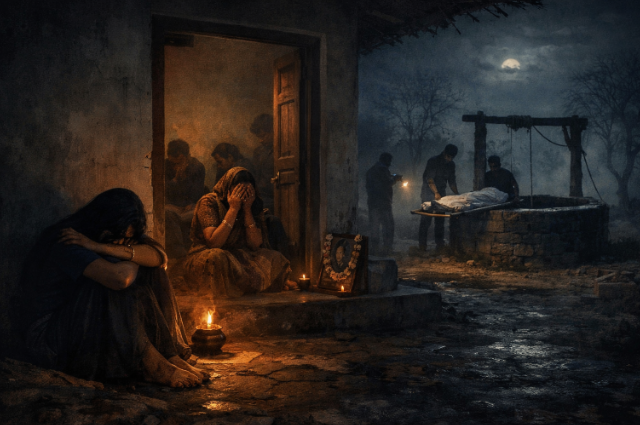
Later, the body was pulled out of the well. There was no organised process—people stood around, unsure what to do. Some held ropes, others covered their faces.
When the body finally came out, her mother’s legs froze. The moment she saw his face, she knew—something terribly wrong had happened. The final rites were done quickly, almost as if everyone wanted to erase the moment as fast as possible.
No one had words. No one dared to look.' Returning home felt unreal. The house felt hollow. Silence filled every corner. A suffocating heaviness lingered in the air.
Her mother sat in the same spot for hours, staring straight ahead. She didn’t cry, didn’t speak—she just sat, frozen.' No one slept that night.' Every small noise made everyone jump. It felt as if he was still running, as if the well was calling him.
The next day was heavier. Visitors came and went, but no one’s heart felt lighter. The neighbour repeated the same thought—
“Whatever happened, it started with that New Year picnic. Who knows where he went with his friends? What place did he see?”
Her mother kept repeating:
“He must have seen something… something no one should see. Or he went somewhere he shouldn’t have gone. Something evil must have gotten into him… That’s what took my brother’s life. Otherwise, he would never have jumped into the well over something so small.”
After that day, the house never felt the same again. What happened was tragic and shocking. But the lesson is clear: sudden changes in a person’s behaviour—rage, stubbornness, or attempts to flee—should never be dismissed as mere acting or moodiness.
Sometimes, that person is crying out for help, in the only way they know how.