
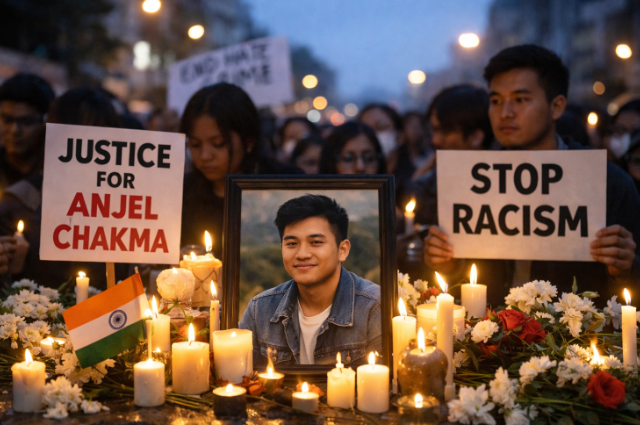
India witnessed a grievous incident that haunted the conscience of the state in December 2025. This event reignited the painful debates about racism, inequality, discrimination and identity within it’s own borders. Anjel Chakma, a 24-year-old MBA student from Tripura, died after a brutal assault in Dehradun, Uttarakhand. An attack that was fueled by racial prejudice and deeply carved ignorance. His story is not just another case of murder in India; perhaps it’s a mirror that is shown to the society that is combating with understanding the unity in diversity.
Who was Anjel Chakma?
Anjel Chakma belonged to the Unakoto district of Tripura, a small town in India’s Northeast. He was a student at a private university in Dehradun, where thousands of candidates from all over the nation study each year. Same as every other young blood, Anjel was also filled with dreams and ambitions to fulfil.
On the 9th of December, 2025, Anjel, accompanied by his younger brother, Michael, was shopping in the Selaqui area of Dehradun when their lives were violently upended. According to the reports of several reporters, both brothers were encircled by a group of local men, some of whom were even intoxicated, and began to say inappropriate racial statements to them, calling them with derogatory terms such as “Chinese” or “Chinese Momo*, terms used to insult and embarrass people of Northeastern China, usually based on their physical features.
When Anjel raised his voice and stood up against the inappropriate slurs, he was silenced in a way no one deserves. Initially, he said, "We are not Chinese, we are Indians, “and the situation got worse. The group attacked them with metal rods and knives, leaving them both brutally injured. Anjel suffered from severe head, neck and spinal injuries. He was taken to the Graphic Era Hospital instantly, where he fought for his life for 17 days before his soul left his body on 26 December 2025.
Attack that Enraged the Nation
Anjel’s news of his hospitalisation and sudden death rapidly ignited and enraged the nation with shock, grief and anger all over the state. More specifically, amongst the people of Northeastern India. Candlelight vigils were held, student groups and supporters protested in rallies and demanded justice for Anjel, and the voices grew louder every new day.
In Tripura, Assam and other Northeastern town, student committees and civil rights councils organised marches and demanded stricter laws to protect minorities and students from such racial prejudices. The memory of Nido Tania was invoked, who is just another similar case, similar body, similar death, like Anjel back in 2014 after a violent confrontation in the national capital region, to underline the nature of racial violence against the people from the Northeast.
The voices of people weren’t unheard. The political parties, as well as regional leaders, condemned this horrific incident as a hate crime and demanded justice.
Legal Response and Outcome
The Uttarkhand Police responded to the Public protests by filing a murder case and arresting five individuals connected to the assault. One suspect, identified as Yagya Awasthi, remained at large with a reward announced for his capture. A Special Investigation Team (SIT) has been formed to investigate the case deeply.
A public Interest Litigation (PIL) has been filed before the Supreme Court of India, urging the court to recognise racial slurs and racially encouraged violence as an identified category of Hate Crime under Indian Law. Absence of such legal protection laws for minorities persist such incidents, according to the Advocates.
Contested Narratives and Public Debate
Where many activists and social citizens describe the assault as racially motivated, official investigations have yielded contradicting statements. The senior police officer in Dehradun stated that the Probe hasn’t yet found the conclusion based on the evidence that the attack was due to racial prejudice, slur remarks or rather a planned hate crime.
This comment has further ignited the controversy, and critics argue that dismissing the racial angle reduces the lived experiences of the people of the Northeastern states who have long complained of discrimination in races. Whether the attack was on racial prejudices or not, perhaps the impact of it on the nation was significant.
Northeastern Students and Community Influenced
Dehradun hosts nearly 3000 students from the Northeastern states, many of whom have been reported to feel unsafe after Anjel’s death. Instead of surrendering, the students and locals have been out for protests and would raise their voices until justice was served. Awareness campaigns, programmes, and events for an inclusive and respectful society have increased and taken place too.
This incident was not only about a boy named Anjel, who lost his life, but the death of Anjel based on his identity sparked the people on broader levels.
Family Pleas and Demand for Justice
Anjel’s family has been vocal in demanding justice and strict policies for the protection of minorities in the state. They have called for life imprisonment for the offender and emphasised the fact that the loss of their son’s life is not just a personal incident but a global tragedy for them.
Conclusively, the matter of Anjel Chakma’s death was not only a call for recognition but a promise of youth to have a better life and better opportunities despite their caste, culture, religion or colour. This legal battle would continue as the protest unfolds, Anjels story remains a stark reminder that the fight against such racial prejudices is far from over, and the safety and respect for all citizens, regardless of region or appearance, must be central to the nation’s conscience and law.
References
- Anjel Chakma lynching. Wikipedia. Wikipedia
- Dehradun protests over the death of Angel Chakma. The New Indian Express. The New Indian Express
- Police rule out racial motive in Chakma killing as NHRC seeks report. The Tribune. The Tribune
- Anjel Chakma's police denial of a racial attack. NDTV. www.ndtv.com
- Students vow to continue the protest until the main accused is arrested. The Times of India. The Times of India
- NHRC issues notice to authorities over killing. MyInd. Home
- PIL seeks hate crime guidelines after murder. LawBeat. LawBeat
- National outrage and condemnations. NDTV/Outlook India.