
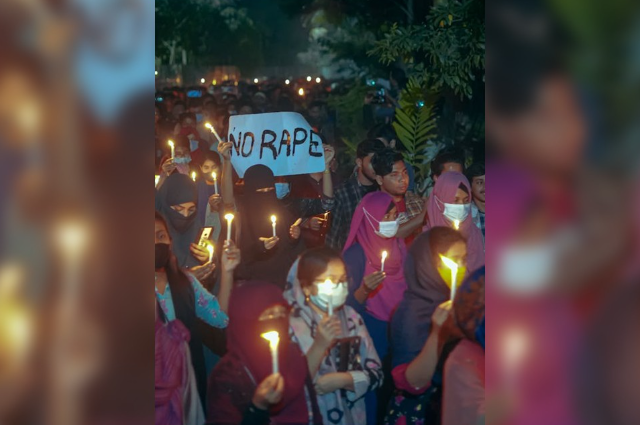
A Night That Was Never Supposed to Define Her
February 6, 2012. Kolkata.
She was a single mother of two daughters. She liked music. She laughed easily. She had a grandmother who was a school principal, a family that loved her, and a life that was entirely, unremarkably hers.
That night, she stepped out of a nightclub on Park Street — one of Kolkata's most lit, most celebrated streets — and accepted a lift from five men she had just met. It was late. She wanted to get home. They seemed safe enough.
They were not.
What happened inside that moving car over the next hour is a matter of court record — a gang rape, brutal and deliberate, by five men who would later deny everything. She was dumped near Exide Crossing at 3:30 in the morning, bruised, shattered, and alone. She hailed a taxi. She went home. And in the morning, she did what the bravest among us do when the world has just shown us its worst face.
She went to the police.
That decision — to file that FIR, to insist that what happened to her was real and criminal and worth fighting — would cost her everything. And it would also make her immortal.
The Second Assault — By the System
When Suzette Jordan walked into Park Street Police Station on February 9, 2012, she was not met with compassion. She was met with laughter.
According to documented accounts, the officers on duty laughed at her complaint. They asked her — in what positions she had been raped.
She was sent for a medical examination eight days after the assault — eight days — which is a violation of every protocol designed to protect survivors. And yet, even after that unconscionable delay, the medical report found what she had said all along: injury marks consistent with rape.
The facts were there. The evidence was there. Suzette Jordan was there, standing in that police station, insisting on being heard.
But India was not done assaulting her.
On April 4, 2012, IPS officer Damayanti Sen — the Joint Commissioner of Kolkata Police who had actually cracked the case and was making real progress — was abruptly transferred out of Kolkata. The message was clear to anyone paying attention: pursuing this case had consequences.
And then came the blow that no survivor should ever have to absorb.
The Chief Minister of West Bengal, Mamata Banerjee, stood before the country and called Suzette Jordan a liar. She dismissed the case as a "sajano ghotona" — a fabricated, staged incident — accusing the survivor of trying to embarrass her government. Mobs attacked Suzette's home. Journalists dissected her character on national television. Officials questioned why she had been at a nightclub alone. Why had she been drinking? What she had been wearing.
A state government official, on record, suggested the answer to rape was for women to come home early.
Suzette Jordan had been raped once in a car. She was now being raped again — by the machinery of a state that had decided her inconvenience to those in power was greater than her right to justice.
The Choice That Changed India
For over a year, she was "the Park Street rape victim." A case number. A news headline. A woman without a face — because Indian law protects survivors' identities, and the media honoured that.
But in June 2013, Suzette Jordan made a decision that no law required, no one asked for, and almost no one expected.
She unmasked herself.
She walked in front of cameras and said the words that would echo across every courtroom, every newsroom, and every survivor support group in India for years to come:
"I am not the Park Street rape victim. I am Suzette Jordan. I am a survivor."
She was not naive about the cost. She knew what India did to women who spoke. She had already seen mobs outside her home. She had already been called a liar by the most powerful woman in her state. She had already been treated like the accused rather than the accuser in her own case.
She did it anyway.
Why? Because she understood something that most of us, sitting safely in our silence, do not. She understood that anonymity — however well-intentioned — was also a form of shame. That as long as survivors hid, society could pretend the crime was something to be ashamed of. And the shame, she had decided, belonged to the men in that car. Not to her.
"Why should I hide my identity when it was not even my fault?" she asked, speaking to cameras with a composure that must have cost her enormously. "Why should I be ashamed of something that I did not give rise to? I was subjected to brutality, I was subjected to torture, and I was subjected to rape. And I am fighting. And I will fight."
India had never heard a rape survivor speak like this before.
The Woman Behind the Fight
What the headlines often missed — what crime reporting always misses — was who Suzette Jordan actually was when the cameras were not on her.
She was a mother first. Her two daughters, Rhea and her younger sister, were teenagers navigating a world that was publicly dissecting their mother's trauma. After Suzette's death, Rhea wrote an essay about her — first as a school assignment, later published — that revealed a woman the world never quite got to know.
"Suzette Katrina Jordan was my Mama's name," Rhea wrote. "She had her own perspective, her own logic as to how life should be lived. She was incontestably stubborn and unbelievably broad-minded. She believed in being real."
While fighting her case in court, Suzette became a counsellor at a helpline for survivors of sexual and domestic violence. She used her own wound to tend to others. She appeared on Aamir Khan's Satyamev Jayate, bringing her story to millions of living rooms across India. She marched on the streets of Kolkata to protest subsequent rapes and murders in Bengal. She used Facebook — then a relatively new platform for activism — to speak directly to the public, bypassing the media that had so often twisted her words.
And through all of it, she faced humiliation that should never befall any human being. She was denied entry into a Kolkata restaurant — simply because she was a rape survivor, and the management did not want the association. When she spoke out about it on social media, there was outrage. But outrage fades. Suzette had to keep living in a city that had decided who she was.
The depression that follows sustained public shaming, sustained legal battle, and sustained trauma is not a weakness. It is a physiological response to an unbearable load. The diseases that eventually took her life — meningoencephalitis, an inflammation of the brain and its surrounding membranes — are known to be exacerbated by prolonged psychological stress.
India did not kill Suzette Jordan with a weapon. It killed her with its indifference, its judgment, and its breathtaking cruelty toward a woman who had already survived the unsurvivable.
The Verdict She Never Lived to Hear
Suzette Jordan died on March 13, 2015, at a state-run hospital in Kolkata. She was forty years old.
She died before the verdict.
On December 10, 2015 — nine months after her death — Additional Sessions Judge Chiranjib Bhattacharya of the Kolkata Sessions Court found three of the five accused guilty of gang rape, criminal intimidation, and conspiracy. Each was sentenced to ten years of rigorous imprisonment and fined one lakh rupees.
Two of the main accused — including Kader Khan, who had been in a relationship with Bengali television star and later parliamentarian Nusrat Jahan — remained absconding for years. Khan was eventually arrested from a hideout in Noida, five years after the crime. As of 2020, he remained in prison.
Justice arrived. Incomplete, delayed, and delivered to an empty chair — but it arrived.
And it arrived because Suzette Jordan refused to sit down.
What She Left Behind
The easy thing to do with Suzette Jordan's story is to file it under "tragedy" and move on. Another woman. Another crime. Another India-failed-her headline.
But that would be to miss entirely what she actually accomplished.
Before June 2013, India had no public template for a rape survivor who chose visibility over anonymity — not as a political statement, but as a personal act of dignity. Suzette Jordan created that template. She showed every survivor who came after her that the face behind a crime is not the face of shame. The face of shame belongs to the perpetrators, to the officials who laughed, to the politicians who called her a liar, to the restaurants that turned her away, to the society that blamed her clothes and her nightclub and her drink.
She was the first. And the first always pays the highest price.
Her daughter Rhea ended her essay with a question that deserves to outlive every verdict, every news cycle, and every government statement ever made about this case.
"When I grow up, I want to be like my Mother. Be REAL. Would you dare to? What do you have to lose?"
I found Suzette Jordan's story while researching real acts of courage for this competition — not the kind celebrated with trophies and ceremonies, but the kind that is lived quietly, stubbornly, in courtroom corridors and television studios and hospital beds. I did not expect to find a woman who had already answered every question I had about what it means to stand up when every force around you is pushing you down. I did not expect to find myself sitting still for a long time after reading her daughter's words.
Some stories do not ask to be admired. They ask to be witnessed. This is one of them.
Conclusion: A Name Is Not a Small Thing
In a country that has spent decades teaching its women to hide their faces, their pain, their stories — Suzette Jordan did something quietly revolutionary. She gave hers away. Freely. Loudly. Unapologetically.
She did not win every battle. The state doubted her. The system delayed her. The disease defeated her body before justice could reach her ears. Two of her rapists walked free for years. The restaurant that turned her away never truly faced accountability. The officials who laughed never apologised.
And yet.
Three men went to prison. A conversation changed. A generation of survivors watched a woman stand in front of cameras and refuse to be reduced to a case number. The word "victim" began — slowly, imperfectly, but genuinely — to be replaced by the word "survivor" in India's public vocabulary.
That shift has a name.
It is Suzette Jordan.
And she deserves to be remembered not as a tragedy, not as a headline, and not as a symbol — but as what she always was.
A real woman. A fierce mother. A person who fought.
I am not the Park Street rape victim.
I am Suzette Jordan.
I am a survivor.
REFERENCES
- Suzette Jordan — https://en.wikipedia.org
- All You Need to Know About the Park Street Rape Case: https://www.dnaindia.com
- I Am Not the Park Street Rape Victim. I Am Suzette Jordan: https://scroll.in
- Suzette Jordan Rape Case: Three Rapists Awarded 10 Years Imprisonment: https://www.thenewsminute.com
- Indian Park Street Rape Victim's Rapists Convicted: https://www.dawn.com
. . .