
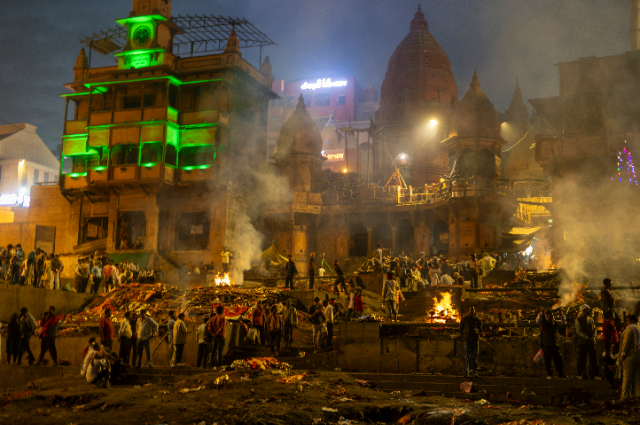
The Antediluvian Arteries: Navigating the Veins of the Eternal City
To enter Kashi is to step outside the linear progression of time. It is a palimpsest where every century has written its story over the previous one without erasing the ink. As I navigated the convoluted, narrow alleys—lanes so ancient they seem to pulse with the breath of millennia—the world of the living began to blur. The familiar aromas of the marketplace—sandalwood, incense, and street food—were gradually eclipsed by a more primordial scent: the smell of parched wood and the heavy, metallic tang of burning existence.
Walking toward Manikarnika is a shedding of layers. The walls are stained with history and betel juice, and every corner whispers a story of someone who came here to die but stayed to become eternal. By the time the horizon of the Ganga finally opens up, revealing the searing orange of the pyres against the grey river, you are no longer a spectator. You are a witness to the ultimate reality of the flesh. The air here is thick—not just with smoke, but with the grit of thousands of years of transition. Each step feels like a surrender of the ego.
The Metabolism of the Eternal: Understanding the Anatomy of the Pyre
At Manikarnika, fire is not a single event; it is a perennial metabolism. To understand the depth of this place, one must look at the wood. Mountains of timber—logs of mango, pipal, and for the wealthy, the fragrant sandalwood—are stacked like skeletal architecture along the ghats. There is a brutal geometry to it. Each stack is a temporary throne for a departing soul, arranged with an ancient science to ensure the draft of the river carries the essence upward.
Then there is the Kunda—the fire-pit of the eternal flame. Legend says this fire has not been extinguished for thousands of years, a spark borrowed from the cosmic dance of Shiva. During Masan Holi, this fire becomes the source of the 'color.' The ash isn't just burnt carbon; it is the dehydrated remains of human journeys. Watching the sparks fly into the night sky, one realizes that each spark is a sentence in someone's biography, finally escaping the syntax of the body. The heat is incandescent, a glowing bridge between the mundane and the infinite. It is a sensory assault that leaves no room for pretension.
The Divine Paradox: The Metaphysics of the Outcast’s Holi
Rangbhari Ekadashi marks the 'Gauna' of Lord Shiva—the day he brought his bride, Ma Parvati, to his abode. While the rest of Kashi celebrates this union with pink Gulal, Shiva, the Pashupatinath, remembers his outcasts. The ghosts, the ghouls, and the spirits—the 'Ganas' who are deemed inauspicious by the civilized world—found themselves left out of the bridal festivities. In an act of radical inclusivity, Shiva descended upon the cremation grounds to play Holi with them.
He did not use the fragrant powders of the marketplace; he used the Chita-Bhasma (funeral ashes). This ritual is a stark reminder that in the eyes of the Absolute, the distinction between the 'Auspicious' and the 'Ominous' is merely a human construct. It is a celebration where the bridal chamber meets the pyre, proving that life and death are but two sides of the same coin. The grey dust is the ultimate equalizer, erasing the vanity of social status and leaving only the raw energy of the spirit. It is the only place on earth where a wedding gift is composed of the remains of the dead.
The Texture of Mortality: The Visceral Reality of the Bhasma Dance
By noon, the ghat transforms into a theater of the surreal. Thousands of devotees and Aghoris gather, their skin coated in a ghostly layer of grey grit. The sound of the Damrus is not a melody; it is a primal resurgence—a rhythmic thumping that vibrates within the marrow of the observer. When the first handful of Bhasma is thrown, the air vanishes. You are breathing in the stories of the strangers who were cremated an hour ago.
The sun becomes a pale disc behind a curtain of grey dust. It is an abrasive experience—the ash gets into your eyes, your hair, your lungs. It is a sensory overload that forces you to confront the reality of the flesh. In this fog, everyone looks the same. The rich man’s ash and the poor man’s ash are indistinguishable. The grey veil erases every hierarchy, leaving only the raw, humming energy of the crowd. It is a chaotic, gritty, and unapologetically real confrontation with what we all eventually become. There is no grace here, only the raw, throbbing truth of existence.
The Stoic Sentinels: The Unflinching World of the Dom Rajas
No chronicle of this ghat is complete without the Dom community. While the crowd loses itself in the dance, the Doms stand as silent architects of the transition. They see the body for what it is—a vessel of five elements. Their relationship with fire is professional, yet deeply spiritual. No one can achieve Moksha without the fire from their hearth.
I watched an elderly Dom, his skin leathered by decades of heat, as he witnessed the Holi. He didn't dance or chant; he simply existed in the fire’s glow. For him, the ash isn't a symbol; it’s a daily reality of metabolism. His presence provides a grounding reality to the ecstatic chaos. He is the anchor in the storm of ash, a reminder that the fire is always hungry, and it always wins. His charcoal-stained hands are the final editors of every human narrative that reaches these stones, turning flesh into philosophy.
The Universal Solvent: The River and the Aftermath of the Flame
As the sun dipped below the horizon, casting a crimson glow over the Ganga, the madness reached its peak. The river, shimmering under the pale moonlight, seemed to carry the weight of all the ashes it had swallowed that day. In Kashi, the Ganga is not just a water body; she is a solvent. She dissolves the sins, the ashes, and the histories of the city, carrying them into the vastness of the infinite.
I left the ghat with ash in my hair and a strange, cold clarity in my heart. The roar of the crowd faded into the rhythmic crackling of the remaining pyres. The fire does not end the story; it merely translates it into a different language—one of smoke, memory, and silence. As I bathed in the river later that night, the ash took hours to wash away, but the realization it brought will likely never leave. Life is not a quiet preparation for the end; it is a dance upon the ashes of the past, a fire that must be lived with every breath.
. . .
References & Bibliography;
Academic & Theoretical Sources (Primary and Secondary)
- Conrad, Joseph. (1899). Heart of Darkness. (Use of the concept of the ‘inner station’ and claustrophobic imagery in the introduction).
- Donne, John. (1633). Holy Sonnets: Death, be not proud. (Discussed in the literary juxtaposition section as a Western counter-narrative to the Kashi philosophy).
- Dhar, Krishna. K. (2020). The Mahashmashana: Life, Death, and Moksha in Banaras. Kolkata: Kashi Publications. (Source for historical data on the perpetual metabolism of Manikarnika Ghat).
- Eck, Diana L. (1982). Banaras: City of Light. Princeton: Princeton University Press. (The seminal work on the spiritual geography and anthropology of Kashi).
- Hardy, Thomas. (1891). Tess of the d'Urbervilles. (Concept of inescapable destiny and the role of natural elements, used to parallel the Dom community's stoicism).
- Iyer, Raghavan. N. (2007). Ritual, Mythology, and Folklore: The Metaphysics of Masan Holi. Mumbai: Vedic Studies Institute. (Theology of Shiva and the 'Ganas', used in the "Divine Paradox" section).
- Puranas. Skanda Purana: Kashi Khanda. (Source material for the mythological origins of Rangbhari Ekadashi and Shiva’s connection to Manikarnika).
- Saraswati, Baidyanath. (1985). The Dom Community: Kings of the Shmashana. Delhi: Anthropological Survey of India. (Sociological data on the Doms of Manikarnika used in the "Stoic Sentinels" section).
- Gupta, Arindam. (Director). (2018). Masan Holi: The Carnival of Death. [Documentary Film]. Kolkata: FrameStory Productions. (Source for visual cues and description of the Damru’s 'primal resurgence').
- Sharma, Pankaj. (2025, March). The Grey Celebration: Personal Account of Bhasma Holi. [Photo-Essay in 'The Kashi Times']. Varanasi. (Data on the specific textures of funeral ash used in the sensory analysis section).