
The Rhythmic Pulse of an Era
In the quiet, historical corridors of Bengal, there once existed a sound that defined the very soul of the rural economy—the rhythmic, hypnotic ‘khot-khot’ of the handloom. This was more than a mere occupational noise; it was the heartbeat of a civilisation that transformed raw fibres into wearable tapestries of culture. However, during a recent on-ground exploration into the weaving clusters near Durgapur, I discovered that this heartbeat is flickering. The silence that has descended upon these sheds is not peaceful; it is heavy, ominous, and tells a ‘Real Story’ of a heritage in its final throes.
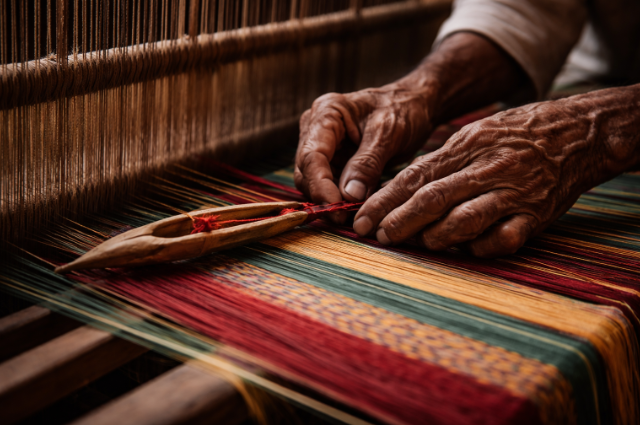
As I stepped into the dimly lit workspace of Sanatan Da (name changed to preserve his dignity), a sixty-four-year-old master weaver, the contrast was immediate. The wooden loom, once a symbol of Swadeshi pride and economic sovereignty, now stood like a skeletal remains of a forgotten god. Sanatan Da’s eyes, mapped with the fatigue of fifty years of concentration, did not look for sympathy. They looked for justice. "The loom is not a machine, Didi," he whispered, "it is an extension of my breathing. When the loom stops, the artisan inside me starts to fade." This narrative is a critical examination of the chasm between our modern industrial 'progress' and the human cost of artistic displacement.
The Historical Tapestry – From Sovereignty to Subjugation
To appreciate the gravity of the current crisis, one must revisit the epoch when the Indian handloom was the gold standard of global trade. From the legendary muslins of Dhaka, described by poets as 'woven air,' to the intricate Balucharis of Bishnupur that narrated the epics of the Ramayana on silk borders—our weavers were the undisputed architects of aesthetic excellence. During the colonial era, the loom was our silent weapon of resistance. Mahatma Gandhi’s call for Khadi was not just about cloth; it was about reclaiming the dignity of labour.
In the households of weavers like Sanatan Da, the craft was a sacred inheritance. He recalls a childhood where the mathematics of complex patterns was taught before the alphabet. It was a complete socio-economic ecosystem where every family member—from the elderly dyeing the yarn to the children starching the warp—played a pivotal role. The loom was the centre of the universe. However, as we transitioned into the era of the Fourth Industrial Revolution, that sacred centre has been marginalised by the cold, metallic efficiency of the power loom.
The Metallic Roar – A Paradox of Progress
The tragedy of the modern weaver is rooted in a cruel, technological paradox. We live in an era where 'Slow Fashion' and 'Ethical Consumerism' are celebrated in the ivory towers of urban boutiques, yet the very artisans who embody these values are being systematically erased. The primary antagonist in this narrative is the high-speed power loom—a metallic marvel that can produce in a single hour what takes Sanatan Da four days of painstaking labour.
To the untrained eye of a modern consumer, the machine-made replica might appear identical to the hand-woven original. However, as any student of the humanities understands, a reproduction lacks the 'aura' of the original. The power-loom mimics the pattern but fails to replicate the soul—the subtle, intentional irregularities that breathe life into a piece of fabric. "The machine can copy my design," Sanatan Da says, his fingers tracing a delicate silk motif, "but it cannot copy the prayers I weave into it."
The Economics of Erasure – The Mahajan and the Market
Beyond the roar of the machines, there is a silent, systemic strangulation occurring within the supply chain. The 'Real Story' of the weaver is often dictated by the 'Mahajan' or the middleman. In villages across Bengal, weavers are often trapped in a cycle of debt, forced to procure raw materials at inflated prices, only to sell the finished masterpiece for a pittance.
The economic architecture is skewed against the artisan. While the retail price of a handcrafted saree in a city showroom can run into tens of thousands, the weaver often receives barely enough to cover his basic sustenance. This economic suffocation has led to a heartbreaking exodus. The younger generation, witnessing the poverty of their fathers, is abandoning the loom for the anonymity of urban labour. Sanatan Da’s own son now works as a delivery agent in the city. "There is no art in his work," the father remarks with a bitter smile, "but there is a predictable paycheck."
The Psychological Landscape – A Heritage in Trauma
Beyond the empty looms and the silent shuttles, there is a mental health crisis that remains largely unrecorded. For a weaver like Sanatan Da, the loss of his craft is not merely an economic setback; it is an ontological crisis. When an artisan is forced to abandon the loom for a life of unskilled labour, he doesn't just lose his livelihood—he loses his language.
The loom is an extension of the weaver's consciousness. To take away the shuttle is to silence a voice that has been speaking through silk and cotton for generations. In our conversation, Sanatan Da’s silence was often more articulate than his words. This psychological displacement is what happens when pride is replaced by humiliation. It is a slow, systemic erasure of identity that no digital archive can truly restore.
The Digital Resurrection – A Fragile Ray of Hope
In a turn of irony, the same digital world that accelerated the rise of fast fashion is now offering a slim, fragile ray of hope. In recent years, a small segment of young weavers and social entrepreneurs has begun utilising platforms like Instagram to bypass the parasitic middlemen.
This section examines the 'Direct-to-Consumer' model as a potential lifeline. By narrating the 'Real Story' behind each garment—attributing the piece to a specific artisan—the perceived value of the handloom is resurrected. However, we must ask: Is this digital renaissance accessible to all? While digital storytelling is a powerful tool, it cannot be the sole saviour. This chapter argues for a more inclusive, grassroots approach to digital literacy that empowers every artisan to tell his own story.
The Socio-Political Blueprint – A Call for Structural Change
The 'Real Story' of the handloom is a test for the future of Indian policy. To prevent the loom from falling silent, we need more than just aesthetic appreciation—we need structural reform. We need stricter 'Handloom Mark' regulations to prevent the flood of power-loom replicas. We need a direct subsidy model for raw materials that bypasses the Mahajan network.
And finally, a societal shift is required. As consumers, we must recognise that a hand-woven saree is not an 'expensive product,' but a 'piece of labour-intensive art.' The government and civil society must act as patrons, not just regulators, ensuring that the weaver’s shuttle remains a symbol of dignity. This is the ultimate message that must be conveyed to society.
Conclusion: The Loom Must Not Fall Silent
As I left the weaving cluster near Durgapur, the sun was setting behind the silent, rusted tin roofs of the weavers' sheds. I carried with me a piece of fabric from Sanatan Da’s loom—a simple cotton stole that felt heavier than any designer brand. It carried the weight of history and the grit of a man who refuses to let his ancestry die.
The 'Real Story' of the silent looms is a mirror to our modern civilisation. It asks us a fundamental question: In our rush toward a metallic, digital future, what are we leaving behind? If we allow the 'khot-khot' of the loom to vanish, we aren't just losing a textile industry; we are losing a part of our collective soul. It is time we listen to the silence of the looms and find the voice to change it.
References & Bibliography
Books and Articles:
- Sarkar, K., Indian Handloom: A Cultural Legacy, 5th Edition, Rupa Publications, 2021.
- Roy, T., The Artisans of India: Traditional Crafts in a Global Economy, Oxford University Press, 2005.
- Bhattacharya, B., “The Socio-Economic Crisis of Handloom Weavers in Bengal,” Indian Journal of Rural Development, Vol. 32, No. 2, 2018, pp. 210–225.
- Sen, S., The Weaver’s Soul: A Journey through the Looms of Bengal, Ananda Publishers, 2015.
- Mukherjee, P., “Power-loom vs. Hand-loom: The Struggle for Survival,” Economic & Political Weekly, Vol. 45, 2010.
Online Sources:
- Ministry of Textiles, Government of India, Handloom Development Schemes and Guidelines, https://texmin.nic.in.
- National Handloom Development Corporation, Artisans and Cluster Information Database, https://nhdc.org.in.
- Craft Revival Trust, Documentation of Traditional Indian Weaves, https://craftrevivaltrust.org.