
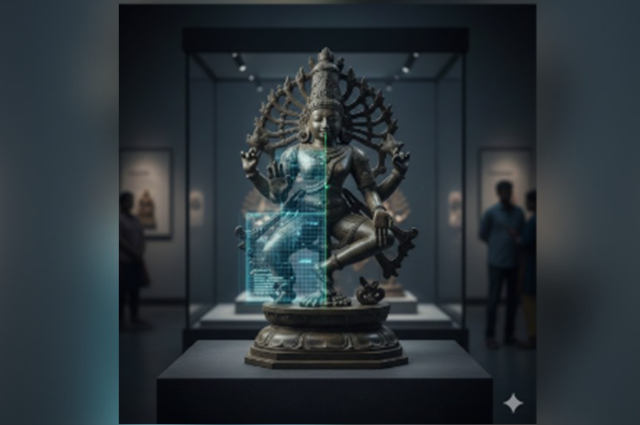
The Silent Witness: Metallurgical Proof of a Broken Sanctum
Operational Framework: The Anatomy of Restitution
- The Status of the Divine: Why Indian courts treat an idol as a "Living Legal Person" (Juridical Entity).
- The Isotopic Fingerprint: Using Lead Isotope Mapping to render "Good Faith" purchase claims obsolete.
- The UNESCO Paradox: Breaking the 1970 deadline using the "Perpetual Minor" loophole.
- The Digital Sentinel: How 2026’s Blockchain registry is creating an invisible "Geofence" around India’s temples.
- The Price of Silence: The psychological and cultural trauma of a community whose center has been surgically removed.
The Juridical Person — Why a Deity Never Dies
The Isotopic Fingerprint — Metallurgy as the Ultimate Witness
For decades, the "Good Faith" purchase defense has been the fortress of international art smugglers. Collectors claim they "didn't know" the object was stolen. In 2026, the cold, hard science of Forensic Provenance has demolished this defense.
Every bronze deity born in the foundries of the Chola or Pala empires carries a unique "Metallic DNA." Through Trace Element Analysis (TEA) and Lead Isotope Mapping, forensic scientists can now conduct a metallurgical autopsy on any idol.
By bombarding the bronze with X-rays, we can identify the exact ratio of copper, tin, and trace elements like arsenic or bismuth. These ratios are unique to specific ancient mines. When the chemical signature of a Nataraja in an Australian museum matches the exact isotopic profile of the ore from the 10th-century mines of the Kaveri Delta, the "Unknown Origin" tag becomes a lie.
This is no longer a historical debate; it is Ballistic Evidence. In 2026, we are using this "Soil Signature" to prove in international courts that the deity was physically uprooted from a specific sanctum. If the metal matches the mine, and the mine is in India, the possession is a crime.
The 1970 UNESCO Trap — Breaking the Statute of Silence
The 1970 UNESCO Convention was designed to stop the illicit trade of cultural property, but it unintentionally created a "cut-off date." Smugglers and museums have long used this as a "Get Out of Jail Free" card, claiming that any object acquired before 1970 is beyond legal reach.
But our forensic audit reveals a massive loophole. If the Deity is a Juridical Minor, the statute of limitations under the "Law of Discovery" cannot apply until the "owner" (the Deity) is in a position to sue. Since a minor cannot sue without a guardian, and the original guardians (the local community) were silenced by colonial or criminal forces, the clock never started ticking.
By combining the Antiquities and Art Treasures Act, 1972 with international human rights law, India is now arguing that holding a stolen deity is a "Continuous Tort"—a crime that happens every single day the deity is away from its home. This is the Forensic Indictment that is currently forcing museums to quietly return "items" before they are shamed in open court.
The Smuggler’s Trail — Decoding the International Cartel
To understand the "Kidnapping," we must understand the "Kidnappers." The illegal trade in antiquities is the third-largest criminal enterprise in the world, surpassed only by drugs and arms. The most notorious case of our time, the Subhash Kapoor Trail (Operation Hidden Idol), revealed a terrifying reality: thousands of Indian deities were not just stolen; they were "laundered."
Smugglers use a process called "Provenance Laundering." A stolen Chola bronze from a village in Tamil Nadu is first shipped to Hong Kong or Dubai. There, fake ownership papers are forged, claiming the item has been in a "private European collection" since the 1960s. This "paper trail" is the forensic equivalent of a mask. In 2026, Indian investigators are using AI-driven Image Recognition to scan every auction catalog globally, matching the "scars" and "patina" of advertised idols with old, forgotten temple records from the 1920s. We are using their own digital catalogs to unmask the theft.
The Human Cost — The Psychological Trauma of a Hollow Sanctum
When a deity is stolen, the Western world sees a "loss of art." But for the local community, it is a Surgical Removal of their Spiritual Heart. A temple without its vigraha is a "Dead Space." This is a violation of the Collective Right to Worship, a fundamental human right recognized by the UN.
Forensic sociology shows that villages whose deities were stolen often suffer from a loss of social cohesion and cultural identity. The "Juridical Soul" isn't just a legal term; it represents the shared consciousness of a people. When the Annapurna was stolen from Varanasi and ended up in a Canadian gallery, the city didn't just lose a statue; it lost its "Giver of Food." The 2021 repatriation was not just a legal victory; it was a Civilizational Healing.
The Digital Guardian — Blockchain and the 2026 Sovereign ID
As we look toward the future, physical locks and security guards are no longer enough. India has pioneered the Heritage Sovereign ID (HSID) system. Every deity in every registered temple is now assigned a Non-Fungible Cryptographic Token (NFT) on a sovereign blockchain.
This digital twin contains the idol’s metallurgical DNA, its 3D-scanned dimensions, and its entire ownership history. In 2026, any museum or private collector who attempts to buy an Indian antiquity without its corresponding Blockchain Provenance is automatically flagged for "Money Laundering" and "Terror Funding" (as antiquities often fund extremist groups). We have turned the "Internet of Things" into the "Internet of Divine Things," creating an invisible, unbreakable shield around our heritage.
The "Shebait" Responsibility — The Human Proxy of the Divine
In the eyes of the law, a Deity cannot speak. It acts through its Shebait—a human manager or trustee. This legal relationship is unique. The Shebait does not "own" the God; they "serve" the God's legal interests.
In 2026, the Indian legal team is training a new generation of "Legal Shebaits"—lawyers and historians who are authorized to file suits in foreign courts on behalf of the Deity. This ensures that even if a local community is too poor or too intimidated to fight, the Juridical Soul always has a voice in the courtroom.
Conclusion — The Rebirth of the Delta
Restitution is not about the past; it is about the Sovereignty of the Future. By reclaiming our stolen deities, we are reclaiming our right to define our own history. The forensic audit of India's heritage has proved that divinity cannot be auctioned, and sovereignty cannot be stolen. As the Chola bronzes return to the Kaveri Delta, they aren't just coming back to a museum. They are returning to their Sanctum, reclaiming their throne, and proving that in the battle between the Gavel and the God, the Juridical Soul always prevails.
Bibliography & References
- The Antiquities and Art Treasures Act, 1972. Ministry of Culture, Government of India. (The primary legislation governing the protection of Indian heritage).
- Supreme Court of India (1967): Bishwanath and Ors. vs Sri Thakur Radhaballabhji (AIR 1044). (The landmark judgment establishing the Juridical Personhood of Hindu Deities).
- UNESCO (1970): Convention on the Means of Prohibiting and Preventing the Illicit Import, Export and Transfer of Ownership of Cultural Property.
- High Court of London (1991): The Pathur Nataraja Case (Union of India vs. Banyan Tree). (A foundational case for the repatriation of stolen bronzes based on "deity rights").
- Renfrew, Colin (2000): Loot, Legitimacy and Ownership: The Ethical Crisis in Archaeology. (A key text on the ethics of the international art trade).
- India Pride Project (2025): Annual Report on Forensic Provenance and Heritage Restitution.
- Archaeological Survey of India (ASI) White Paper (2024): Implementing Blockchain Provenance for National Antiquities.