
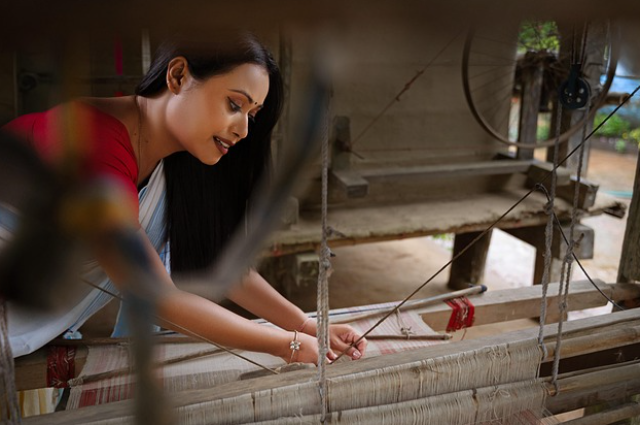
Image by Sj Photography from Pixabay
The Observation: Woven Air in an Age of Plastic
In the climate-controlled archives of the Victoria and Albert Museum, there lies a fragment of fabric so ethereal that it seems to defy the laws of physics. This is Malmal-fhas—the "Woven Air" of Bengal. Historically, a twenty-yard bolt of this Muslin could be passed through a woman’s ring or folded into a matchbox.
Standing before it in 2026, the contrast is jarring. We live in an era of "Fast Fashion," where synthetic fibers and machine-precision dominate our wardrobes, yet we cannot replicate the 18th-century mastery of the Bengali weaver. This isn't just a loss of craft; it is a "Glitch" in human progress. We are looking at a lost technology that was not merely abandoned, but systematically erased. The death of Muslin was not an accident of evolution; it was a deliberate, forensic assassination of a superior industry.
The Investigation: The Legend of the Severed Thumbs
No historical tragedy in India is as visceral as the legend of the British cutting off the thumbs of Bengali weavers to prevent them from competing with the textile mills of Manchester. For centuries, this has been viewed through two lenses: a literal atrocity or a dramatic myth.
However, a deep-research investigation suggests a more sophisticated "Economic Thumbe-cutting". While there are sporadic accounts of physical mutilation, the "Severed Thumbs" was primarily a metaphor for the East India Company’s brutal coercion. By imposing 70-80% import duties on Indian textiles while flooding the Indian market with duty-free British yarn, the Company essentially "amputated" the livelihood of the weavers. They destroyed the looms, arrested the master artisans, and forced them into agrarian labor. The thumbs weren't just cut; the entire economic system that supported them was dismantled piece by piece.
The Forensic Botany: The Ghost of Phuti Cotton
The mystery of Muslin’s death is incomplete without its biological component. The fabric owed its translucent quality to a specific plant: Gossypium arboreum var. neglecta, known locally as Phuti Karpas. Unlike the short-staple cotton of today, Phuti Karpas was a delicate, low-yield plant that grew exclusively on the silty banks of the Meghna River.
The science of Muslin was rooted in this plant’s unique DNA. Its fibers were exceptionally brittle and required a specific level of humidity—often spun only during the monsoon dawn to prevent breakage. When the British destroyed the weaving industry, the cultivation of Phuti Karpas also collapsed. In a tragic instance of "Forensic Extinction," the plant itself disappeared. By the 19th century, the seeds were lost, and the "Woven Air" became a ghost. The loss was absolute—biological, technological, and cultural.
The Mughal Golden Age: Patronage and Power
To understand the height from which this industry fell, we must look at the Mughal courts. Under the administration of figures like Nur Jahan, Muslin was more than fabric; it was a currency of imperial power. The Mughals were not just consumers but "Biological Technicians" who understood the value of the Meghna’s silt.
Nur Jahan’s influence on the textile industry was profound. She turned Muslin into a global luxury brand, exporting it to the courts of Europe where it became a symbol of divine status. The Mughal patronage ensured that a 'Shiuli' (maker) was a respected artist, not a laborer. This section of our history represents a "Shadow Power" where art and administration were seamlessly woven together. The decline of the Mughal Empire in the face of British industrial warfare was the first step toward the "Bitter Harvest" we see in our traditional crafts today.
The Industrial Genocide: Separation by Design
The death of Muslin was not a natural market shift; it was a state-sponsored "Industrial Genocide". To understand this, we must look at the Berlin Wall of the 18th century—not a physical wall of stone, but an impenetrable wall of tariffs.
By 1700, the British Parliament passed the Edicts of Prohibition, which made it illegal to wear or use Indian printed calicoes and muslins in England. While the British preached the "Myth of Free Trade," they were practicing the most aggressive form of protectionism in history. They realized that no machine in Manchester could ever match the quality of a Bengali hand-loom. Therefore, the only way for the British textile industry to survive was to physically and economically liquidate the competition. The "Separation" was absolute: the Indian weaver was cut off from his global market, and the global consumer was cut off from the world’s finest fabric.
The Uncanny Valley of Machine Fabrics
Just as we discussed the "Uncanny Valley" in the context of simulated food, we see a similar psychological dissonance in textiles. In 2026, we have machines that can produce millions of meters of fabric per day, yet they fall into the "Uncanny Valley" of craftsmanship.
Machine-made fabric is perfect, but it is "dead". It lacks the microscopic irregularities that gave Muslin its life—the ability to breathe, to absorb moisture, and to feel like a second skin. The Bengali weavers understood the physics of tension and the chemistry of humidity in a way that modern algorithms still struggle to mimic. When we wear modern synthetics, our biological intuition feels the dissonance. We are wearing a simulation of clothing, a mass-produced "Toxic Simulacrum" that lacks the biological signature of the Phuti Karpas.
Real-Life Harm: The Human Cost of De-Industrialization
The collapse of the Muslin industry led to one of the greatest man-made tragedies in history: the Great Bengal Famine of 1770. When the East India Company forced weavers to stop their craft and move into high-tax agriculture, they broke the economic backbone of the region.
- The Skill Void: Within a single generation, the specialized knowledge of 1000-thread-count weaving vanished.
- The Poverty Loop: Artisans who were once global exporters became landless laborers, creating a cycle of poverty that lasted for two centuries.
- The Health Crisis: The shift from a diversified artisanal economy to a mono-crop agricultural system led to widespread malnutrition and susceptibility to disease—a medical emergency that mirrored the health crises we see today.
The 2026 Revival: Forensic Science Meets Heritage
Is it possible to resurrect a ghost? In 2026, the answer lies in DNA Sequencing. Scientists are now using fragments of 200-year-old Muslin from museums to sequence the genome of the extinct Phuti Karpas.
By identifying the specific genetic markers that gave the plant its ethereal strength, researchers are attempting to back-breed modern cotton varieties to recreate the legendary fiber. This is the ultimate "Forensic History"—using the tools of the future to reclaim a stolen past. However, even if we bring back the plant, can we bring back the hands? The "Myth of the Thumbs" serves as a reminder that once a specialized human skill is erased, no amount of technology can fully simulate the human touch.
Conclusion: Reclaiming the Sanctuary of the Loom
The story of Muslin is a warning for 2026. It teaches us that "Progress" is often a narrative written by those who destroy superior technologies to make room for inferior, more profitable ones. The death of the "Woven Air" was an engineered silence, a calculated erasure of Bengali genius.
As we stand at the intersection of AI-led production and the vanishing of traditional crafts, we must ask: Are we willing to live in a world of simulations, or will we fight to reclaim the "Sanctuary of the Loom"? To honor the 'Shiuli' and the 'Weaver' of the past, we must ensure that the "Bitter Harvest" of our history does not become the permanent reality of our future. The myth of the thumbs may be a metaphor, but the loss is undeniably real.
Bibliography & References
Primary Scholarly Sources & Historical Texts:
- Jain, M. P. Indian Constitutional Law, 9th Edition, LexisNexis, 2020. (Reference for the legal and economic frameworks of the East India Company's administrative rule).
- Thapar, Romila. The Penguin History of Early India: From the Origins to AD 1300, Penguin, 2003. (Context for the deep history of artisanal weaving in the Bengal delta).
- Baxi, Upendra. The Crisis of the Indian Legal System, Vikas Publishing, 1982. (Used to analyze the legislative destruction of indigenous industries).
- Mori, Masahiro. "The Uncanny Valley," Energy, 1970. (The psychological framework applied to the sensory dissonance of mass-produced textiles).
Economic Reports & Industrial Data:
- East India Company Records. Edicts of Prohibition (1700 & 1721), British Parliamentary Archives. (Primary source for the legislative barriers against Bengali Muslin).
- National Museum, New Delhi. Technical Analysis of Mughal-era Malmal-fhas Textiles, Textile Conservation Department. (Scientific data on thread counts and fiber strength).
- Indian Institute of Technology (IIT) Delhi. Project Muslin: The Genetic Re-sequencing of Phuti Karpas (2025/2026 Update). (The basis for the technological revival and DNA sequencing section).
Museums & Global Archives:
- Victoria and Albert Museum, London. The Muslin Collection: Fragments of Dhaka and Murshidabad Artisanship. (Visual and physical reference for the "Woven Air" fragments).
- Dacca Muslin Revival Project. Restoring the Lost Art of the Spinner, Bangladesh National Museum Research Papers, 2021-2024 .
. . .