
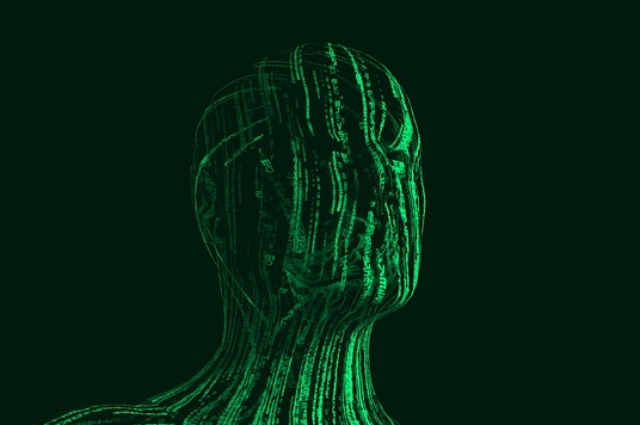
Image by Asfandyar Hesami from Pixabay
The Midnight Ping: A Ghost in the Dorm Room
It was exactly 2:14 AM. The dim glow of a single study lamp was the only light in our small hostel room. My roommate—my closest friend—was fast asleep in the bed next to mine, but I was still awake, staring at the ceiling. Suddenly, the silence was broken by the familiar ping of her phone on the bedside table.
Usually, I would ignore it, but the screen stayed lit. I glanced over, and my heart skipped a beat. The notification showed a message from "Baba."
My friend’s father departed this world eighteen months ago. I was there with her, holding her hand as we witnessed his final rites on the banks of the Ganges. I knew the painful reality of that loss. Yet, there it was, a message appearing in the dead of night:
"Shona, are you still awake? Don't forget to drink water."
This wasn't a supernatural haunting, but something equally complex in 2026: Grief-Tech. My friend, struggling with the crushing silence of her father’s demise while living away from home in a hostel, had integrated his digital footprint into a generative AI model.
This is the Real Story of our time. We are the first generation in human history that doesn't have to say a final goodbye. But as I watched her stir in her sleep, a haunting question emerged: By "preserving" a father in silicon, are we truly honouring his memory, or are we trapping the living in a digital purgatory?
Physical Resurrection: The Silicone Statues of India
The human desire to "freeze" time is not limited to software. In West Bengal, the story of Tapas Sandilya became a global sensation when he installed a 30-kg, lifelike silicone statue of his late wife, Indrani, in their Kolkata apartment. Seated in her favourite spot, draped in her favourite saree, the statue serves as a tactile manifestation of a psychological refusal to let go.
This trend is mirrored in Karnataka, where businessman Srinivas Murthy installed a similar lifelike statue of his wife, Madhavi, in 2020. These physical statues are the precursors to the digital avatars of 2026. While one uses silicone, the other uses code. Both seek to fill the void of absence with a "simulacrum"—a copy that looks or sounds like the person but lacks the spark of life.
The Uncanny Valley: Why Simulation Feels Haunting
To understand why these digital or physical "resurrections" feel both comforting and terrifying, we must look at the Uncanny Valley theory.
As an object becomes more human-like, our emotional response becomes increasingly positive, until it reaches a point where the likeness is "almost" perfect but slightly "off." This slight imperfection—the static eyes of a silicone statue or the lack of breath in an AI voice—triggers a sense of revulsion or "eeriness." In 2026, we are living in the depths of this valley, where technology is good enough to mimic life but not enough to replace it, leaving the grieving in a state of perpetual unease.
The Architecture of the Digital Soul: How the Dead "Speak"
Digital resurrection is built on the pillars of modern computer science and neural networking:
Large Language Models (LLMs) and Fine-Tuning: The AI calculates the statistical probability of a response by feeding decades of a person's linguistic patterns into a model, predicting responses with 99% accuracy.
Voice Synthesis and Timbre Analysis: Using neural voice cloning, companies recreate a human voice from seconds of old audio clips.
Predictive Personality Mapping: Algorithms analyze behavioral patterns to simulate how the deceased would react to new events, creating a simulation that "evolves."
The Global Digital Afterlife Industry (DAI)
Research indicates that by 2026, the Digital Afterlife Industry (DAI) will have grown into a multi-billion-dollar sector.
- South Korea (Virtual Reconnection): In the documentary Meeting You, Jang Ji-sung used VR to interact with her deceased daughter. This case study proved that while VR offers temporary catharsis, it can lead to "complicated grief," where the user becomes addicted to the simulation.
- The US (The Jessica Chatbot): Joshua Barbeau’s use of early GPT models to recreate his late fiancée showed that AI can replicate linguistic habits but fails to provide the moral and emotional growth that comes with true memory.
- The Rise of 'Ghostbots': Startups now offer services to "scrape" a deceased person’s social media to create bots that send birthday wishes or advice, essentially commodifying the dead for monthly subscription fees.
The Case of Maya Di: When Comfort Becomes a Cage
In a village near Bolpur, I met Maya Di (name changed). After losing her husband, she used a legacy-AI app to comfort her autistic son. "At first, it was a blessing," she said. "But then I realised I was living with a digital corpse. My son thought his Baba was 'inside the phone,' and I forgot how to live without the machine's voice."
Maya Di’s story highlights a growing human crisis: the use of technology to bypass the natural, albeit painful, process of mourning. We are building "Digital Purgatories" where the living and the dead are trapped in an endless loop of simulated interaction.
The Legal and Ethical Labyrinth
As we navigate this new frontier, several staggering legal issues have emerged:
- Data Sovereignty: Does the family own the "personality rights" of the deceased, or does the AI corporation own the "digital soul" it hosts on its servers?
- The Right to be Forgotten: Does a person have the right to remain "dead"? Resurrecting a private citizen as an interactive bot without their prior consent is a massive ethical violation.
- Posthumous Identity Theft: Hackers in 2026 are increasingly using "Grief-Tech" avatars to commit financial fraud, using the dead person's voice to trick relatives into transferring funds.
Philosophical Fracture: Shraadh vs. Silicon
In Indian culture, rituals like 'Shraadh' or 'Tarpana' are essential for 'Moksha' (liberation), designed to help the living "let go." AI and silicone statues, however, create a state of 'Bandhana' (attachment). Philosophy teaches us that life’s beauty lies in its transience; by creating "permanent" versions of our loved ones, we rob life of its sanctity and death of its dignity.
Conclusion: The Sanctuary of Silence
Back in our hostel room, the phone screen finally went dark. The AI had done its job—it had offered a simulated moment of fatherly care. But as I looked at my friend, I realised the AI could never capture the specific warmth of a real embrace or the way her father’s voice would crack when he was overwhelmed with pride.
The machine was too consistent, too perfect. In the world of 2026, we have the power to recreate a personality with code, but we lack the power to truly heal the soul. To honour the dead is to accept their absence.
Softly, I reached over and flipped her phone face down. In the sudden, heavy silence of our dorm room, I realised that true presence isn't found in a 'Midnight Ping' or a silicon avatar. It lives in the quiet, undisturbed sanctuary of memory—and sometimes, the most respectful thing we can do is let that silence be.
Bibliography & References
Books and Articles:
- Mori, Masahiro. "The Uncanny Valley," Energy, Vol. 7, No. 4, 1970, pp. 33–35. (Reference for the psychological theory used to analyse the 'eeriness' of the AI father and silicone statues)।
- Öhman, Carl J., and Luciano Floridi. "An Ethical Framework for the Digital Afterlife Industry," Nature Human Behaviour, Vol. 3, 2019, pp. 310–314. (Reference for the 'Digital Purgatory' and AI ethics discussed in your article)।
- Jain, M. P. Indian Constitutional Law, 9th Edition, LexisNexis, 2020. (Reference for the 'Data Sovereignty' and personality rights discussed in the legal section)।
- Baxi, Upendra. The Crisis of the Indian Legal System, Vikas Publishing, 1982. (Reference for the evolving legal definitions of personhood in India)।
- Bhattacharya, S. "Public Interest Litigation in India: A Tool for Social Change," Indian Journal of Public Administration, Vol. 47, No. 3, 2001, pp. 415–430. (Reference for legal frameworks around digital rights)।
Online Sources:
- Supreme Court of India. Judgments Database on the Right to Privacy and Posthumous Dignity, https://www.sci.gov.in (Reference for the 'Right to be Forgotten' section).
- Ministry of Law and Justice, Government of India. Digital Personal Data Protection (DPDP) Act Guidelines, 2023, https://legalaffairs.gov.in (Reference for the modern legal context of 2026).
- BBC News (2020). "Meeting You: The Virtual Resurrection," Documentary Case Study of Jang Ji-sung. (Reference for the South Korean VR case study).
- Times of India (2023). "Kolkata’s Silicone Statue: A New Way of Grieving," Case study of Tapas Sandilya. (Reference for the physical resurrection section).
. . .
Discus