
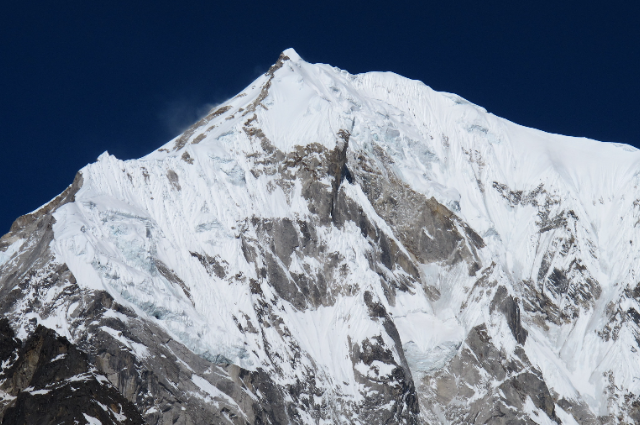
Source: Rajesh Kumar Singh/AP, via NPR
At 08:37 on the morning of August 26, 2026, seismic stations across South Asia registered a magnitude-5.2 signal originating from the north face of Langtang Lirung, a peak standing 7,227 metres above sea level in Nepal's Langtang National Park. Scientists who reviewed the data later confirmed that the signal was not caused by an earthquake. The mountain had not shaken. A glacier had fallen.
Seven minutes later, a surveillance camera at the Gyirong Port border crossing between Nepal and China captured what came next. People are visible in the footage running. Then there is no border crossing. A wall of water and ice and rock consumed it. What had taken decades to build — roads, bridges, a customs facility, a checkpoint that connected two nations across the Himalayas — was gone inside a minute.
By the time Nepal's upstream river monitoring stations could have sent a warning downstream, they were already gone. They had been swept away by the same flood they were supposed to detect. A senior fellow at the Stimson Centre, reviewing the aftermath, called the affected region a monitoring "blind spot." Geologists, he said, had paid it little attention.
That phrase — paid it little attention — is the real story of what happened to Nepal on August 26, 2026. Not the glacier. Not the flood. The inattention.
What Happened, and How Fast
The glacier that collapsed was on the north face of Langtang Lirung. Scientists believe a section of ice and bedrock failed simultaneously — not because of rain, not because of a storm. The morning was clear. No extreme weather had been reported in Rasuwa district. The collapse happened, geomorphologists believe, because permafrost — the frozen ground that has held Himalayan rock and ice in place for millennia — had been weakening. As one researcher from the University of Colorado, Boulder put it: "Permafrost has been the cryospheric glue that's held the rock and ice and glaciers together for millennia, and now we're getting increasing evidence that it's being weakened by warming trends."
When the glacier fell, it fell thousands of feet. The velocity and friction of the impact generated enough heat to melt the ice almost instantly. That meltwater, combined with rock and debris, displaced the Bhotekoshi River in the valley below. The river did not overflow. It became something else entirely — a moving wall of mud and stone travelling at speeds that gave no community in its path a meaningful chance to evacuate.
The flood carried bodies 240 kilometres downstream. Victims were recovered not just in Rasuwa and Dhading districts in Nepal, but in Kushinagar and Maharajganj districts of Uttar Pradesh, India. The Bhotekoshi had become a carrier, crossing an international border with its dead.
Within 24 hours, the confirmed figures were already incomprehensible: over 700 dead in Nepal, at least 16 in China's Tibet Autonomous Region, and more than 3,000 people missing across both countries. Within a week, those numbers had grown to at least 1,357 dead and 5,326 missing in Nepal alone.
The Workers Inside the Tunnels
Among the missing were people the initial news coverage barely mentioned — the workers.
Over 900 employees of twelve hydropower projects that line the rivers of the Rasuwa and surrounding districts were unaccounted for after the flood. These were engineers, labourers, tunnel workers, site managers — people from Nepal, India, South Korea, and other countries who had been working inside the mountain itself, building the dams and power stations that generate electricity for Nepal's development. Their worksites were buried. In some cases, the surface of the hydropower plant had been completely consumed by mud, with not a single structure visible above the silt.
Australian tunnel rescue expert Arnold Dix, who was called by Nepalese authorities to assist at the Upper Trishuli 3A Hydropower Station, said 27 power stations had been "wiped out," with 12 "destroyed — nothing left at the surface." At the Upper Trishuli 1 Hydroelectric Project alone, at least 576 workers were reported missing. Around 300 were believed to be trapped inside tunnels — alive, in the dark, with no way to communicate.
For nine days, families waited.
Rescue teams pumped air into sealed tunnels. Soldiers dug with excavators through the night. A controlled explosion was carried out at one site on August 31 simply to locate the tunnel entrance buried under ten metres of mud. Foreign specialists flew in from Australia and across the region, all attempting to reach people who, by every geological estimate, should not have survived.
On September 4, 2026 — nine days after the flood — rescuers at the Langtang hydropower plant pulled two workers out alive.
One of them, as he was brought out, said that more people were alive inside.
"I can't explain what we are feeling at the moment. We are just grateful to God," said Amir Maharjan, brother of one of those rescued, to the Associated Press.
Three more workers were found alive in the following days — two in one tunnel, one in another — each rescue discovered using satellite imagery to locate facilities buried so completely they could not be seen from the surface.
As of September 10, 2026, hundreds of hydropower workers remain unaccounted for.
Nepal's Foreign Minister Said What Needed to Be Said
In the days after the flood, Nepal's Foreign Minister Shisir Khanal made a statement that every government in the world's top twenty carbon-emitting nations should be required to read aloud.
Nepal, he said, was bearing a disproportionate share of the consequences of climate change. His country contributes less than 0.1% of global greenhouse gas emissions. It has no heavy industry to speak of. It has no history of mass fossil fuel consumption. And yet Nepal sits at the collision point of two forces it did not create: the warming of the atmosphere produced by industrialised nations over two centuries, and the Himalayan geography that makes it uniquely, catastrophically vulnerable to the consequences of that warming.
The glaciers of the Hindu Kush Himalaya are melting faster than almost anywhere else on Earth. Scientists studying Langtang's glaciers specifically had documented rapid warming and accelerating recession in the years leading up to August 26. The permafrost that holds the mountains together is weakening. The lakes that form behind ice and rock dams — glacial lake outburst flood threats, known as GLOFs — are multiplying. Nepal currently has over 3,000 glacial lakes. Scientists have identified at least 47 as potentially dangerous.
Since 1900, dozens of floods have occurred near the Nepal-China border. The 2015 earthquake triggered a massive glacier collapse at the very same Langtang Lirung. In July 2025, just thirteen months before this disaster, a glacial lake outburst had already swept away the Friendship Bridge at Rasuwagadhi, damaged hydropower projects in Rasuwa, and killed nine people. A Stimson Centre analyst reviewing that 2025 event noted that the upstream monitoring stations in the region were inadequate.
Thirteen months later, those same inadequate monitoring stations were swept away before they could sound the alarm.
The Architecture of Ignored Warnings
This is the detail that must not be lost in the grief and the rescue operation footage.
Nepal did not lack scientific knowledge about this risk. The International Centre for Integrated Mountain Development, ICIMOD, based in Kathmandu, has been documenting glacial lake threats across the Hindu Kush Himalayan region for decades. Their satellite imagery had tracked changing glacial conditions in Rasuwa. Research published in peer-reviewed journals had specifically studied Langtang's glaciers and flagged accelerating recession. Geomorphologists were aware that the north face of Langtang Lirung was undergoing destabilisation.
What Nepal lacked was not knowledge. It lacked resources — resources to build a monitoring infrastructure that could actually detect and warn against a glacial collapse in a region that a Stimson Centre analyst called a "blind spot." And it lacked those resources, in large part, because the nations most responsible for the emissions warming these glaciers have consistently failed to deliver on their climate finance commitments to the countries most vulnerable to the consequences.
In 2009, wealthy nations promised to mobilise $100 billion per year in climate finance for developing countries by 2020. That goal was not met in 2020. When it was finally reached, years late, the majority of the funding came in the form of loans — not grants — meaning the most climate-vulnerable nations were being asked to go into debt to pay for adapting to a crisis they had not caused.
Nepal received some of this financing. Not enough to build early warning systems in every glacial blind spot in the Himalayas. Not enough to relocate every community living downstream of a destabilising glacier. Not enough to protect 900 tunnel workers from a flood that seven minutes of warning might, in some cases, have allowed them to survive.
When Pride Cost Lives: The Delayed Rescue
There is a third failure in this story, and it belongs not to the climate system or the monitoring infrastructure, but to Nepal's own government.
In the immediate aftermath of the August 26 flood, as 933 workers lay trapped inside nine blocked hydropower tunnels across Rasuwa and Nuwakot districts, Nepal's government initially declined offers of foreign rescue assistance. South Korea, which had nine of its own citizens missing at a hydropower construction site, was left negotiating for access. Australia's tunnel rescue experts, eventually called in to assist at the Upper Trishuli 3A station, arrived days after the flood. China and India, Nepal's two largest neighbours and the countries with the most relevant high-altitude rescue expertise, were not approved to deploy immediately.
Bhim Gautam, chief executive of the Independent Power Producers Association of Nepal, told NPR that Nepal simply did not have "enough technology, equipment and expertise" to mount successful rescue operations at hydropower facilities of this scale. His industry's leaders, he said, had to actively pressure the government to accept foreign help. "Late last week, the government approved rescue teams from China, India and Australia to come," he said. "But it is so late now."
Political analyst Chandradev Bhatta, speaking from Kathmandu, explained that Prime Minister Balen Shah's government — which came to power on the back of last year's anti-establishment Gen Z protests — appeared to resist foreign deployment for geopolitical reasons. Nepal's experience during the 2015 earthquake, when China, India and Western powers competed visibly for geopolitical influence during the reconstruction phase, had made foreign assistance a politically sensitive subject. That sensitivity, in 2026, translated into delay. And delay, in a tunnel rescue, translates directly into death.
Nepal's Finance Minister denied that foreign help had been refused, insisting assistance was accepted "according to the needs on the ground." The government did not respond to NPR's request for comment.
What cannot be denied is the arithmetic. Rescue workers spent three days, in some cases, simply locating the buried tunnel entrances. The technology and expertise that could have shortened those three days were available, offered, and initially held at the border. Two men were pulled alive from a tunnel on September 4 — nine days after the flood. One said more were alive inside. Whether those inside survived the additional days of delayed, under-resourced rescue is a question Nepal's government will have to answer.
The mountain did not wait for geopolitics. The tunnels did not either.
The 77 Pilgrims and the Human Multiplicity of Loss
The flood did not distinguish between categories of victim. Among the missing were 77 Isha Foundation pilgrims from 19 different nationalities who had been travelling to Tibet through the Gyirong Port when the waters came. Latvians, Canadians, Australians, South Koreans, Americans — 33 Latvians reported missing, 32 Canadians, 75 Americans, 34 Australian pilgrims among the first confirmed absent. The South Korean Foreign Ministry reported 9 citizens working at a hydropower plant construction site. Around 622 students were unaccounted for. At least 147 government officials — police officers, teachers, local elected representatives, customs employees — were among the missing.
The diversity of the missing is, in its own way, a statement. This was not a disaster that struck only the poor or only the Nepali. It struck everyone within reach of the Bhotekoshi on the morning of August 26. But it is worth noting that among those 5,326 missing in Nepal, the largest single category is the hydropower workers — people who had come to build infrastructure for Nepal's economic future and who were inside the mountain when the mountain moved.
Their names are still being collected. DNA samples are being requested from their families to help identify whatever is eventually recovered.
What Nepal Is Owed, and What It Has Received
After the flood, the United States announced humanitarian aid of $3.6 million — increased from an initially announced $500,000. International rescue teams arrived. Satellite imagery was shared. Two Australian tunnel experts flew in to assist.
These are nothing. But they are also not accountability.
Nepal's total losses from this single event — infrastructure destroyed, hydropower capacity wiped out, communities displaced, lives ended — will run into billions of dollars. The 27 power stations damaged or destroyed represented a significant portion of the country's electricity generation capacity. The Trishuli river corridor, which these plants line, is central to Nepal's ambitions for energy independence and export. In one morning, years of development were buried under silt.
Nepal is not asking the world to feel sorry for it. Its foreign minister made that clear. What Nepal is asking — what climate justice demands — is that the nations whose cumulative emissions destabilised the permafrost holding Langtang Lirung together take binding, measurable, funded responsibility for what that destabilisation costs the countries in the flood path.
That responsibility is not charity. It is not aid. It is what the science of attribution — the growing field that links specific climate events to specific emission histories — increasingly confirms must be called what it is: liability.
The Number That Matters Most
In the immediate aftermath, the focus fell on death tolls, on rescue operations, on diplomatic statements. These are necessary. But there is one number that, in the weeks and months ahead, will define what this disaster truly meant.
That number is zero.
Zero binding commitments made by high-emission nations specifically for Himalayan early warning infrastructure. Zero international legal mechanisms that allow Nepal to seek compensation from the countries whose industrial history warmed the atmosphere that weakened the permafrost that dropped the glacier into the Bhotekoshi. Zero enforceable protocols requiring hydropower projects in glacially active zones to have evacuation tunnels, emergency communication systems, or independently verified escape routes for workers trapped underground.
The rescue of those two workers on September 4 — nine days in the dark — was a miracle of human determination. It should not have required a miracle. It should have required a protocol.
Conclusion: A Disaster With a Name
On August 26, 2026, a glacier fell. Seven minutes later, a border crossing was gone. Within days, over 1,300 people were confirmed dead, and more than 5,000 were missing, many of them still inside the mountains they had been paid to build inside.
Nepal's foreign minister called it what it is — not a natural disaster, but a climate injustice wearing the mask of one. The mountain did not collapse because Nepal was careless. It collapsed because the permafrost that had held it together for millennia was being quietly dismantled by a century and a half of atmospheric warming, and because the nations responsible for that warming had not provided the monitoring infrastructure, the early warning systems, or the climate finance that might have shortened that seven-minute gap between the glacier falling and the water arriving.
The two men pulled from the tunnel on September 4 survived. One of them said more were alive inside.
As of today, the search continues.
The glacier is not the only thing that needs to be held accountable.
References
- Wikipedia — 2026 Nepal–Tibet Floods: en.wikipedia.org/wiki/2026_Nepal%E2%80%93Tibet_floods
- CNN — August 26–September 5, 2026 Live Updates: cnn.com
- Washington Post — Hundreds Feared Stuck in Hydropower Tunnels (August 31, 2026): washingtonpost.com
- Al Jazeera — Nepal Tunnel Traps Hinder Flood Rescue (August 31, 2026): aljazeera.com
- PBS NewsHour — Rescuers Pull 2 Trapped Workers from Hydropower Tunnel (September 4, 2026): pbs.org
- AntarcticGlaciers.org — August 2026 Nepal-Tibet Floods: antarcticglaciers.org
- EarthSky — Nepal Flash Flood: What Caused It? (August 26, 2026): earthsky.org
- ICIMOD — International Centre for Integrated Mountain Development: icimod.org
- Rio Times Online — How a Lake Burst in Tibet Flooded Nepal's Valley Towns: riotimesonline.com
- CBC — Hundreds Feared Stuck in Hydropower Tunnels (August 31, 2026): cbc.ca
- Vajiramandravi — Nepal Floods 2026: Causes, Map, Impact: vajiramandravi.com
- Stimson Centre — Regional Climate Risk Analysis references via Wikipedia citations