
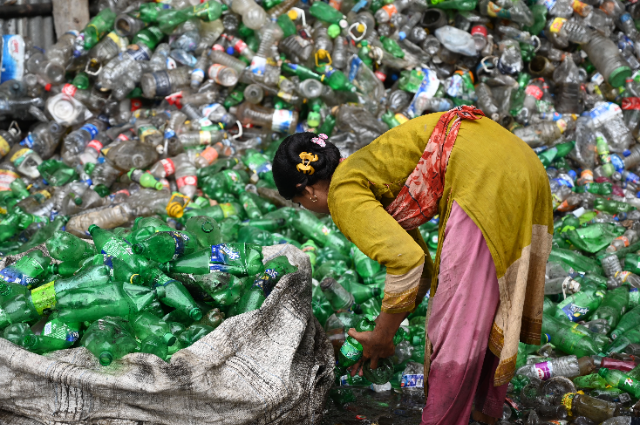
A waste collection round rarely attracts applause. It begins with a route, a schedule and a task that most households would rather not think about: taking yesterday’s discards out of sight. Yet in Erattayar, a village panchayat in Kerala’s Idukki district, this everyday service has become the foundation of a larger story—one about women, work, environmental responsibility and the meaning of dignity.
The women of the Haritha Karma Sena (HKS) do not simply remove waste from doorsteps. They help connect households to a decentralised system of collection, sorting and recovery. Their work makes visible a part of public life that is often treated as someone else’s responsibility. In doing so, they challenge two familiar assumptions: that waste work is low-status labour, and that women’s contribution to environmental management belongs mainly inside the home.
From a household problem to a public system
Waste is easy to ignore when it leaves the gate. But it does not disappear. Plastic packaging, discarded containers and other non-biodegradable materials require collection, segregation, transport and an appropriate route for recovery or disposal. When these steps fail, waste accumulates in public spaces, drains and vulnerable landscapes. The environmental problem is therefore not only about what people consume; it is also about the systems they build to deal with what remains.
Kerala’s decentralised waste-management approach places local self-governments and households at the centre of this work. Haritha Karma Sena is one of its visible links: trained workers provide doorstep collection and support the movement of non-biodegradable materials towards material collection and resource-recovery facilities. The State’s 2021 report describes HKS responsibilities that include doorstep services, technical support to households, community composting services and the management of collection and recovery facilities [1].
This arrangement matters because it treats waste management as a continuing public service rather than an occasional clean-up. A clean street depends not only on a municipal vehicle or a distant processing plant, but also on regular household participation, reliable collection and workers who can perform the task safely and consistently.
Erattayar’s numbers—and the people behind them
In Erattayar, systematic Haritha Karma Sena work began in 2020 with the formation of a consortium and training for its members, according to the Kerala Local Self Government Department. The department’s account says the team works across 14 wards. From 2021 to December 2024, it collected 406 tonnes of inorganic waste, including 210 tonnes of plastic. It also reports that the initiative provides doorstep service to all houses and institutions in the panchayat [2].
The same government account gives a monthly income range of ₹10,000 to ₹25,000 for members through waste collection and other activities. It describes a user-fee arrangement in which 90 per cent of the amount received is distributed, and 10 per cent is retained in the consortium account as a corpus fund. The fund can support bonuses on occasions such as Onam and meet certain primary expenses following accidents; the account also says members are included in an accident-insurance policy [2].
These figures are significant, but they should not be allowed to swallow the people they describe. Four hundred and six tonnes is a measure of collected material; it is not a measure of the patience required to explain segregation to a household, the physical effort of lifting and sorting, or the social negotiation involved in entering spaces where waste is generated but its handling is often disowned. The numbers show scale. The work behind them gives the scale its human meaning.
The Erattayar model has also involved technical improvements. The M. S. Swaminathan Research Foundation reports that support for capacity-building and technical guidance helped increase plastic-baling efficiency: producing 5,000 kilograms of reusable plastic bales reportedly fell from 20 days to five, while daily baling capacity rose to 700–1,000 kilograms. The foundation also reports an increase in average member income from ₹8,000 to ₹20,000 in the period it describes [3]. These are institution-reported outcomes, and their value lies in showing how training, equipment and process redesign can affect both productivity and earnings.
The dignity of work is not an optional extra
The deeper significance of Haritha Karma Sena is not captured by tonnage alone. Waste work has long been associated with stigma, low status and invisibility. In many societies, women have been expected to manage household waste without recognition or pay, while formal decisions about infrastructure and public services have often been made elsewhere. When women undertake organised collection as paid, trained workers, the boundary between private domestic responsibility and public environmental service begins to shift.
A 2026 study in Waste Management & Research, based on semi-structured interviews with 117 Haritha Karma Sena women, found that most participants reported satisfaction and a sense of empowerment. The researchers argue that structured work and administrative support can strengthen social respect, public acceptance and dignity. They also identify substantial challenges, including socio-cultural, political, financial, infrastructural and logistical barriers, as well as occupational health and safety risks. The paper specifically raises concern about workers who lack adequate health insurance [4].
That combination of findings is important. It prevents the story from becoming a simple celebration in which employment automatically equals empowerment. A job can provide income and public recognition while still exposing workers to unsafe materials, inadequate facilities, irregular earnings or insufficient protection. Recognition must therefore be more than a photograph taken during a cleanliness campaign. It must be reflected in protective equipment, health coverage, fair and predictable compensation, suitable transport, training, grievance mechanisms and a voice in decisions that shape the work.
A separate 2025–26 study of workers in Kollam Corporation similarly highlights the tension between the essential nature of HKS work and the conditions under which it is performed. Based on a survey of 50 workers, it reports concerns about safety equipment, workplace facilities, physical exhaustion, health problems and dissatisfaction with wages among a substantial portion of respondents [5]. Its findings relate to a particular study area and sample; they should not be treated as a description of every HKS unit in Kerala. They do, however, reinforce the need to evaluate the system from the workers’ point of view.
A green workforce needs more than green slogans
The language of sustainability often focuses on recycling rates, plastic bans, clean-energy targets and technology. Those matters are important. But environmental systems also depend on people whose labour makes policies work in everyday life. A household can be asked to segregate waste, but segregation has little practical value if collection is irregular, workers lack equipment or recovered materials have no reliable onward channel.
Erattayar’s experience suggests that local systems can become more effective when workers are organised, trained and supported by local institutions. Its consortium model, user-fee mechanism and technical assistance offer elements that other local bodies may examine. The Kerala government says the initiative has progressed to providing training to other local bodies in the district [2]. This is a useful sign of institutional learning, although replication should not mean copying figures or structures without adapting them to local geography, waste streams, markets and worker needs.
A genuinely sustainable model must ask several questions. Are workers protected from sharp, contaminated or hazardous materials? Do they have gloves, masks, footwear and access to washing facilities appropriate to the risks? Is there dependable transport and a safe place to sort and store materials? Are user fees collected transparently and distributed fairly? Can workers influence schedules, equipment decisions and the design of facilities? Are they covered when illness or injury prevents them from earning? These are not peripheral welfare questions. They determine whether the service can endure.
Changing what a community chooses to see
There is also a cultural task. Residents must learn to see waste collection not as an inconvenience performed by anonymous workers, but as a skilled public service on which neighbourhood health depends. That change begins with ordinary conduct: segregating waste correctly, paying agreed user fees, keeping collection points accessible, treating workers respectfully and not handing over unsafe materials carelessly. Public participation cannot end at the moment a bag is placed outside the door.
For local governments, the responsibility is equally concrete. They must build reliable collection routes, maintain facilities, ensure transparent accounts, support training and provide enforceable health and safety protections. For researchers and journalists, the responsibility is to document both outcomes and lived experience—listening to workers rather than speaking about them as a single, interchangeable group. For readers, it is to recognise that convenience has a labour cost, and that the people who carry that cost deserve visibility and respect.
The measure of a cleaner future
Erattayar’s reported collection figures tell one part of the story: 406 tonnes of inorganic waste collected over four years, including 210 tonnes of plastic. Its reported income range and service coverage tell another. The research on Haritha Karma Sena women adds a third: organised work can bring satisfaction, dignity and social recognition, but these gains remain incomplete when occupational risks and structural barriers persist [2, 4].
The women of Haritha Karma Sena are not merely the final link in a waste chain. They are part of the infrastructure of a sustainable community. Their work connects household choices with public health, local governance with environmental recovery, and the language of empowerment with the daily realities of paid labour.
A community’s progress should not be measured only by how clean its streets appear after collection. It should also be measured by how it treats the people who make that cleanliness possible. If the future is to be sustainable, it must be sustainable for the workers as well as for the environment. The women changing Kerala’s waste story deserve not only gratitude, but safe conditions, fair livelihoods and a recognised place in the decisions that shape their communities.
References:
- Government of Kerala, Local Self Government Department. The State of Decentralised Solid Waste Management in Kerala: Report 2021. https://lsgkerala.gov.in
- Government of Kerala, Local Self Government Department. “Erattayar” (Featured Topics / Kudumbashree). https://lsgkerala.gov.in/en/kudumbashree/featured-topics
- M. S. Swaminathan Research Foundation. “Erattayar Panchayath’s Waste Management Model Attracts National Attention.” https://old.mssrf.org
- Cheruvalath, Reena, Reshma Ramankutty, Aswini S., Nilanjana Goswami, and Anu K. Anthony. “Professionalising Waste Collection: Exploring a Unique Model of Haritha Karma Sena Women, Kerala.” Waste Management & Research (2026). PubMed record: https://pubmed.ncbi.nlm.nih.gov
- Swaroopjith, S. “Empowering the Green Workforce: A Socio-Economic Analysis of Haritha Karma Sena (HKS) Members in Kerala’s Decentralised Waste Management System.” BODHI International Journal of Research in Humanities, Arts and Science (2026). https://bodhijournals.com/index.php/bijrhas/article/view/306