
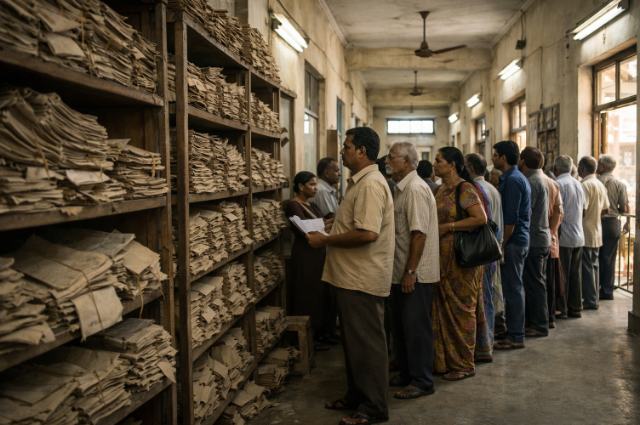
Picture this: you walk into a government office one afternoon, feeling fine, wide awake, definitely alive, and someone behind the counter tells you, completely straight-faced, that you actually died last year. No one says sorry. No one looks confused. They just wave a file at you, stamp some papers, and send you on your way. Sounds like a joke, right? It’s not. This really happened to a man in Uttar Pradesh. And that mess? It rattled the Indian legal system, won an international award, and even inspired a Bollywood movie.
But honestly, Lal Bihari “Mritak” is just the tip of the iceberg. India’s legal history, its criminal courts, even its dusty old laws are packed with stories that’ll make your jaw drop, or force you to double-check because they sound so unreal. Everything you’re about to read actually happened. No exaggerations. So, get ready.
Fact 1: The Man Who Was Officially Dead for 19 Years and Fought Back by Running for Elections
Imagine you wake up one morning, go about your day, and find out the government thinks you’re dead. Not just a little dead, officially, legally, dead. That’s exactly what happened to Lal Bihari, a young handloom weaver from Azamgarh, Uttar Pradesh. In 1975, he walked into a bank to apply for a modest loan. The officer behind the counter glanced at his papers and told him, in the calmest way possible, that he wasn’t eligible. Why? The records said Lal Bihari had already died.
Turns out, behind his back, his uncle paid off a local land official, just three hundred rupees, to have him declared deceased and grab his ancestral land. And suddenly, Lal Bihari didn’t exist anymore. He couldn’t own property, cast a vote, or even use basic government services. But there he was, alive and very much yelling about it.
He went to the police. They shrugged him off, wouldn’t even file a report. The courts were no better; hearings got pushed back endlessly. Bureaucrats wanted proof he was alive, but the system didn’t have a way to accept it. His wife was now, by law, a widow.
At some point, something snapped. Lal Bihari added “Mritak”, meaning “deceased”, to his name. From then on, every letter he signed was as “Late Lal Bihari Mritak.” But he didn’t stop there. He had his wife apply for a widow’s pension (they turned her down). He tried to get himself arrested, figuring the police would have to admit he was alive if they put him in jail. He even kidnapped his cousin’s child, tossed pamphlets at officials, picked fights, and organised his own funeral. Anything to get noticed.
Eventually, he started running for elections, not to win, but because the process forced the Election Commission to confirm he existed. He went head-to-head with heavyweights like Rajiv Gandhi in 1989, using the loophole to demand recognition. The government could ignore a nobody weaver, but not a candidate for public office.
Finally, on June 30, 1994, a District Magistrate restored Lal Bihari to the ranks of the living, nineteen years after the government “killed” him on paper.
And here’s the kicker: instead of seeking revenge, Lal Bihari let his uncle and cousins keep farming the land. He said the fight had given him something bigger than property.
He went on to start the Mritak Sangh, a group for people declared dead on paper thanks to land scams, inheritance fraud, or plain corruption. Today, the group has more than twenty thousand members all over India. In 2003, Lal Bihari even won the Ig Nobel Peace Award. But in a final twist, because he was “dead” for so long, the US wouldn’t give him a visa to collect the award in person.
Fact 2: The "Association of Dead People" Is a Real, Registered Organisation in India
A lot of people think Lal Bihari’s story was just some bizarre fluke, one man getting declared dead by mistake. But it’s not that rare. In India, getting “killed off” on paper doesn’t take much. Slip a little bribe to the right official, and suddenly, you’re erased. The folks who end up in this mess? Usually, people who left their hometown ages ago. And the people behind it? Greedy relatives who want to grab land or family homes.
When Lal Bihari started fighting back, he realized he wasn’t alone. He drew in thousands of other “dead” people across Uttar Pradesh. He even started a group, the Uttar Pradesh Mritak Sangh, which literally means the Association of Dead People. The stories that came pouring in were strangely ordinary and deeply sad. There was Deepchand, a tailor who left for Delhi and came back to find out he was officially dead. His older brother just shrugged and said, “I have left nothing for you.” Or take Ram Lallak, he went to West Bengal for work, only to return home and discover he’d been declared dead. He spent years fighting in court: declared alive, then dead again, then alive, and again, dead. “I have died thrice," he said. “Right now, I’m officially dead, but I’ve got a court stay on it.”
Things finally got some attention in July 1999, when Time magazine wrote about the Mritak Sangh. The Uttar Pradesh High Court told the state government to investigate. They put out ads asking all the “dead” people to come forward. By early 2000, there were about 90 cases, and the High Court, calling it a “never-ending process”, passed it to the National Human Rights Commission to keep watch.
The numbers are quietly horrifying. Across India, thousands of people are stuck in this legal limbo, invisible to the system. No rations, no voting, no property, no bank accounts , all because someone paid a bribe and erased them for a few hundred rupees.
Fact 3: A Husband Used a Cobra as a Murder Weapon, and Science Caught Him
If Lal Bihari’s saga sounds like something out of a dark comedy, the Uthra murder case from Kerala will make you wonder if crime fiction just isn’t trying hard enough.
Uthra was twenty-five when she died of a snakebite while sleeping at her parents’ place on May 7, 2020. Her husband, Sooraj S. Kumar, a bank employee, got arrested soon after. Police quickly realised this was no accident, it was a cold, calculated plan, maybe the most chilling crime India’s seen in years.
Sooraj first gave Uthra sedatives mixed in juice, waited until she was knocked out, and then forced a cobra to bite her left arm. Not once, but twice. Just to make sure. And this wasn’t even his first try. Two months before, Uthra had survived a Russell’s viper bite, which, it turns out, Sooraj had set up as well. She spent 52 days in the hospital after that.
Why did he do it? Greed, plain and simple. Sooraj wanted her gold dowry and the life insurance money. Uthra’s family had already given him and his relatives more than 100 gold sovereigns, a new car, and cash. The murder became a classic in Indian criminology because Sooraj used a “natural” weapon to try to get away with it.
But here’s where the story gets wild: Science tore his plan apart. Kerala Police recreated the crime with a life-sized dummy, a fresh piece of chicken tied to its hand. They let a cobra loose on it. The snake ignored the dummy and just slithered away. Only after a lot of provocation did it finally bite the chicken. The team measured the fang marks. Natural bites were 1.7 centimetres wide; when they forced the cobra to bite, the marks got bigger, up to 2.4 centimetres. This showed Uthra’s fatal bite wasn’t natural. Someone had forced it.
In October 2021, the Kollam sessions court found Sooraj guilty. Judge M. Manoj called the crime “diabolic, brutal, and heinous,” and gave him 17 years in prison, plus two life sentences and a fine of five lakh rupees.
Sometimes, truth really is stranger than fiction.
Fact 4: Your Kite Is Legally an Aircraft in India, and You Could Be Fined ₹10 Lakh for Flying It
Here’s something that’ll probably make you see Independence Day a little differently. According to a law that’s been around since 1934, the Aircraft Act, a kite actually counts as an “aircraft.” Seriously. If you want to fly one, you technically need a license for its use, manufacture, and maintenance. Break the rules, and you’re looking at a big fine and maybe even time in jail.
Now, here’s how the law spells it out. Section 2(1) of the Aircraft Act defines “aircraft” as any machine that gets lift from the air. And yes, it actually lists kites, balloons, gliders, airships, and flying machines right alongside each other. So, that old paper kite tied to a string in your nephew’s hand? The law treats it just like a Boeing 737.
It gets stranger. Section 11 says you can get two years in prison or a ₹10 lakh fine if you fly anything, yes, even a kite, in a way that causes “danger to any person or any property on land, water, or in the air.” The catch? The law never explains what “danger” actually means. It’s left wide open, so if the authorities want to hassle you, they pretty much can.
Why does this law even exist? Back in British India, kites weren’t just toys; they were tools for protest. In 1928, people used kites to tell the Simon Commission to get lost. So this old law about kites probably started as a way to stamp out political dissent. All these years later, it’s still in place. So when you’re out there flying a kite on Independence Day, celebrating freedom, you’re technically breaking aviation law. Who knew?
Fact 5: You Can Legally Walk Into Any Five-Star Hotel in India and Demand Free Water and a Washroom
Now, here’s a law that actually works in your favour. In India, you have the legal right to walk into any five-star hotel, ask for water, and use the washroom for free. Not just some weird trivia, this is real, and it’s been the law since 1867. That’s even older than the Constitution.
The Sarais Act of 1867 made sure travellers could get rest, water, and a bathroom in inns and rest houses all over India. Section 7(2) talks about “free access,” which means anyone can walk into any registered hotel or lodge, yes, even the fanciest ones, ask for water or the restroom, and the hotel has to say yes. You don’t have to be a paying guest. Just thirsty or, well, in need. And get this: the law even covers animals. Your pet can legally get a drink, too.
If a hotel staffer tries to refuse you, you can point to the Sarais Act and even Article 21 of the Constitution. If they still don’t budge, you can complain to local authorities, and they’re supposed to take action, like canceling the hotel’s trade or health license. Not a small threat.
The British came up with this act because inns and rest houses used to be pretty grim, and people needed protection while travelling across the country. These days, it protects you from anyone who tries to pull the “restroom for customers only” line. And if a hotel breaks the rule? The fine is just ₹20, proof that some laws stick around long after their bite.
What These Stories Actually Tell Us
These five facts sound like fun trivia at first. Weird enough to get a laugh at dinner, odd enough that you’d think someone made them up. But scratch the surface, and things get a lot heavier.
Lal Bihari’s story isn’t just about one guy fighting an absurd battle. It’s about how easy it is for corruption to wipe someone off the map, how a few hundred rupees slipped to the right person can erase a whole identity, and how the system simply looked away for nearly twenty years. The Mritak Sangh’s twenty thousand members aren’t just a number. They’re real people, trapped in a maze of paperwork, shut out from voting, property, and welfare, all because someone paid off a petty official.
The Uthra case isn’t just another bizarre crime. It cracks open the reality of dowry harassment, domestic violence, and the extra pressure women with disabilities face. Sometimes, things spiral into the unthinkable. And when that happens, forensic science steps in, giving a voice to those who can’t speak for themselves anymore
Those old kite and innkeeper laws? They sound ridiculous until you realise they still have teeth. The Aircraft Act of 1934 sticks around from colonial days, lying in wait to be used however someone sees fit. Meanwhile, the Sarais Act reminds us that some ancient rules, written for another time, still carry a kind of dignity and usefulness that new laws can’t quite match.
India’s the kind of place where a dead man once ran against a prime minister, where a cobra became both a murder weapon and the evidence that solved the case, where flying a kite on Independence Day technically breaks aviation law, and where a 157-year-old British law means you can walk into a luxury hotel and ask for a glass of water, no questions asked. These facts aren’t just true; they shine a light on the messy gap between what’s written in the lawbooks, how laws actually get enforced, and what real people have to deal with every day.
In the end, the real world always outdoes fiction, stranger, sharper, and way more revealing.
References
- Lal Bihari – Wikipedia: https://en.wikipedia.org
- Uttar Pradesh Association of Dead People – Wikipedia: https://en.wikipedia.org
- The Living Dead – Open The Magazine: https://openthemagazine.com
- India's 'Living Dead' and the Man Who Spent 18 Years Proving That He Was Alive – Oddity Central: https://www.odditycentral.com
- Ig Nobel Prize 2003 Peace Winners – Improbable Research: https://improbable.com
- Kerala Snakebite Murder – Wikipedia: https://en.wikipedia.org
- Unmasking the Killer Behind the Cobra: How Kerala Cops Cracked the Case – The News Minute: https://www.thenewsminute.com
- Wife's Murder by Cobra Bites: How Science Helped Nail Kerala Man – The Print: https://theprint.in
- The Aircraft Act, 1934 – India Code (Official PDF): https://cdnbbsr.s3waas.gov.in
- Did You Know That Flying a Kite Could Land You in Jail? – Spontaneous Order / Centre for Civil Society: https://spontaneousorder.in
- The Sarais Act, 1867 – India Code (Official): https://www.indiacode.nic.in
- Free Access to Drinking Water and Washroom Facilities in India – Astha Goyal and Associates: https://www.asthagoelandassociates.com
- Sarais Act Fact Check – Newsmeter: https://newsmeter.in