
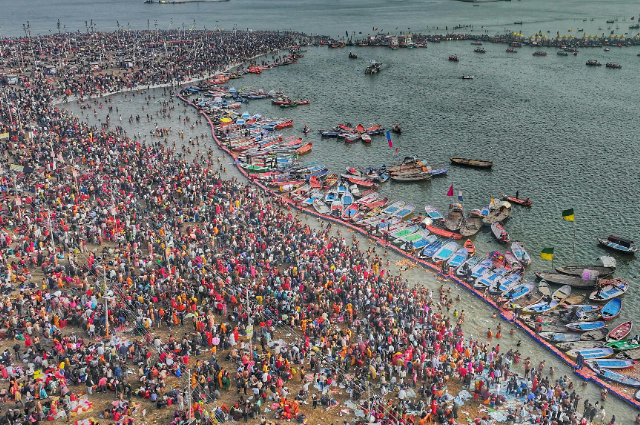
On the sacred morning of Mauni Amavasya, January 18, 2026, millions of devotees gathered at the Triveni Sangam in Prayagraj, seeking purification in the holy waters where three rivers meet. But in the middle of this river of faith, a standoff started to take shape, pulling religion and politics into a very public tug-of-war. Swami Avimukteshwaranand Saraswati, who calls himself the Shankaracharya of Jyotish Peeth, tried to lead his traditional palanquin procession, but the police stopped him cold. This wasn’t just about keeping order. It cracked open a much bigger question: Who really holds power when religion and politics collide in India?
The Magh Mela scene turned dramatic fast. Cops blocked the Swami’s path to the sacred river, his followers erupted in protest, and before long, he sat down in defiance and launched a hunger strike. Things really caught fire when the Prayagraj authorities handed him a notice that went straight for the jugular: On what grounds did he call himself “Shankaracharya” in the first place?
That notice leaned on a Supreme Court order from 2022, which put a freeze on any new Shankaracharya appointments at Jyotish Peeth until the courts could untangle an old succession mess. This fight goes all the way back to 1953, when Swami Brahmananda Saraswati died and left behind a will that only led to more questions. For over seventy years, the courts have tried to sort out who gets to lead, while tradition and law keep running into each other. Swami Avimukteshwaranand says he’s the rightful Shankaracharya because his predecessor, Swami Swaroopanand Saraswati, appointed him and besides, as Hindu scholars point out, a Peeth can’t function without a Shankaracharya. Still, the state is now calling that claim into question, poking at the very roots of his religious authority.
When Politics Hijacked a Religious Dispute
What really set off this administrative notice wasn’t some legal technicality; it was the way politicians jumped in right after. In no time, opposition leaders started rallying behind the seer. Akhilesh Yadav, the Samajwadi Party chief, actually picked up the phone and called Swami Avimukteshwaranand to show his support. Then he went online and tore into the BJP government, saying their arrogance reminded him of Ravana, the ten-headed demon. Congress leaders weren’t far behind; they called the move an insult to centuries of Hindu tradition. Praveen Togadia from the International Hindu Parishad chimed in too, dusting off the old slogan “Hindu batega toh katega”, basically warning that division means destruction for Hindus. Suddenly, what started as a local bureaucratic issue turned into a shouting match over Hindu identity itself.
People couldn’t help but notice the irony. You had a Hindu nationalist government, with Chief Minister Yogi Adityanath, himself a top priest, being accused of going after a Hindu religious leader. And the seer’s own response just made things more complicated. Swami Avimukteshwaranand pointed out that two other rivals, both claiming the Shankaracharya position at Puri Peeth, were allowed to set up their camps at the same Magh Mela without any trouble from the authorities. The real question hung in the air: Was this about safety and following the rules, or was it payback against a spiritual leader who’d become too much of a political headache?
The Rebel Seer Who Wouldn't Play Along
If you want to understand why this whole thing blew up, you have to look at Swami Avimukteshwaranand himself. He’s not your typical religious leader who sticks to prayer and keeps quiet about politics. He’s gone out of his way to call out the BJP, which is a pretty rare move for a Shankaracharya.
Back in 2024, Prime Minister Narendra Modi went ahead and held the Ram Temple inauguration in Ayodhya, even though the place wasn’t finished yet. Almost every big Hindu religious leader showed up for the ceremony. But four Shankaracharyas, including Swami Avimukteshwaranand, boycotted the event. He said the consecration didn’t follow Hindu tradition. That’s not the only time he’s pushed back, either; he also spoke out against the Kashi Vishwanath Corridor project in Varanasi because it meant tearing down old temples for city development. And he’s publicly questioned the Modi government about cow protection, which is a huge deal for Hindu nationalist politics.
All of this tells you a lot about how religion and politics work together in India right now. The state doesn’t just use religious power for its own ends; sometimes, religious leaders push right back. And when someone like Swami Avimukteshwaranand steps out of line, the government acts fast. The notice challenging his title as Shankaracharya didn’t really seem like a legal issue. It felt more like a warning: if your spiritual authority doesn’t line up with political power, you’re going to run into trouble.
How Religion Became the BJP's Secret Weapon
The controversy really shows how much Indian politics has changed in the last decade. Ever since Narendra Modi and the BJP swept to power in 2014, remember, that was the first time in thirty years a single party actually got a majority, religion hasn’t just crept into politics, it’s taken centre stage. The BJP’s Hindutva vision doesn’t just see Hinduism as one religion among many; it’s started to define what it means to be Indian. The old idea of keeping religion and government in separate lanes? That’s basically gone. Now, religious symbols, temple politics, and government decisions are all tangled up together.
What stands out about this era is how deliberately the BJP uses religion as “soft power.” Instead of force, they shape what people want and believe. With Modi at the helm, the BJP has grabbed hold of institutions, public conversations, and even how people imagine India itself. You see it everywhere, take the lotus. It’s the BJP’s symbol, but also India’s national flower. The party and the nation start to feel like the same thing. The BJP’s saffron flags have roots deep in Hindu tradition, and that tiny green stripe on their banners? It’s a nod to secularism, just enough to claim inclusivity, but it’s clear where the focus is.
The 2019 election made this strategy look unstoppable. The BJP won 303 seats, and analysts noticed their appeal had grown way past their old base. They pulled in middle-class voters, Dalits, and Other Backwards Classes. Nearly half of Hindu voters picked the BJP, and surprisingly, about one in five Muslim voters did too, even though the party doesn’t hide its Hindu-first approach. This wasn’t just about dividing people along religious lines. The BJP managed to convince a huge part of the country that being Hindu goes hand-in-hand with modernity and national progress. That’s what’s really different now.
Congress's Disastrous Experiment with "Soft Hindutva"
None of this is really new in Indian politics. Back when the Congress Party was riding high after independence, they talked a lot about secularism, but even then, leaders played the religion card whenever it helped them win votes. Take the 1960s: Congress set up the Bharat Sadhu Samaj, a group of Hindu monks, just to pull in Hindu voters. These monks, everyone called them “Congress Sadhus”, would sing the party’s praises at the Kumbh Mela, sprinkling a little religious credibility over Congress. But honestly, that move blew up in their faces. By the 1989 Kumbh Mela, the very same monks had ditched Congress and thrown their lot in with the BJP and Vishwa Hindu Parishad. Suddenly, they were out front in the Ram Janmabhoomi movement, and Indian politics was about to change for good.
Congress tried what scholars call “soft Hindutva”, hinting at Hindu religious themes to avoid looking anti-Hindu. Turns out, that was a pretty big miscalculation. All it did was make religion fair game in politics and give a boost to the BJP, which, let’s face it, was much better at playing that game. The BJP’s tight relationship with the RSS and their open Hindu nationalist stance meant it could always outdo Congress when it came to religious politics. Look at what happened next: the Babri Masjid demolition in 1992, the Gujarat riots a decade later, and the BJP’s steady march to electoral dominance. Congress’s half-hearted religious appeals didn’t stand a chance against the BJP’s full-throttle Hindu nationalism.
The Opposition's Dangerous Game
The way the opposition rushed to defend the embattled seer shows just how tangled things get in an election season where religion is always lurking in the background. Congress, after watching the BJP's own Hindu nationalist politics for years, saw an opening when it looked like the ruling party was gunning for a Hindu religious leader. The Samajwadi Party, big in Uttar Pradesh, where Muslims and Other Backwards Classes matter most, tried to look like they were standing up for Hindu traditions against a pushy government. Both parties are trying to have it both ways, defending secularism while also backing Hindu religious authority, hoping to build a coalition strong enough to take on the BJP.
But here’s the thing, critics are quick to point out that trying to beat the BJP at their own religious game is just repeating Congress’s old mistakes. When opposition parties start chasing religious votes, they’re basically agreeing that religion should decide who’s in charge. They’re tossing aside secular principles and, at the same time, making the BJP look even more credible. History makes it pretty clear: this just deepens religious divides and doesn’t give voters a real alternative. If politics is all about Hindu identity, why would anyone pick a copycat over the original?
The whole Shankaracharya controversy also shows the messiness of using religious soft power in politics. When real religious leaders push back, questioning government actions or telling a different story, they can shake up the careful balance politicians try to keep. The government’s move to challenge Swami Avimukteshwaranand’s religious status through official channels is a new way of keeping control. It’s a reminder that in today’s India, even ancient spiritual traditions aren’t safe from government interference when they become politically inconvenient.
What This Controversy Reveals About Indian Democracy
The Shankaracharya controversy isn’t just about one seer or one protest; it cracks open bigger questions about how democracy actually works in a country as varied as India. When politics starts seeing everything through the prism of religion, where do minority groups even fit in? When every government move gets judged by partisan religious standards, how does the state convince everyone it’s being fair? And when ancient spiritual traditions get tangled up in today’s political fights, who gets to decide what’s “authentic” faith and what isn’t?
These aren’t just things for academics to debate. This whole episode blew up when the Magh Mela authorities sent Swami Avimukteshwaranand a second warning, threatening to kick him out of his camp and ban him from future festivals. The seer’s health took a hit during his long protest, but he stood his ground; he wouldn’t budge without an apology. Deputy Chief Minister Keshav Prasad Maurya called for calm and dialogue, but the religious community split. Some backed the administration, saying everyone’s got to follow crowd-control rules, even top seers, especially when the crowds swell during the big bathing days. Others slammed the government for meddling in spiritual matters.
What really came out of all this? It’s a source of legitimacy, sure, but also a battleground. It can rally huge crowds or split alliances. Religion in India connects the old with the new, links identity with politics, and puts spiritual leaders under the microscope of bureaucracy. For the ruling party, it’s a way to win votes and shape culture. For the opposition, it’s both a temptation and a trap. For religious leaders, it brings political clout but also scrutiny. And for ordinary people, it shapes how they see themselves, where they belong, and what their country means.
The Unanswered Questions That Haunt Us
In the end, backroom talks settled the Prayagraj standoff, but nobody really answered the tough questions. In a democracy that promises religious freedom and secular government, how should the state actually deal with religious authorities? When every political party uses religion to win elections, can any institution really stay neutral? And when religious identity blurs into national identity, what happens to the diverse, pluralistic India the Constitution promised?
These aren’t just Indian problems; they show up elsewhere, too, but in India, where democracy, diversity, and religious nationalism all jostle for space, the tension feels especially sharp. The Shankaracharya controversy wasn’t just an exception; it was a sign of something deeper. It exposed a political scene where a government built on Hindu nationalism could still be accused of targeting Hindu spiritual leaders, where opposition parties flip between secularism and tradition, where a simple administrative notice can turn into a theological crisis, and where nobody really knows where faith ends and politics begins.
If you’re trying to make sense of all this, here’s the real takeaway: In India today, religion isn’t just about private belief or old customs. It’s power, subtle, persuasive, and deeply political. And like any kind of power, people fight over it, twist it, and turn it to their own ends, far from the sacred riverbanks where these stories first unfold.
REFERENCES:
- Republic World. "Shankaracharya Magh Mela Row Triggers Political Storm: Why Is Swami Avimukteshwaranand At Odds With Authorities? Full Controversy Explained." https://www.republicworld.com
- The Wire. "UP Notice to Avimukteshwaranand Over Use of Shankaracharya, Jyotish Peeth." https://www.thewire.in
- IBTimes India. "Magh Mela Row: Swami Avimukteshwaranand Asked to Justify Shankaracharya Title, Faces Notice Amid..." https://www.ibtimes.co.in
- ABP Live. "Mela Administration Questions Swami Avimukteshwaranand Over Shankaracharya Title Amid Magh Snan Mela." https://news.abplive.com
- The New Indian Express. "Kumbh Mela Admin Issues Notice to Swami Avimukteshwaranand, Asks Him to Explain Use of Shankaracharya Title." https://www.newindianexpress.com
- News24 Hindi. "Swami Avimukteshwaranand Get Notice Questioning on Shankaracharya Title: Magh Mela Sangam Snan Prayagraj." https://hindi.news24online.com
- Oneindia Hindi. "Prayagraj Mela Authority Notice Swami Avimukteshwaranand Shankaracharya Controversy." https://hindi.oneindia.com
- IANS Live. "Prayagraj Mela Authority Issues Notice to Swami Avimukteshwaranand Over Use of Shankaracharya Title." https://ianslive.in