
Image by jing wang from Pixabay
Mount Kailash: The Mountain That Teaches Us to Bow
I have never stood at the base of Mount Kailash.
Yet one night — while reading about the resumption of the sacred Kailash-Mansarovar Yatra after a five-year pause — it felt as though the mountain reached into my room and asked a question I wasn’t ready to answer.
It wasn’t awe in the dramatic, cinematic sense. It was stillness — a pause deeper than awe, born of longing before understanding.
The news said the pilgrimage had resumed. Batches of Indian yatris were chosen by a computerised lottery to undertake the arduous journey toward Mount Kailash and Lake Mansarovar — sacred places of faith and devotion. After years of disruption due to global travel restrictions and diplomatic tensions, the path to this distant peak had reopened. For many, it was not just a trip; it was a reclaiming of belief and shared human heritage.
Seeing that announcement — seeing people step toward a path that had been paused for what felt like an eternity — shifted something inside me. It made Mount Kailash not just a distant mountain of myth, but a present force of devotion in the world today.
This is the story not of a mountain to conquer, but of a mountain that teaches us why we sometimes must not climb.
A Peak That Isn’t Built to Be Climbed
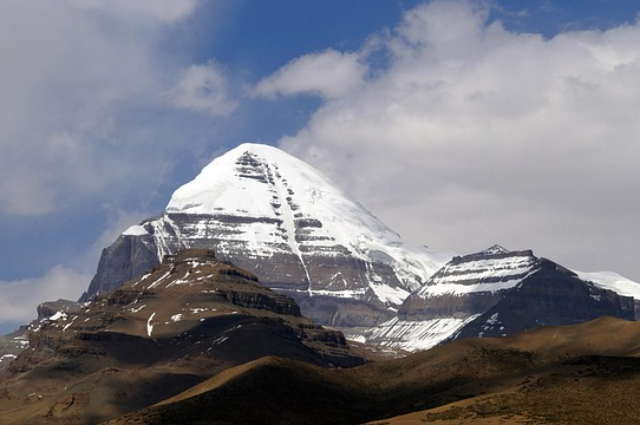
Mount Kailash rises to 6,638 meters (21,778 feet) on the remote western Tibetan Plateau, near the intersection of India, China, and Nepal. It is not among the world’s tallest mountains — far shorter than Everest’s 8,848 meters. Yet, unlike thousands of higher peaks, Kailash has never been climbed in verified recorded history. No summit flags. No triumphant photos. No celebrated expeditions. This paradox — a mountain humble in height yet profound in meaning — has fueled fascination across centuries.
What makes Kailash unusual is not only that people haven’t climbed it, but that many choose not to try. In a time when human effort is often measured by what we can conquer, this mountain’s summit has remained pristine — not because it is unreachable, but because it is uncapturable by human ambition.
For Hindus, it is the eternal abode of Lord Shiva and Goddess Parvati — a place where divine meditation dissolves time itself. Tibetan Buddhists regard it as the sacred seat of Demchok (or Chakrasamvara), a deity of supreme bliss. Jains believe it to be Astapada, where the first Tirthankara attained liberation. Followers of the ancient Bon religion see it as the Nine-Story Swastika Mountain, the cosmic axis connecting heaven and earth.
Twenty years ago, this shared reverence might have sounded symbolic or poetic. Today, it feels real in its persistence.
The Yatra That Returned — and Why It Matters
What’s happening now around Mount Kailash makes its story live and relevant, not just mystical or mythic.
In 2025, after five long years, the Kailash-Mansarovar Yatra — the sacred circumambulation pilgrimage — resumed for Indian pilgrims.
The yatra isn’t easy. Pilgrims walk for days in thin air, frigid winds, and unpredictable weather. Some choose motorised segments when they can; many walk on foot for most of the route. The journey toward Mansarovar — a lake considered as holy as the mountain itself — is a mix of physical trial and spiritual surrender. It begins long before the first step; it begins in the heart.
For thousands of yatris, being selected to walk this route after years of waiting felt like receiving a sacred invitation. The computerised lottery draws names with no regard for wealth or status. A retired teacher from Bihar might walk beside a young student from Tamil Nadu. A mother might accompany her son. Ordinary people, ordinary lives, united by a humbling longing to approach something larger than themselves.
That’s the contrast Kailash teaches: pilgrims circle, climbers aim up. The mountain has no summit photos — but it has millions of footsteps around its base and the shores of Lake Mansarovar.
The pilgrimage resumed as part of a broader cultural and diplomatic engagement. China, citing respect for faith and heritage, confirmed the continuation of the pilgrimage routes and highlighted their role in cultural exchange — a rare point of connection in times of geopolitical tension.
Pilgrims do not go to climb. They go to complete a circle. They go to be part of something that has persisted across history.
Walking Toward Humility, Not Victory
Mount Kailash is not a mountain to be scaled. That differentiates it from every other peak on Earth. Climbers seek summits as proof of human endurance and triumph. Pilgrims seek presence — a state of being rather than overcoming. Kailash’s power lies in this difference.
In the early 20th century, when explorers surveyed the peak for climbing potential, they found not just sheer rock faces and ice walls, but a sense of boundary — not technical, but cultural. Reports from that era describe explorers concluding that the mountain is “utterly unclimbable,” not because modern equipment would fail, but because the entire ethos of the mountain defies conquest.
In later decades, even legendary climbers reportedly declined opportunities to attempt it. Some spoke not of technical challenge, but of the spiritual weight the mountain carries — that climbing it would feel like violating a collective vow of reverence. One famous mountaineer said that if he climbed Kailash, it might mean conquering something deep within people’s souls, and he declined the challenge. That echoes louder than any summit achievement.
The Kora: A Circle Walked With Reverence
The heart of the pilgrimage is the Kora — a 52 Kilometres walk around the base of Mount Kailash. Pilgrims often complete the circuit on foot, braving high passes and rocky ridges, chanting prayers and spinning prayer wheels as they go. Some repeat the Kora multiple times; tradition holds that completing it 108 times brings profound spiritual merit.
I once watched a short video of an elderly woman completing the Kora. Her feet were swollen; her steps were measured. She did not walk with triumph. She walked with quiet purpose. When she reached the finish line, she did not raise her arms. She bowed her head and sat.
That moment stayed with me. She walked not toward an achievement, but toward an acceptance. This is Kailash’s enduring lesson: not every sacred site asks us to rise — some ask us simply to remain present.
Thousands of climbers have conquered taller peaks. Everest has been summited more than 7,000 times. But Mount Kailash’s summit remains pristine, untouched, unconquered — not because it is too high, but because it is too sacred to claim.
A Mountain in the Present, Not Just in the Past*
Modern science attempts to explain the mountain’s pyramid-like shape through geology: tectonic uplift, wind erosion, and glacial sculpting over millennia. Some claim anomalies in compass behaviour near the mountain; others attribute unexplained sensations — like accelerated time perception or deep calm — to psychological response at high altitude. None of these explanations diminishes Kailash’s beauty; they simply translate mystery into language familiar to the modern mind.
But pilgrims do not go for science. They go for meaning.
News of the yatra’s resumption makes this pilgrimage current. Not ancient history, not romanticised legend. Real people, today, are walking toward a sacred place that represents continuity, belonging, and spiritual identity in a fragmented world.
In 2025, the pilgrimage’s return after interruptions stands not just as an event, but as a reminder that certain traditions persist even when journeys are disrupted, borders are tense, and life itself feels uncertain. When direct travel corridors and border agreements improve, it becomes easier for people to walk — but their longing to walk existed long before permits and pacts.
Why We Still Need Sacred Paths
Perhaps the deepest question is this: in an era when humans map mountains from space, when we send machines to Mars, and ascending Everest feels routine, why does Mount Kailash matter so much?
Because it is one of the few places where restraint matters more than reach.
Where circling is nobler than climbing.
Where pilgrims ask not “how high?” but “how deep?”
The mountain’s influence is not measured in height. It is measured in footsteps — and in silence.
Pilgrims describe moments that cannot be photographed:
The dawn light makes the peak glow like a whisper.
The drone of prayer wheels is woven with wind.
The stillness is so profound that you hear your own breath.
These are not spectacular descriptions meant to impress. They are the felt moments that make the pilgrimage transformative.
In the Shadow of the Summit, We Find Ourselves
Mount Kailash does not reject humanity. It simply refuses to be owned by human will. It stands where it always has — silent, symmetrical, unmoved. Not untouched, but unclaimed. Not conquered, but felt.
The pilgrims who walk toward it are not chasing history. They are carrying history forward. They walk not up the mountain, but into themselves. They carry with them simple truths: resilience, humility, and connection.
Perhaps that is the lesson this mountain offers most clearly: the greatest elevation is not measured at the summit, but in how deeply one feels beneath it.
And when the next yatri steps onto that path — not to conquer, but to complete a circle of devotion — the story will not be about reaching the top of a mountain. It will be about finding a deeper sense of belonging in a world that often mistakes achievement for meaning.
Mount Kailash remains — as it always has —
not as a peak to be claimed,
but as a presence to be encountered.
REFERENCES
- “Kailash-Mansarovar Yatra resumes after five years: history of a storied pilgrimage” — Indian Express
- Kailash‑Mansarovar Yatra resumes after five years (Indian Express)
- “Indian pilgrims cross the Chinese border into Tibet as relations thaw” — Washington Post
- Indian pilgrims cross into Tibet as Kailash yatra resumes (Washington Post)
- “750 picked via computerised lottery to go on Kailash Yatra” — Times of India
- 750 pilgrims selected for Kailash Yatra (Times of India)
- “After 5 years, Kailash Mansarovar Yatra resumes through Sikkim” — NDTV
- Kailash Mansarovar Yatra resumes via Sikkim (NDTV)
- “Kailash Mansarovar Yatra to Restart via Nathula Pass in June 2025 After 5 Years” — NativePlanet
- Kailash Yatra restarting via Nathula Pass in 2025 (NativePlanet)
- “Sikkim to resume Kailash Mansarovar Yatra via Nathu La after 5-year hiatus” — NewsOnAir
- Sikkim to resume Kailash Yatra via Nathu La (NewsOnAir)
- “Govt says Kailash Mansarovar Yatra will commence between June and August” — The Statesman
- Govt: Kailash Yatra to commence June–August (The Statesman)